
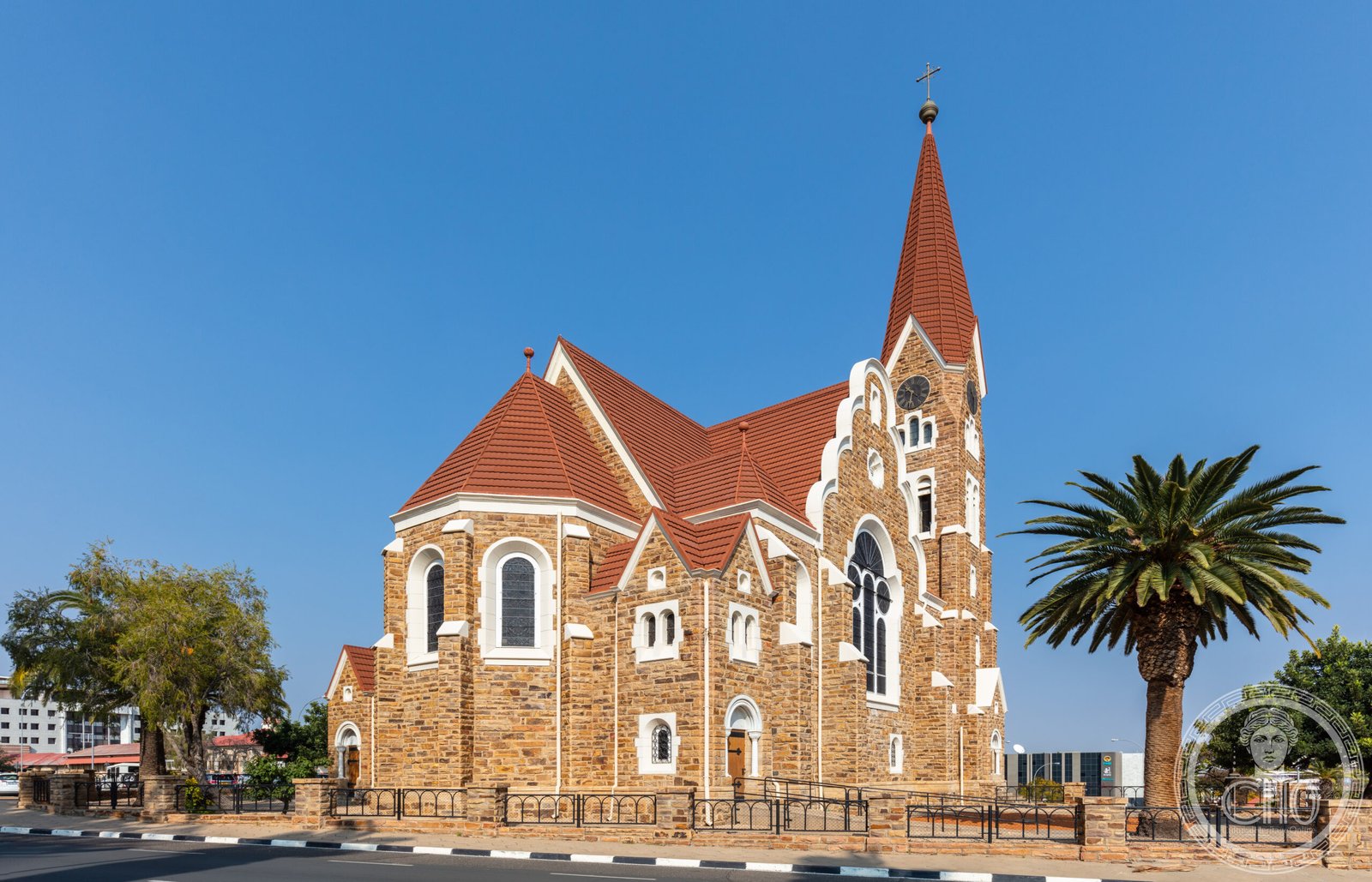
On a central roundabout of Robert Mugabe Avenue, opposite the Tintenpalast, the Christuskirche is one of the most recognisable architectural symbols of Windhoek. The Tintenpalast was the seat of the German colonial administration and is today the parliament of Namibia. The church was designed by the government architect Gottlieb Redecker. The foundation stone was laid on 11 August 1907 in the presence of Governor Von Lindequist, and the consecration took place on 16 October 1910, though one source gives 15 October, a discrepancy of a single day between the sources. It blends neo-Romanesque, art nouveau and neo-Gothic influences. It was built of quartz sandstone quarried near the Avis dam and carried by a small railway, with a porch of Carrara marble imported from Italy and roof, clock and other elements shipped from Germany. The building went up in the immediate aftermath of the German genocide of the Herero and Nama (1904-1908), in which the German colonial forces killed, by current estimates, between forty thousand and eighty thousand Herero, about eighty per cent of the population before the conflict, and about half the Nama population. The German Lutheran Church presented the building at the time as a «church of peace», a symbol of reconciliation after the conflict. Inside, however, a bronze plaque lists the names of the German soldiers, sailors and civilians who fell during what the sources of the day called the Nama and Herero «revolts» of 1903-1907: a concrete and documented link between the building and the colonial memory of the conflict, although the exact text of the plaque has not been found in a primary transcription. No source consulted, on the other hand, shows that the building of the church was funded with proceeds, land or forced labour taken specifically through the genocide: a claim of that kind would find no documentary support and is to be avoided. The church once stood near the Reiterdenkmal, an equestrian monument raised in 1912 in explicit memory of the German soldiers fallen in the Herero and Hottentot «revolts», removed from the site in 2013 after public pressure and replaced there by the Independence Memorial Museum, dedicated to the memory of the genocide. The Christuskirche belongs today to the Evangelical Lutheran Church in the Republic of Namibia (ELCRN), with a German-speaking congregation that still holds Sunday services there at 10. It was declared a national monument on 29 November 1974.
About the Church
Christuskirche, on a central traffic circle in Windhoek, Namibia, opposite the Tintenpalast, was designed by architect Gottlieb Redecker and built 1907–1910 in a mix of neo-Romanesque, Art Nouveau and Gothic Revival styles. A German-speaking Lutheran congregation still worships here, and it remains one of the city’s most recognizable landmarks.
Key facts
- 11 August 1907: foundation stone laid by architect Gottlieb Redecker’s design, Governor Von Lindequist present.
- 16 October 1910: church consecrated.
- Built in the immediate aftermath of the 1904–1908 Herero and Nama genocide by German colonial forces.
- An interior bronze plaque lists German soldiers, marines and civilians killed in the 1903–1907 conflict.
- 29 November 1974: declared a National Monument.
- Belongs to the Evangelical Lutheran Church in the Republic of Namibia; German-language Sunday services continue.
History
Built between 1907 and 1910, Christuskirche was presented by the German Lutheran Church as a “church of peace” almost immediately after German colonial forces carried out a genocide against the Herero and Nama peoples that killed tens of thousands. That framing sits uneasily beside an interior memorial plaque honoring German war dead from the same conflict, and beside the church’s former proximity to the Reiterdenkmal, a colonial equestrian monument removed in 2013 and replaced by Namibia’s Independence Memorial Museum. No source documents that the church itself was financed through genocide-linked proceeds or forced labor — its connection to that history is one of timing, symbolism and an unresolved, still-debated legacy rather than direct financial complicity.
What you see
A golden quartz-sandstone facade blending Gothic Revival and Art Nouveau detailing, a Carrara marble portico, a pointed spire, three bronze bells cast by Franz Schilling, stained-glass windows reportedly gifted by Kaiser Wilhelm II, and an altarpiece copying Rubens’s “Resurrection of Lazarus,” painted by Berlin artist Clara Berkowski.
Practical information
- Opening hours: generally open to visitors outside services; German-language services held Sundays at 10:00.
- Address: Robert Mugabe Avenue traffic circle, Windhoek, Namibia, opposite the Tintenpalast.
Getting there
The church stands on a traffic island on Robert Mugabe Avenue in central Windhoek, directly opposite the Tintenpalast (Namibia’s parliament). GPS: 22.5678°S, 17.0872°E.
Nearby
- Tintenpalast — the former German colonial administration building, now Namibia’s Parliament, directly across from the church.
- Independence Memorial Museum — occupies the former site of the Reiterdenkmal, dedicated to Namibia’s independence struggle and colonial history.
Sources
- Wikipedia — “Christ Church, Windhoek,” “Herero and Nama genocide,” “Reiterdenkmal, Windhoek”
- namibweb.com — Christuskirche history and construction details.
- The Heritage Portal — “Two architects left deep footprints on the development of Windhoek”
- The Namibian, allAfrica — reporting on Christuskirche and the legacy of the genocide.
Find it on the map
See this place and what’s around it →📷 Become a Cultural Heritage Online photographer
Share your photos of places: they stay published under your name as the author. The more they're seen, the more you get noticed — and soon a contest will reward the most appreciated photos.
Log in or sign up free to add a photo