
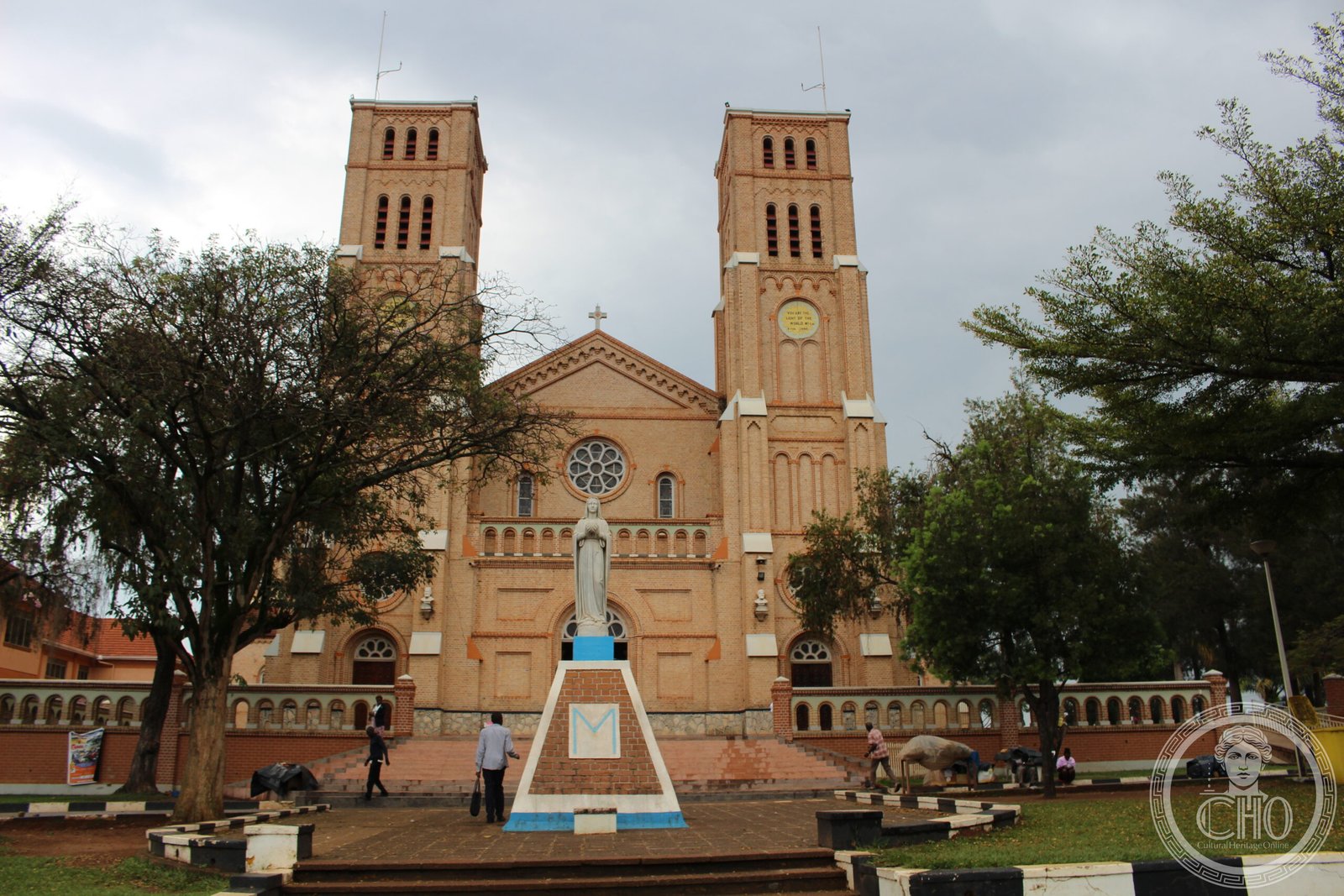
On Rubaga (Lubaga) hill, about three kilometres west of central Kampala, St Mary’s Cathedral is the seat of the Catholic archdiocese of Kampala. The hill had been the site of the royal palace of the kabaka Muteesa I of Buganda, later abandoned after a fire; in 1879 a mission of the White Fathers settled there, led by Father Siméon Lourdel — nicknamed “Mapeera” by Muteesa I himself — and Brother Amans Delmas, who began here to catechise the royal pages who would become the future Catholic martyrs of Uganda, executed between 1885 and 1887 under his successor Mwanga II in places other than Rubaga — among them Nakivubo, where the first martyr Joseph Mukasa was killed on 15 November 1885, and Namugongo, where thirteen Catholics and several Anglican converts were burned alive on 3 June 1886 — canonised in 1964 by Pope Paul VI. In 1889 Mwanga II himself formally gave Rubaga hill to the White Fathers. According to the archdiocese’s own historical tradition, the present stone cathedral is the seventh structure raised on the same site since 1891, the earlier ones having been destroyed by religious conflict, fire and even an earthquake; building of the present edifice, in a Romanesque style inspired by French Normandy, began on 3 May 1914, was interrupted for about two and a half years during the First World War for lack of funds, was completed in 1924 and consecrated on 31 December 1925; the architect’s name, given by a single source as “Brother Gilbert”, cannot be independently verified. Rubaga hill, together with Namirembe — assigned instead to the Anglican mission of the British Church Missionary Society — reflected a deliberate political choice by the rulers of Buganda: to separate the two rival missions territorially, the French Catholic one (“Wafaransa”) and the British Anglican one, in order to avoid violent conflict between their converts. The cathedral holds the remains of Archbishop Joseph Kiwanuka (1899–1966), the first African Catholic bishop and the first African archbishop of Kampala. Three popes have visited: Paul VI gave his farewell address to the Ugandan faithful there on 2 August 1969, according to the official text published by the Vatican, during his first journey outside the Vatican to Africa; John Paul II stopped there in February 1993, according to sources not fully corroborated, in a private capacity, planting a commemorative tree; Pope Francis addressed priests, religious and seminarians there on 28 November 2015, before going on to the Martyrs’ Shrine at Namugongo.
About the Cathedral
Rubaga (Lubaga) Cathedral, on a hilltop roughly three kilometres west of central Kampala, is the seat of the Roman Catholic Archdiocese of Kampala. Built 1914–1925 on land donated in 1889 by Kabaka Mwanga II, it stands on the hill where French White Fathers missionaries first catechized the Buganda royal pages who would later become the Catholic Uganda Martyrs.
Key facts
- 1879: White Fathers missionaries, led by Fr. Siméon Lourdel, establish a mission at Rubaga
- 1889: Kabaka Mwanga II formally donates Rubaga Hill to the Catholic mission
- 3 May 1914 – 1924: current stone cathedral built, construction paused roughly 2.5 years during World War I
- 31 December 1925: cathedral consecrated
- Houses the remains of Archbishop Joseph Kiwanuka (1899–1966), the first African Catholic bishop and first African Archbishop of Kampala
- Visited by Pope Paul VI (1969), Pope John Paul II (1993) and Pope Francis (2015)
History
Rubaga Hill became a Catholic mission base in 1879, formally granted to the White Fathers by Kabaka Mwanga II in 1889, after the royal pages catechized there had already become the Catholic Uganda Martyrs, executed elsewhere in Buganda between 1885 and 1887 and canonized in 1964. Buganda’s kings deliberately separated Rubaga from the rival Anglican mission on nearby Namirembe Hill to keep the two European missionary spheres from clashing directly. The current cathedral, the seventh structure on the site according to archdiocesan tradition, took over a decade to complete through a wartime funding gap, and has since received three popes.
What you see
A twin-towered brick Romanesque facade, styled after churches in Normandy, France, with a statue of the Virgin Mary before the entrance and a great altar of Muvule wood inside, crafted over two years by Brother Sylvester.
Practical information
- Opening hours: generally open daily outside services; check current hours before visiting
- Address: Rubaga Hill, Lubaga Division, Kampala, Uganda
Getting there
The cathedral stands on Rubaga Hill, about 3 km west of central Kampala. GPS: 0.3025°N, 32.5522°E.
Nearby
- Namirembe Cathedral — Kampala’s Anglican cathedral, on a neighboring hill historically assigned to the rival British CMS mission
- Uganda Martyrs’ Shrine, Namugongo — the pilgrimage site marking where most of the Catholic and Anglican martyrs were executed in 1886
Sources
- Wikipedia — “Lubaga Cathedral,” “Uganda Martyrs,” “Namirembe Cathedral”
- Vatican.va — official text of Pope Paul VI’s farewell address at Rubaga, 2 August 1969
- GCatholic.org — Archdiocese of Kampala records
- Archdiocese of Kampala (klarchdiocese.org.ug) — cathedral history
- Encyclopaedia Britannica — “Martyrs of Uganda”
Find it on the map
See this place and what’s around it →📷 Become a Cultural Heritage Online photographer
Share your photos of places: they stay published under your name as the author. The more they're seen, the more you get noticed — and soon a contest will reward the most appreciated photos.
Log in or sign up free to add a photo