
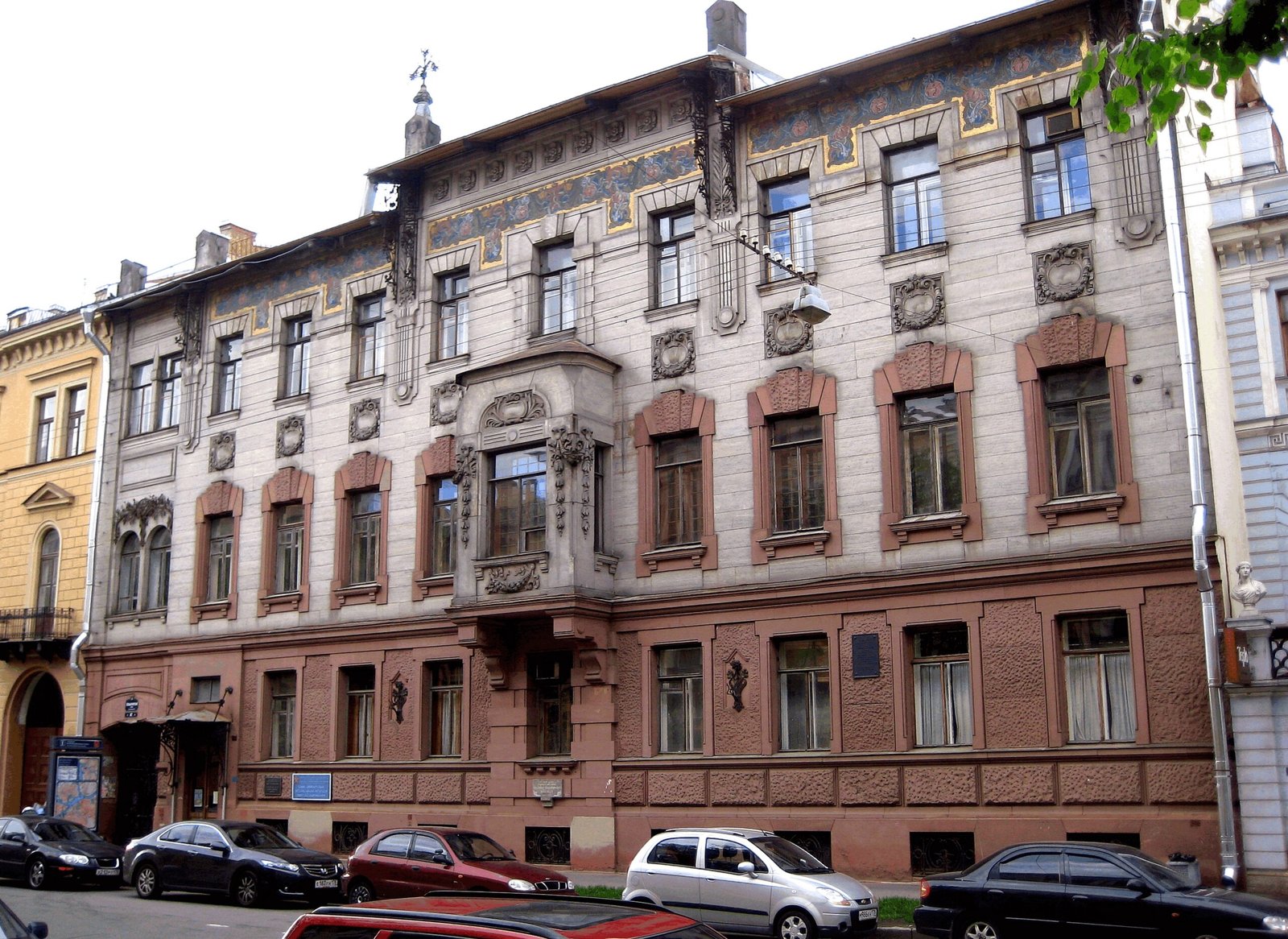
A townhouse on Bolshaya Morskaya Street where a jurist’s political circle and a novelist’s childhood once shared the same rooms.
At a glance
Nabokov House stands at 47 Bolshaya Morskaya Street, a mid-to-large 19th-century townhouse built for the Polovtsev family. From 1897 it belonged to Vladimir Dmitrievich Nabokov, statesman and jurist, and it was here that his son, the novelist Vladimir Nabokov, was born in 1899. The first floor now holds a museum devoted to the writer’s life and work.
History
The house predates its most famous residents. It was raised for the Polovtsev family in a Neo-Renaissance idiom typical of the street’s grand townhouses. Vladimir Dmitrievich Nabokov obtained it as part of Elena Rukavishnikova’s dowry in 1897. Under his ownership, the house became a stage for liberal politics. It hosted the final session of the National Congress of Zemstvos in 1904, and, in the years around the 1905 revolution, gatherings of the Constitutional Democratic party that Nabokov helped lead. Bolshevik revolutionaries broke into the house during the October Revolution of 1917. The family’s tenure ended that November, when Vladimir Vladimirovich Nabokov left for good. He later described the house in exacting detail in his memoirs, The Other Shores and Speak, Memory, calling it the only house that ever truly mattered to him. As a child there, his sister Olga debated politics with a close friend, Alisa Rosenbaum, later known as Ayn Rand.
What you see
Little of the Nabokovs’ domestic world survives intact. Fire, revolution and decades of institutional use stripped most original furnishings away. What remains are the bones of several rooms on the first and second floors, and one striking detail: a stained-glass window above the staircase leading to the third floor, an Art Nouveau flourish set within the building’s older Neo-Renaissance shell. The museum floor recreates the household’s rhythm through named rooms — the Phone Room, Dining Room, Library, Kitchen and the Committee Room where Constitutional Democratic party meetings once took place. Upstairs, the newspaper Nevskoe Vremya occupies the offices once used by the family.
Cultural significance
The house sits at the intersection of two histories: Russian liberal politics before the revolution, and the making of one of the twentieth century’s great literary voices. For scholars, it is a physical anchor to a childhood otherwise known only through prose. The museum, opened on the first floor in the late 1990s, sustains that legacy through lectures, readings and an annual international Nabokov summer school, drawing researchers from Russia, Europe and the United States. In 2013 the building itself became a target. Vandals broke its windows and daubed a slur on its wall, part of a wider harassment campaign tied to objections over Nabokov’s novel Lolita. The attacks, investigated as criminal vandalism, underscored how contested his work remains even now.
Key facts
- Location: 47 Bolshaya Morskaya Street, Saint Petersburg, Russia
- Built: 19th century, for the Polovtsev family
- Style: Neo-Renaissance townhouse with Art Nouveau stained-glass detailing
- Nabokov family ownership: 1897–1917
- Birthplace of Vladimir Nabokov, 1899
- Museum on the first floor, heritage-listed status
Practical information & getting there
The Nabokov Museum occupies the ground floor at 47 Bolshaya Morskaya Street, in the heart of central Saint Petersburg, within easy walking distance of Palace Square and St Isaac’s Cathedral. It is open daily except Monday, with shorter hours on weekends; check the museum’s official site before visiting, since opening times can change. Bring identification if you plan to use the research library, and allow extra time if a lecture or exhibition is underway, as these events shape the day’s access.
Sources & resources
Find it on the map
See this place and what’s around it →📷 Become a Cultural Heritage Online photographer
Share your photos of places: they stay published under your name as the author. The more they're seen, the more you get noticed — and soon a contest will reward the most appreciated photos.
Log in or sign up free to add a photoIs this page about you?
This page is read by travellers and heritage enthusiasts who find it on Google. Tell us how you are connected to this place and we will take it from there.