

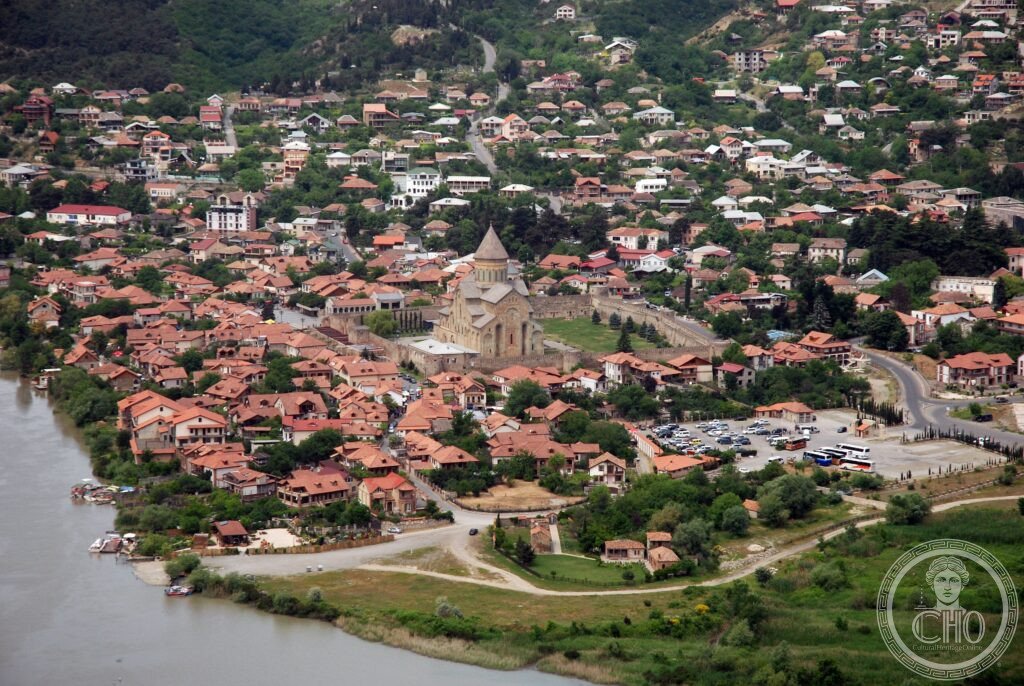
Mtskheta was capital of the ancient Kingdom of Iberia for centuries and the place where Georgia turned Christian in 327 CE. Its skyline is still ruled by the Svetitskhoveli Cathedral, built to hold a relic believed to be Christ’s robe, and by the Jvari Monastery watching over the confluence of two rivers.
At a glance
Mtskheta served as capital of the Kingdom of Iberia, known also as Kartli, from around the 3rd century BCE until the 5th century CE. In 327 CE King Mirian III adopted Christianity as the state religion after his queen, Nana, and later Mirian himself were converted through the missionary Saint Nino, making Georgia the second country in the world to establish Christianity as its official faith, after Armenia and before the Byzantine Empire did so officially in 380 CE.
Three monuments here are inscribed together as a UNESCO World Heritage Site, listed in 1994: the Svetitskhoveli Cathedral, the Jvari Monastery, and the Samtavro Monastery and convent.
Key facts
- Name: Svetitskhoveli means ‘Living Pillar’ in Georgian, referring to the cathedral’s founding legend.
- Cathedral built: 1010–1029 CE, commissioned by Catholicos Melkisedek I and designed by the architect Arsukidze, on the site of an earlier 4th-century church.
- Relic: the cathedral is said to hold the buried Chiton, the seamless robe of Christ, believed to have been brought to Mtskheta after the Crucifixion.
- Jvari Monastery: built 586–605 CE on the hilltop above the confluence of the Mtkvari and Aragvi rivers, commissioned by Erismtavari Stepanoz I.
- Samtavro Convent: founded in the 4th century under Queen Nana, with a small 11th-century church holding the tombs of Nana and King Mirian III, Georgia’s first Christian royals.
- Status: inscribed as a UNESCO World Heritage Site in 1994.
History
Mtskheta lay on a branch of the Silk Road and served as capital of Iberia for centuries before Christianity arrived. According to Georgian tradition, the missionary Nino of Cappadocia reached Georgia around 320 CE and converted Queen Nana, then healed King Mirian III of blindness in a forest; his conversion in 327 CE made Christianity the state religion, ahead of the Roman Empire’s official conversion under Theodosius in 380 CE.
The political capital moved to Tbilisi under King Vakhtang I Gorgasali in 478 CE, but Mtskheta remained Georgia’s ecclesiastical centre. The Jvari Monastery was raised on the hilltop above the town between 586 and 605 CE. Arab forces held Tbilisi and the wider region from 654 CE for several centuries, until King David the Builder liberated Tbilisi in 1122, ushering in the Georgian Golden Age that reached its height under Queen Tamar between 1184 and 1213. The current Svetitskhoveli Cathedral had already been built in 1010–1029, replacing the earlier wooden church.
Georgia later suffered repeated invasions, including those of Timur between 1386 and 1403, before falling under Persian and then Russian influence; the Russian Empire annexed the Kingdom of Kartli-Kakheti in 1801. Georgia became part of the Soviet Union in 1921 and regained independence in 1991. Mtskheta’s three principal monuments were inscribed on the UNESCO World Heritage list in 1994.
What you see
Svetitskhoveli Cathedral follows a cross-in-square plan typical of medieval Georgian churches, with an elevated cylindrical drum pierced by windows above the crossing. Its exterior is carved with grapevine motifs, animal friezes and geometric interlace across the drum and apses, in a restrained decorative style. A pillar shrine inside the church marks the spot of the miraculous cedar column of the founding legend, and the Chiton of Christ is said to be buried nearby. An inscription on the outer wall, showing a carved hand, commemorates the architect Arsukidze, whose hand was reportedly amputated on the orders of his patron once the building was complete.
The Nino’s Cross, a vine-wood cross bound with hair and regarded as the most sacred object in Georgian Orthodoxy, is normally kept in the cathedral treasury and shown on major festivals.
On the hilltop above the confluence of the Mtkvari and Aragvi rivers stands the Jvari Monastery, built around an earlier cross raised by Saint Nino. Its equal-armed cross-in-square design is considered the first fully realised example of the type that shaped later Georgian church architecture. The platform beside it gives a wide view over the confluence and the plain of Mtskheta below, a scene described in Pushkin’s poem ‘The Mtsyri’.
In the town itself, the Samtavro Convent preserves a small 11th-century church holding the tombs of Queen Nana and King Mirian III.
Practical information
- Treasury access: the Nino’s Cross is usually kept out of sight and displayed only on major religious festivals; check with the church authorities for current arrangements.
- Dress code: as with other Georgian Orthodox sites, modest dress is expected inside the churches.
- Combined visit: Svetitskhoveli Cathedral, Jvari Monastery and Samtavro Convent can be seen together in a single visit to the town and its hilltop.
Getting there
Mtskheta lies close to Tbilisi, Georgia’s capital, which David the Builder recaptured from Arab rule in 1122. Travellers based in Tbilisi typically visit as a day trip; for current transport options it is best to check locally rather than rely on fixed schedules.
Nearby
- Jvari Monastery — on the hilltop above the town, overlooking the confluence of the Mtkvari and Aragvi rivers.
- Samtavro Convent — in the town itself, with the tombs of Georgia’s first Christian royal couple.
- Tbilisi — the modern capital, which superseded Mtskheta as Georgia’s political centre in 478 CE.
Sources
- Georgian Orthodox Church
- The Life of Kartli (10th-century Georgian chronicle)
- UNESCO World Heritage
- Alexander Pushkin, ‘The Mtsyri’
Find it on the map
See this place and what’s around it →📷 Become a Cultural Heritage Online photographer
Share your photos of places: they stay published under your name as the author. The more they're seen, the more you get noticed — and soon a contest will reward the most appreciated photos.
Log in or sign up free to add a photoIs this page about you?
This page is read by travellers and heritage enthusiasts who find it on Google. Tell us how you are connected to this place and we will take it from there.