
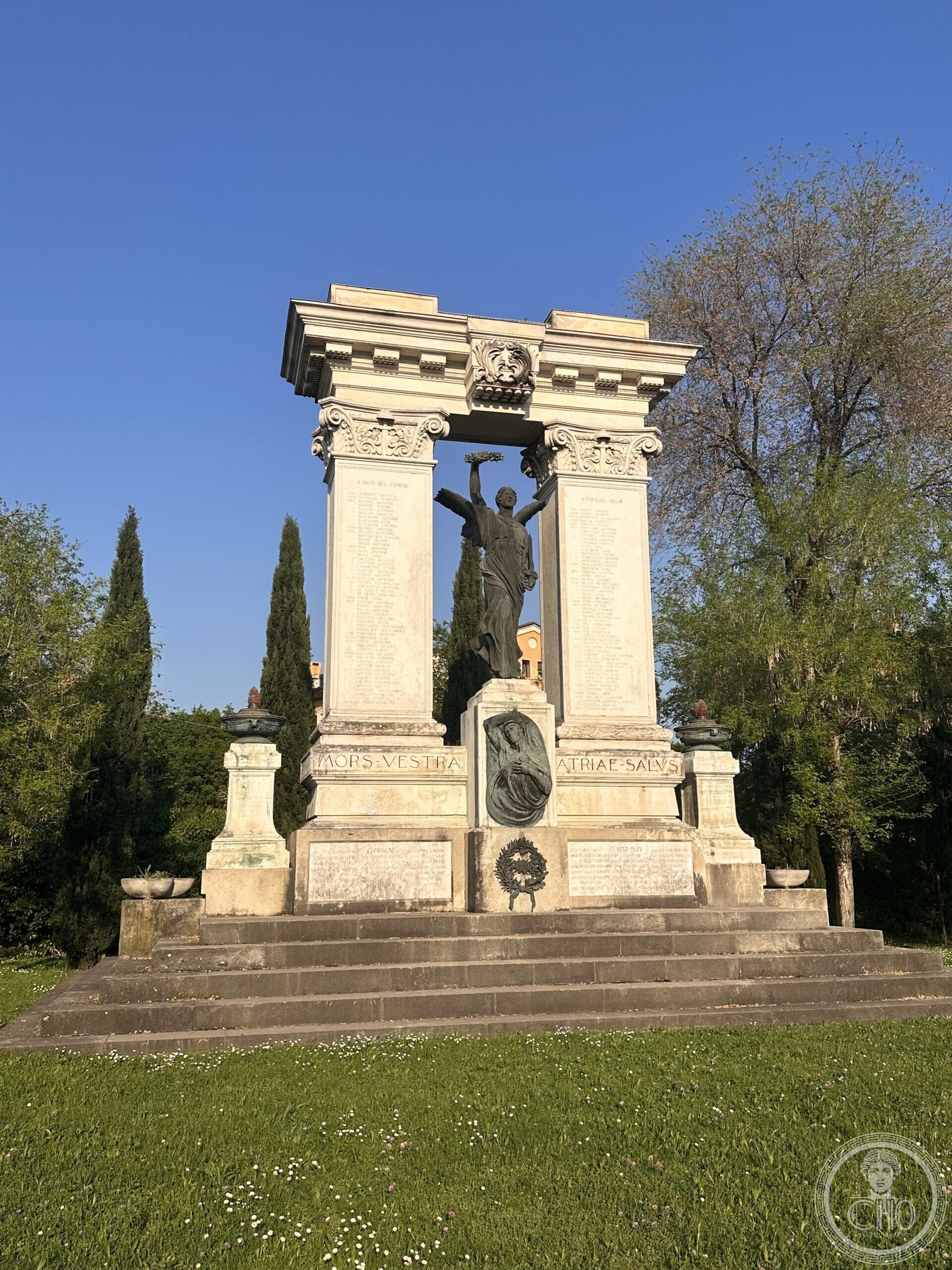
A stone triumphal arch on the banks of the Piave carries the names of Spresiano’s war dead on its two pillars, while a bronze Winged Victory — modelled on the ancient Nike of Samothrace — raises a laurel wreath between them.
At a glance
Spresiano sits on the Piave river, on the line the Italian army held and then crossed back over in the final Piave offensive of 1918, and its war memorial reflects that history directly: an inscribed triumphal arch, its central figure a bronze reconstruction of the Nike of Samothrace, designed by the Venetian architect Lorenzo Rinaldi — who also designed the town’s parish church — and inaugurated on 28 October 1931.
Key facts
- Architect: Lorenzo Rinaldi (Venice), also architect of Spresiano’s parish church
- Central sculpture: bronze Winged Victory, an artistic reconstruction of the Nike of Samothrace, by sculptor Paolo Possamai of Solighetto
- Inaugurated: 28 October 1931
- Inscription: Mors vestra patriae salus (“your death, the homeland’s salvation”)
- Names recorded: the town’s fallen of the First World War (the “Caduti del Comune” and the 1915–18 campaign) on the two flanking pillars
On the Piave line
Spresiano lies on the Piave, the river along which the Italian army made its stand after the defeat at Caporetto in late 1917, and across which it advanced again in the decisive Battaglia del Solstizio and the final offensive of 1918. A monument raised here in 1931 to the fallen of that war stands, like many along the river, on ground that was itself part of the front. The choice of a Winged Victory recalls both the ancient Nike of Samothrace and the long Italian tradition of using the same figure on First World War memorials nationwide.
What you see
A stone triumphal arch of two Ionic-columned pillars carries a plain entablature and a carved mask at its centre; each pillar is inscribed on its inner face with lists of the dead, one headed “Caduti del Comune” and the other “Campagna 1915-18,” and the base bears the Latin motto Mors vestra patriae salus. Between the pillars stands a bronze winged female figure, arms raised, holding a laurel wreath in one hand and a sword at her side in the other — the Winged Victory that gives the monument its focal point.
Getting there
The monument stands in a public park on Via Nazionale in Spresiano, in the Province of Treviso, a short walk from the town centre.
Sources
- On-site historical plaque (“Marca Storica,” Provincia di Treviso), photographed at the monument, giving the architect, sculptor and 1931 inauguration date.
- Luigi De Marchi, who photographed the monument and its plaque.
Find it on the map
See this place and what’s around it →Record researched and written by Carla Szathvary for Cultural Heritage Online, 2026.
📷 Become a Cultural Heritage Online photographer
Share your photos of places: they stay published under your name as the author. The more they're seen, the more you get noticed — and soon a contest will reward the most appreciated photos.
Log in or sign up free to add a photo