
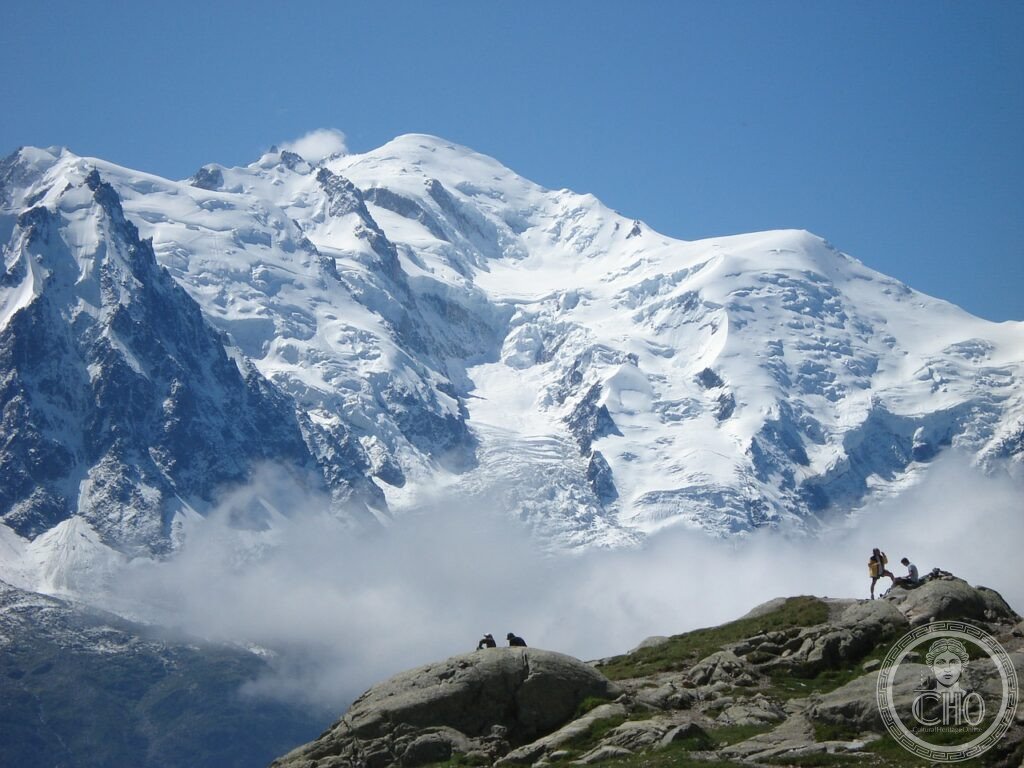
At 4,808 metres, Mont Blanc is the highest point in the Alps and in Western Europe, its summit an ever-shifting ice cap rather than bare rock. Since Jacques Balmat and Michel-Gabriel Paccard first stood atop it in 1786, the mountain and the valley of Chamonix beneath it have shaped the entire modern practice of mountaineering.
At a glance
Mont Blanc rises on the border of France, Italy and Switzerland, its exact summit height fluctuating slightly from year to year because the top is capped by ice rather than rock. Chamonix, on the French side, is widely regarded as the birthplace of modern alpinism, and its guiding tradition dates back to the founding of the Compagnie des Guides de Chamonix in 1821, the oldest mountain guide association still active anywhere in the world.
The massif itself remains a point of quiet dispute: France and Italy have never formally agreed on where the border across the summit lies, with each side describing the ownership of the peak differently.
Key facts
- Height: 4,808 m, with a 2021 measurement giving 4,807.81 m; the summit is an ice cap whose thickness varies with snowfall and temperature.
- First ascent: 8 August 1786, by Jacques Balmat, a local crystal-hunter, and Dr Michel-Gabriel Paccard, following a prize offered decades earlier by the Swiss scientist Horace-Bénédict de Saussure, who himself reached the summit the following year with instruments to measure pressure, temperature and humidity.
- Aiguille du Midi: a cable car climbs from Chamonix to this needle of rock at 3,842 m, from where the Matterhorn, Monte Rosa and the Apennines can be seen on a clear day.
- Mer de Glace: France’s longest glacier at 11 km and the second-largest in the Alps, it has retreated by 2.5 km since 1820.
- Tour du Mont Blanc: a roughly 170 km circuit of the entire massif through France, Italy and Switzerland, typically walked over ten to twelve days.
- Mont Blanc Tunnel: an 11.6 km road tunnel linking France and Italy beneath the massif, opened in 1965.
History
English travellers began visiting Chamonix in the early eighteenth century, and the valley entered the Grand Tour circuit for English aristocrats in the 1740s, with William Windham and Richard Pococke among the first documented visitors. Horace-Bénédict de Saussure’s long study of the glaciers, rock, weather and flora around Mont Blanc, and his prize for the first ascent, helped turn the mountain into a subject of serious scientific interest as well as adventure. The first successful summit in 1786 opened what became known as the golden age of alpinism, during which nearly all the major Alpine peaks received their first ascents between 1854 and 1865. The valley’s guiding tradition was formalised in 1821 with the founding of the Compagnie des Guides de Chamonix. In the twentieth century the Mont Blanc Tunnel opened in 1965, at the time the longest road tunnel in the world, connecting Chamonix with Courmayeur beneath the massif. A fire in the tunnel in March 1999 killed 39 people. Mont Blanc is not inscribed as a UNESCO World Heritage Site; its Alpine landscapes are instead protected under French, Italian and Swiss national law.What you see
Chamonix sits at 1,035 m and functions as an international mountain town, its main street lined with alpine equipment shops and its Musée Alpin tracing the history of climbing here from Balmat’s day to the present. The Aiguille du Midi cable car carries visitors up nearly 2,800 metres to a rocky spire at 3,842 m, from which the Vallée Blanche off-piste route drops back towards the valley. The Mer de Glace can be reached from Chamonix by the Montenvers rack railway, and a carved ice cave allows visitors to walk inside the glacier itself. On the cliffs above it, painted red lines mark where the ice surface once stood, a stark record of decades of retreat.Practical information
- Getting to the mountain: Chamonix is reached by train from Geneva, by the Mont Blanc Express from Martigny in Switzerland, a line running since 1908, or by road through the Mont Blanc Tunnel from Courmayeur on the Italian side, which is tolled in both directions; the Col du Mont Blanc road closes over winter.
- Aiguille du Midi and Vallée Blanche: the cable car should be booked ahead in peak summer, and the altitude at the top can cause discomfort for some visitors; a further gondola link, the Panoramic Mont Blanc, continues on to Pointe Helbronner in Italy.
- Tour du Mont Blanc: best walked between July and September, with refuges and gîtes worth booking well ahead for the busiest weeks; most walkers go anticlockwise, and the official Tour du Mont Blanc website provides stage details, refuge lists and forecasts.
- Ultra-Trail du Mont Blanc: the UTMB ultra-marathon circles the massif over roughly 171 km within a strict time limit each year.
Getting there
Chamonix is served by train from Geneva and by the Mont Blanc Express from Martigny in Switzerland. Drivers can approach from the Italian side of the massif through the Mont Blanc Tunnel from Courmayeur. The Aiguille du Midi cable car and the Tour du Mont Blanc route both start from Chamonix itself.
Nearby
- Courmayeur and the Aosta Valley, Italy — reached through the Mont Blanc Tunnel or on foot over the Col Ferret; the Italian face of the mountain is more rugged and quieter than the French side, and the Skyway Monte Bianco gondola climbs to Pointe Helbronner at 3,466 m.
- Aosta — a medieval town with a Roman amphitheatre, east of Courmayeur.
- Matterhorn and Zermatt — reached by train via Martigny and Visp; a car-free resort beneath one of the most recognisable mountain silhouettes in the Alps, served by the Matterhorn Glacier Paradise cable car.
- Annecy — a medieval old town on Lac d’Annecy, one of the cleanest natural lakes in Europe, with the Palais de l’Île and the Château d’Annecy.
Sources
- Wikipedia, Mont Blanc
- Wikipedia, Aiguille du Midi
- Wikipedia, Tour du Mont Blanc
- Wikipedia, Mer de Glace
- Horace-Bénédict de Saussure, Voyages dans les Alpes
- Ronald Clark, The Alps
Find it on the map
See this place and what’s around it →📷 Become a Cultural Heritage Online photographer
Share your photos of places: they stay published under your name as the author. The more they're seen, the more you get noticed — and soon a contest will reward the most appreciated photos.
Log in or sign up free to add a photo