
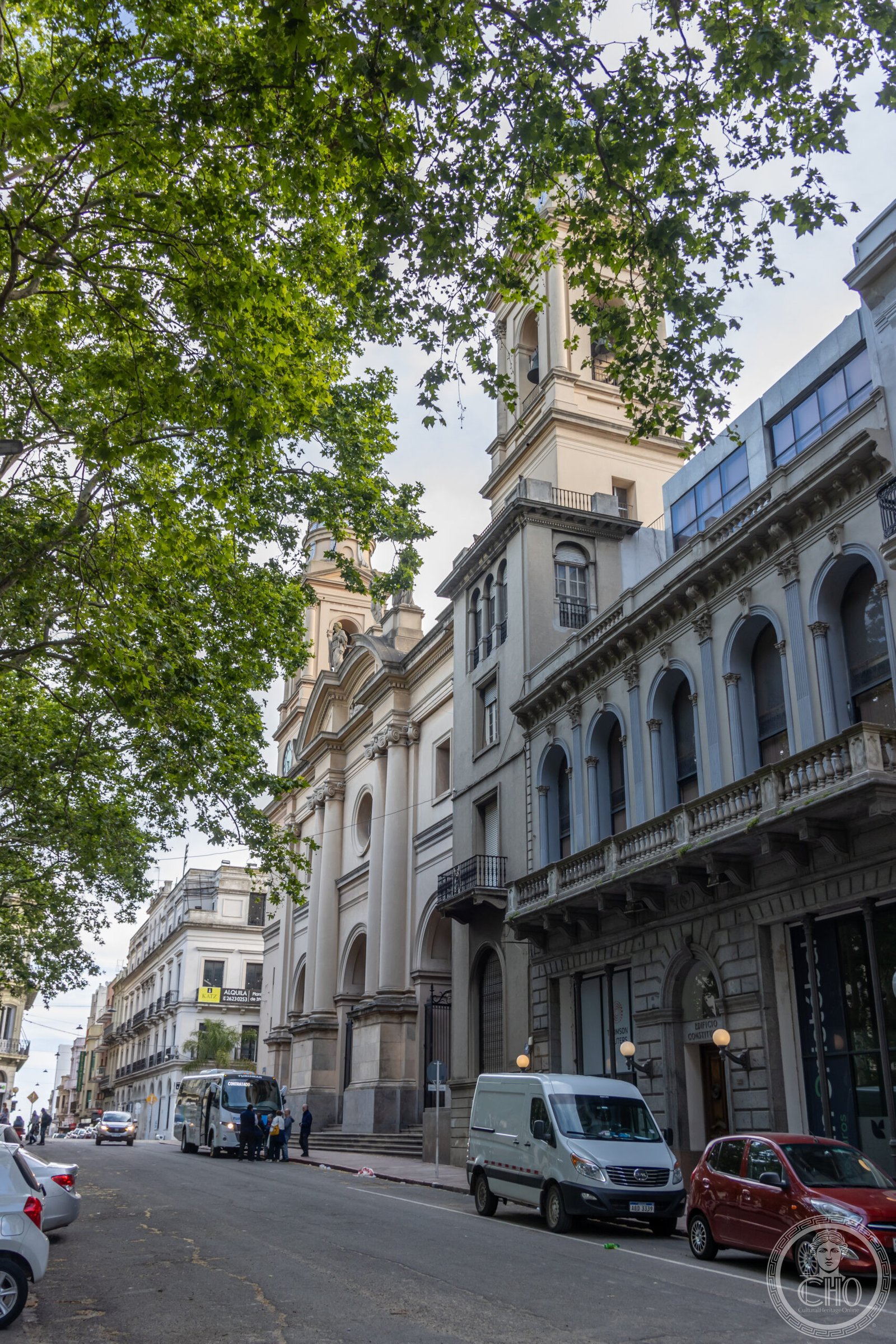
On Plaza Constitución, in the Ciudad Vieja of Montevideo, the metropolitan cathedral stands where a first brick church had been built between 1730 and 1746. Its full name is basilica cathedral of the Immaculate Conception and of Saints Philip and James, patrons of the city. The first stone of the present building was laid in 1790 and the work closed with the consecration in 1804. The attribution of the original design is still contested among the sources, which variously name Tomás Toribio, José Custodio de Sáa y Faría and José del Pozo y Marquy, while the present façade was remade between 1941 and 1949 by the architect Rafael Ruano. The building is often called the oldest in Uruguay, although that statement appears only in popular sources and not in a primary government one. Declared a national historic monument in 1975, it holds the tomb of Monsignor Jacinto Vera, first bishop of Montevideo, today venerable and in a cause of beatification, and the image of the Virgin of the Thirty-Three, patroness of Uruguay. The archdiocese of Montevideo, erected as apostolic vicariate on 14 August 1832, raised to diocese in 1878 and to metropolitan archdiocese on 14 April 1897, is led today by Cardinal Daniel Fernando Sturla Berhouet, archbishop since 2014 and cardinal since 2015. Uruguay is described by encyclopedic sources as the most secularised country of the Americas. The constitutional reform that came into force on 1 March 1919, pushed by President José Batlle y Ordóñez, laid down the separation of State and Church, and a specific law of 23 October 1919 officially renamed the religious feasts in lay terms: Christmas became «Family Day», Epiphany «Day of the Children» and Holy Week «Tourism Week», names still in official use. Self-declared Catholics range, depending on the source, between forty-two and forty-seven per cent of the population, with a share of the religiously unaffiliated reaching comparable figures. The higher figure sometimes quoted, sixty-seven per cent, refers instead to the internal count of the baptised kept by the Church, not to a demographic survey, and the two are not to be confused. Pope John Paul II visited this cathedral on the evening of 31 March 1987, during his journey to Chile, Argentina and Uruguay, praying briefly before the tomb of Monsignor Vera and then giving an address; the great open-air Mass of that same journey, with one hundred and fifty thousand faithful, was held elsewhere, at Tres Cruces, and not in the cathedral. Pope Francis never visited Uruguay, contrary to what is sometimes remembered; he had discussed the possibility with the Uruguayan ambassador to the Holy See, but the journey never took place in his lifetime.
About the Cathedral
The Metropolitan Cathedral of Montevideo, seat of the Archdiocese of Montevideo on Plaza Constitución in Ciudad Vieja, was consecrated in 1804 after a construction campaign begun in 1790, on the site of an earlier 1730s–40s brick church. It is often described as Uruguay’s oldest standing building, though that claim rests on popular rather than primary government sources.
Key facts
- 1790–1804: current cathedral built and consecrated; original architect disputed among sources.
- 14 August 1832: Vicariate Apostolic of Montevideo erected.
- 14 April 1897: elevated to metropolitan archdiocese.
- 1 March 1919: Uruguay’s constitutional reform formally separates church and state.
- 23 October 1919: Law No. 6997 officially renames Christmas “Family Day” and Holy Week “Tourism Week”
- 31 March 1987: Pope John Paul II prays at this cathedral’s tomb of Bishop Jacinto Vera, the only papal visit to the building on record.
History
Consecrated in 1804 near the end of the Spanish colonial period, the cathedral became the seat of an archdiocese in a country that would go on to enact, in 1919, one of Latin America’s strictest church-state separations — a reform that officially stripped Christmas and Holy Week of their religious names in government use, even as roughly four in ten Uruguayans still identify as Catholic. Pope John Paul II’s brief 1987 visit to pray at the tomb of Bishop Jacinto Vera remains the cathedral’s only documented papal connection; Pope Francis, despite reported interest, never visited Uruguay during his pontificate.
What you see
A neoclassical facade with austere, Herrerian-influenced lines rises between twin bell towers, one crowned with a blue-and-white tiled dome, fronted by a triple-arched Ionic-columned portico facing Plaza Constitución, opposite the colonial-era Cabildo.
Practical information
- Opening hours: generally open daily outside services; check current hours before visiting.
- Address: Ituzaingó 1373, at Peatonal Sarandí, Ciudad Vieja, Montevideo, Uruguay.
Getting there
The cathedral fronts Plaza Constitución in Montevideo’s historic Ciudad Vieja district. GPS: 34°54′25″S, 56°12′15″W.
Nearby
- Cabildo of Montevideo — the former seat of Spanish colonial government, directly across Plaza Constitución.
Sources
- Wikipedia (Spanish and English) — “Catedral metropolitana de Montevideo,” “Religion in Uruguay”
- Montevideo municipal heritage inventory (inventariociudadvieja.montevideo.gub.uy) — Padrón 4247A.
- GCatholic.org and Catholic-Hierarchy.org — Archdiocese of Montevideo records.
- Uruguay’s official legal database (impo.com.uy) — Law No. 6997 of 23 October 1919.
- Vatican.va — homily archive, Pope John Paul II’s 1987 visit to Uruguay.
- Pew Research Center and Uruguay’s 2011 national census — religious affiliation data.
Find it on the map
See this place and what’s around it →📷 Become a Cultural Heritage Online photographer
Share your photos of places: they stay published under your name as the author. The more they're seen, the more you get noticed — and soon a contest will reward the most appreciated photos.
Log in or sign up free to add a photo