
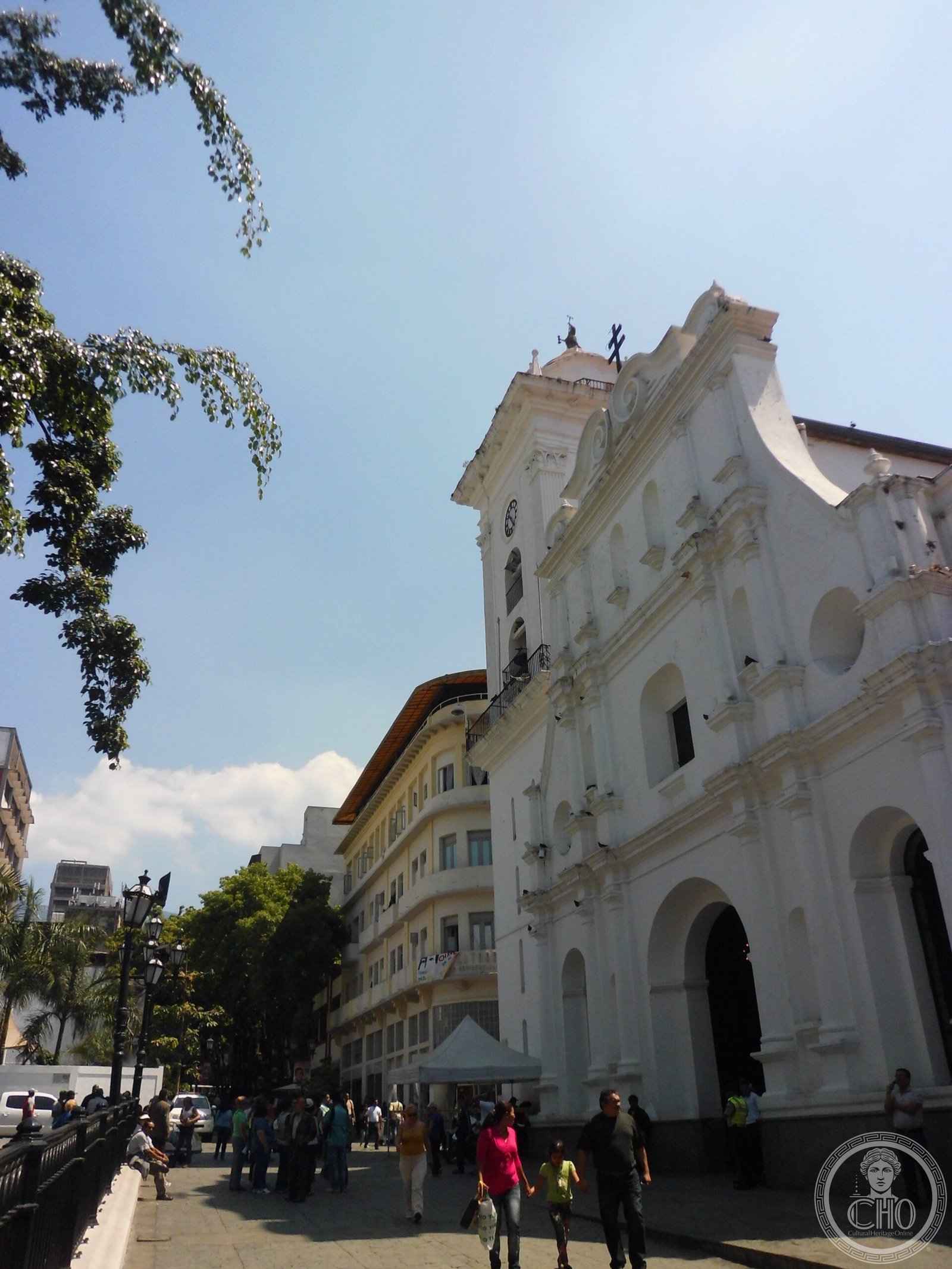
In Caracas, the capital of Venezuela, a first adobe chapel dedicated to Santiago was destroyed by the earthquake of 1641. The present building was begun in 1666 under the master builder Juan de Medina, with the main structure completed around 1674, though some sources place the definitive completion in the early decades of the eighteenth century. The facade visible today dates to 1771, the work of the architect Francisco Andrés de Meneses. On 26 March 1812, Maundy Thursday, a devastating earthquake of estimated magnitude around 7.7 struck Caracas during the war of independence, causing between 1,000 and 20,000 victims according to conflicting estimates, with the figure most cited by the clergy of the time around 10,000-12,000. The cathedral partly collapsed, killing some people and injuring many others, with one of the towers damaged and later rebuilt smaller. Archbishop Narciso Coll y Prat called the event “the terrifying but deserved earthquake”, comparing the affected cities, largely loyal to the independence cause, to “Babylon, Jerusalem and the Tower of Babel” — a royalist reading of the quake as divine punishment for the revolution. Simón Bolívar answered with the famous line: “if nature opposes us, we shall fight nature and force it to obey us”. In colonial Baroque style with neoclassical elements in the facade, the building measures about 82 by 25 metres, with five naves separated by 32 octagonal columns. Inside is “The Last Supper” by Arturo Michelena, a painting left unfinished on the painter’s death in 1898, along with works traditionally attributed to Rubens and to the school of Murillo, popular attributions not confirmed by independent art-historical studies. The Chapel of the Most Holy Trinity holds the tombs of Simón Bolívar’s parents and of his young wife María Teresa Rodríguez del Toro. Bolívar himself was baptised there, and his remains rested in this cathedral from 1842 to 1876, before their solemn transfer to the National Pantheon. The diocese of Caracas, whose origin goes back to the diocese of Coro of 1531, was raised to an archdiocese on 27 November 1803. Several of its recent archbishops have been raised to the cardinalate, among them Jorge Urosa Savino (2005-2018, a cardinal since 2006) and Baltazar Porras Cardozo. The present archbishop is Monsignor Raúl Biord Castillo, installed in 2024. In January 1985 Pope John Paul II addressed Venezuelan lay people in this very cathedral, during his first trip to Venezuela. In recent years there have been documented tensions between the Venezuelan Catholic Church and the government of Nicolás Maduro, including mutual accusations around the canonisation of the first Venezuelan saints in 2024 and accusations of extortion against relatives of detainees linked to the opposition, denied by the archdiocese. No direct documented link between the cathedral as a building and the country’s economic crisis or mass emigration is established, however. On 24 June 2026, two strong earthquakes of magnitude 7.2 and 7.5, only 39 seconds apart, struck Venezuela, causing thousands of victims according to a death toll still being updated at the time of writing this card (over 3,685 dead according to one source as of 8 July 2026). The cathedral of Caracas suffered internal damage and visible cracks on the bell tower, one of at least 25 churches damaged in the archdiocese, with Archbishop Biord visiting the worst-hit churches and masses celebrated outdoors in many parishes for safety reasons.
About the Metropolitan Cathedral
In Caracas, Venezuela, an earlier adobe chapel dedicated to St. James was destroyed by the 1641 earthquake; the current building began construction in 1666 under master builder Juan de Medina, with the main structure completed around 1674, though some sources place final completion in the early 18th century. The facade visible today dates to 1771, designed by architect Francisco Andrés de Meneses.
Key facts
- 1666-1674: the current cathedral built under master builder Juan de Medina.
- 26 March 1812: a devastating earthquake partially collapses the cathedral, framed by royalists as divine punishment for the independence revolution.
- The Chapel of the Holy Trinity holds the tombs of Simón Bolívar’s parents; his own remains rested here 1842-1876.
- 27 November 1803: elevated to the seat of the Archdiocese of Caracas.
- January 1985: Pope John Paul II addresses the laity at the cathedral.
- 24 June 2026: a major earthquake damages the cathedral’s interior and bell tower, part of a still-evolving national disaster.
History
Rebuilt after a 1641 quake and partially collapsed by the catastrophic 1812 earthquake — which a royalist archbishop called divine punishment for Venezuela’s independence movement, prompting Simón Bolívar’s famous vow to fight nature itself — this cathedral has weathered more than three centuries of seismic and political upheaval. Its role as the burial place of Bolívar’s parents and his own remains until 1876 ties it directly to Venezuela’s founding history, even as it now bears fresh damage from the devastating earthquakes that struck the country in June 2026.
What you see
A colonial Baroque cathedral with a Neoclassical 1771 facade holds five naves separated by 32 octagonal columns, its interior featuring Arturo Michelena’s unfinished “The Last Supper” and paintings popularly, though not definitively, attributed to Rubens and the school of Murillo. The Chapel of the Holy Trinity houses a sculpture of Bolívar mourning his parents and bride, one of the cathedral’s most photographed features.
Practical information
- Opening hours: generally open daily outside services; check current status given 2026 earthquake damage before visiting.
- Address: east side of Plaza Bolívar, Catedral parish, Libertador Municipality, Caracas, Venezuela.
Getting there
The cathedral stands on the east side of Plaza Bolívar in central Caracas. GPS: 10°30′22″N, 66°54′50″W.
Nearby
- Panteón Nacional — where Simón Bolívar’s remains were transferred in 1876, roughly five blocks north.
Sources
- Wikipedia — “Caracas Cathedral” and “1812 Caracas earthquake”
- Wikipedia (Spanish) — “Terremotos de Venezuela de 2026”
- ACI Prensa — “25 iglesias de la Arquidiócesis de Caracas presentan daños tras los terremotos en Venezuela”
- Catholic-Hierarchy.org — Archdiocese of Caracas listing.
- Conferencia Episcopal Venezolana — coverage of Pope John Paul II’s 1985 visit.
Find it on the map
See this place and what’s around it →📷 Become a Cultural Heritage Online photographer
Share your photos of places: they stay published under your name as the author. The more they're seen, the more you get noticed — and soon a contest will reward the most appreciated photos.
Log in or sign up free to add a photo