
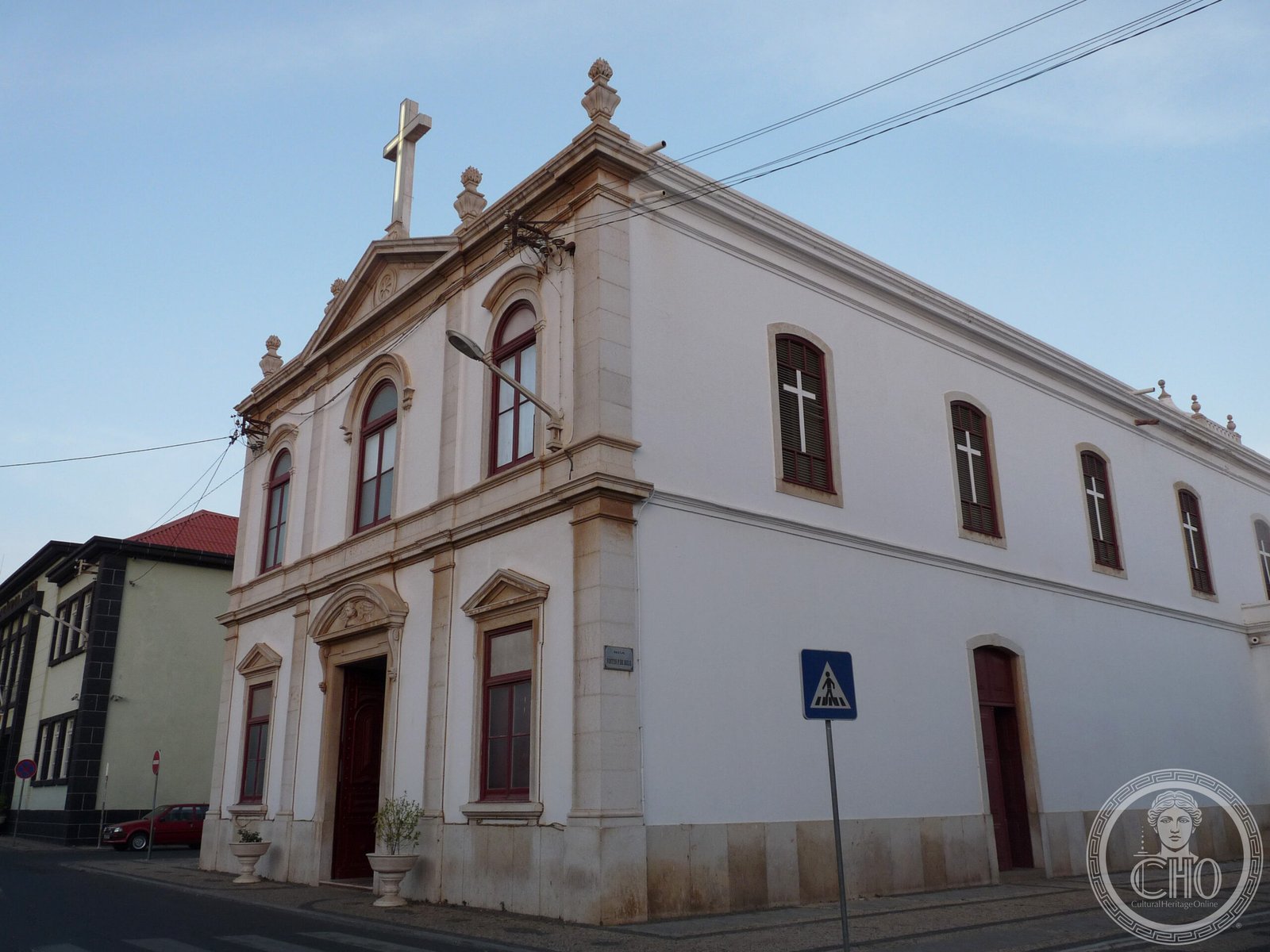
In Praia, the capital of Cape Verde, the pro-cathedral of Our Lady of Grace was built between 1894 and 1902 in neoclassical style, with its main façade facing Praca Alexandre Albuquerque and its bell tower at the rear, towards Avenida Andrade Corvo. Neither the building materials nor the name of an architect is documented. It carries the canonical title of «pro-cathedral» rather than full cathedral, because the original seat of the diocese was the Se of Ribeira Grande, today’s Cidade Velha, whose construction had begun as early as 1556 and which survives now only as a ruin, a UNESCO World Heritage site since 2009. The diocesan seat was moved from Ribeira Grande to Ribeira Brava, on the island of Sao Nicolau, in 1786, and finally to Praia in 1943, for practical reasons tied to the role of the latter as national capital. The diocese of Santiago of Cape Verde was erected on 31 January 1533 and is still a diocese, not an archdiocese, immediately subject to the Holy See. After a reorganisation in November 2003, its jurisdiction covers only the southern Sotavento islands, Santiago, Maio, Fogo and Brava, while the northern Barlavento islands form a separate diocese. On 16 February 2026 Pope Leo XIV accepted the resignation of Cardinal Arlindo Gomes Furtado, bishop since 2009 and the first cardinal in the history of Cape Verde, appointing on the same day as his successor Monsignor Teodoro Mendes Tavares, of the Spiritan order, whose installation was held on 3 May 2026 at the National Stadium of Praia, before about 15,000 people. It should be said clearly that the history of the Atlantic slave trade, well documented at Cidade Velha, with the pelourinho, the pillory column raised between 1512 and 1520, and the practice of «ladinization» of enslaved Africans before embarkation for Brazil, the Caribbean and Spanish America, is not linked in any documented way to this building in Praia, built almost a century after the Portuguese abolition of the trade and far from the historic site, geographically as well. Pope John Paul II visited Cape Verde from 25 to 27 January 1990, but his presence in this pro-cathedral is not confirmed by primary sources. The building was also designated a jubilee church for the extraordinary Jubilee of Mercy in 2016.
About the Pro-Cathedral of Our Lady of Grace
In Praia, the capital of Cape Verde, the Pro-Cathedral of Our Lady of Grace was built between 1894 and 1902 in neoclassical style, its main facade facing Praça Alexandre Albuquerque and its bell tower at the rear, on Avenida Andrade Corvo; neither its building materials nor an architect’s name is documented. It carries the canonical title of “pro-cathedral” rather than full cathedral status, because the diocese’s original seat was the Sé of Ribeira Grande — present-day Cidade Velha — whose construction began as early as 1556 and which survives today only as a ruin, a UNESCO World Heritage Site since 2009.
Key facts
- 1894-1902: the pro-cathedral built in neoclassical style.
- 1943: the diocesan seat moves from Ribeira Brava to Praia.
- Distinct from the Cidade Velha ruins, tied to the Atlantic slave trade — no such connection documented for this building.
- 2016: designated a Jubilee Church for the Extraordinary Jubilee of Mercy.
- 16 February 2026: Cardinal Arlindo Gomes Furtado’s resignation accepted, Bishop Teodoro Mendes Tavares appointed.
- 3 May 2026: Bishop Tavares installed before roughly 15,000 people at Praia’s National Stadium.
History
Built at the turn of the 20th century as Praia grew into Cape Verde’s capital, this pro-cathedral inherited its diocesan seat only in 1943, nearly four centuries after the original cathedral was begun at Ribeira Grande, now the ruined UNESCO site of Cidade Velha. That older site, not this one, carries the archipelago’s documented history as a hub of the Atlantic slave trade — a distinction worth preserving carefully, since the two buildings are roughly 10 kilometers and several centuries apart.
What you see
A neoclassical pediment and gable, topped with a bell and cross, front the pro-cathedral’s main facade on Praça Alexandre Albuquerque, with arched, red-shuttered windows along its flank — a functioning parish church rather than the ruined stone shell found at Cidade Velha.
Practical information
- Opening hours: generally open daily outside services; check current hours before visiting.
- Address: Praça Alexandre Albuquerque, Plateau district, Praia, Santiago Island, Cape Verde.
Getting there
The pro-cathedral stands on Praça Alexandre Albuquerque in Praia’s historic Plateau district. GPS: 14°55′02″N, 23°30′31″W.
Nearby
- Cidade Velha — the ruined original cathedral and UNESCO-listed former colonial capital, roughly 10 km away.
Sources
- Wikipedia — “Pro-Cathedral of Our Lady of Grace, Praia” and “Roman Catholic Diocese of Santiago de Cabo Verde”
- Wikipedia — “Cidade Velha”
- Vatican News (Portuguese) — coverage of Bishop Teodoro Mendes Tavares’s appointment and installation, February-May 2026.
- ACI Africa — “Catholic Diocese of Santiago in Cape Verde prepares for historic installation of new bishop”
- GCatholic.org — Diocese of Santiago de Cabo Verde listing.
Find it on the map
See this place and what’s around it →📷 Become a Cultural Heritage Online photographer
Share your photos of places: they stay published under your name as the author. The more they're seen, the more you get noticed — and soon a contest will reward the most appreciated photos.
Log in or sign up free to add a photo