
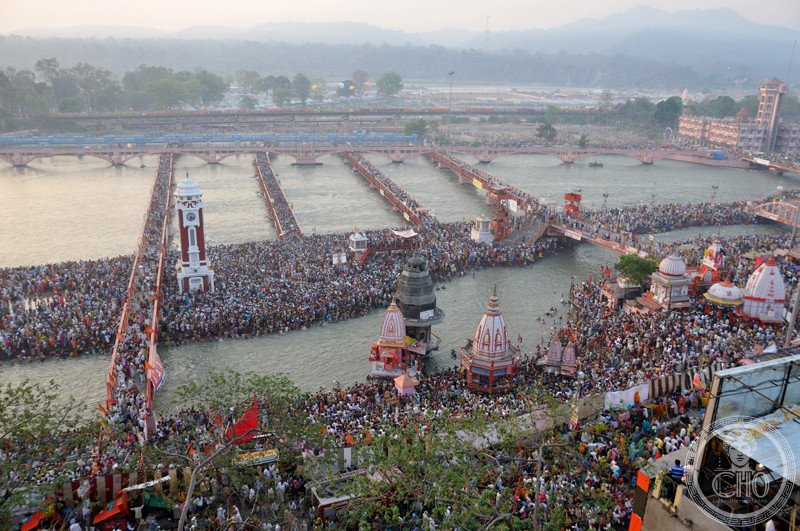
A Hindu pilgrimage held every four or twelve years at four sacred river confluences, drawing millions to ritually bathe in waters believed to cleanse sins and grant spiritual atonement.
In UNESCO’s words
Kumbh Mela (the festival of the sacred Pitcher) is the largest peaceful congregation of pilgrims on earth, during which participants bathe or take a dip in a sacred river. Devotees believe that by bathing in the Ganges one is freed from sins liberating her/him from the cycle of birth and death. Millions of people reach the place without any invitation. The congregation includes ascetics, saints, sadhus, aspirants-kalpavasis and visitors. The festival is held at Allahabad, Haridwar, Ujjain and Nasik every four years by rotation and is attended by millions of people irrespective of caste, creed or gender. Its primary bearers, however, belong to akhadas and ashrams, religious organizations, or are individuals living on alms. Kumbh Mela plays a central spiritual role in the country, exerting a mesmeric influence on ordinary Indians. The event encapsulates the science of astronomy, astrology, spirituality, ritualistic traditions, and social and cultural customs and practices, making it extremely rich in knowledge. As it is held in four different cities in India, it involves different social and cultural activities, making this a culturally diverse festival. Knowledge and skills related to the tradition are transmitted through ancient religious manuscripts, oral traditions, historical travelogues and texts produced by eminent historians. However, the teacher-student relationship of the sadhus in the ashrams and akhadas remains the most important method of imparting and safeguarding knowledge and skills relating to Kumbh Mela.
Official description, UNESCO Intangible Cultural Heritage List — Kumbh Mela
At a glance
Kumbh Mela is the largest peaceful gathering of pilgrims on earth. Millions of people, without invitation, come to bathe in a sacred river, believing that bathing frees them from sins and breaks the cycle of birth and death. The congregation includes ascetics, saints, sadhus, aspirants, and visitors from all castes, creeds, and genders. It is held by rotation in four cities every four years.
Origins & history
Hindu cosmology holds that these four sites received drops of divine nectar (amrita) during the mythological churning of the ocean of milk. An annual bathing festival called Magh Mela had been held at Prayag for centuries, documented in classical texts like the Ramcharitmanas. Before 1858, the name “Kumbh” referred only to the twelfth occurrence of Haridwar’s annual mela. The first formally organized Kumbh Mela at Prayag took place in 1870, following a proposal by the Pragwals—a traditional priest community—to establish an orderly pilgrimage under British administration after the 1857 Indian Rebellion.
The practice
The festival brings together the primary bearers—those from akhadas and ashrams, religious organizations, or individuals living on alms—alongside millions of other devotees. The event encompasses ritual bathing in sacred rivers, religious discourse, assemblies of monks and ascetics, educational events, and fairs. Each of the four rotating locations—Allahabad, Haridwar, Ujjain, and Nasik—involves different social and cultural activities, making each gathering distinct.
Cultural significance
Kumbh Mela holds central spiritual significance in the country and encapsulates astronomy, astrology, spirituality, ritualistic traditions, and social and cultural customs. Knowledge is transmitted through manuscripts and oral tradition, but the teacher-student relationship between sadhus in ashrams and akhadas remains the most vital method for preserving and passing on the skills and understanding that sustain the tradition.
Key facts
- Country: India
- Inscribed: 2017
- UNESCO list: Representative List of the Intangible Cultural Heritage of Humanity
- UNESCO reference: 01258
- UNESCO vocabulary: Pilgrimages; Religious practice; Sacred sites
- Map: Allahabad — the locality named in UNESCO’s official description of this element
Where to experience it
Kumbh Mela rotates among four cities—Allahabad, Haridwar, Ujjain, and Nasik—each hosting the festival every four years in turn. Millions of pilgrims gather at whichever location holds the current celebration, drawn by the belief that bathing in the sacred river washes away sins and breaks the cycle of rebirth. Ascetics, saints, and ordinary devotees participate regardless of caste, creed, or gender. The festival dates follow ancient astronomical calculations, so visitors should consult official sources for the precise timing and location of the next gathering.
Sources & resources
- UNESCO — official element page: Kumbh Mela
- UNESCO — open data record: Intangible Heritage List, reference 01258
- UNESCO — official video: UNESCO film on this element — embedded on this page
- UNESCO — official photograph: Havan (ritual) Pooja by Naga Saint — Sanjay Jagtap, India, 2015
- Reference — Wikipedia (secondary): Kumbh Mela — consulted as a secondary reference, not as confirmation
- Cultural Heritage Online: Our archive and city guides

Find it on the map
See this place and what’s around it →📷 Become a Cultural Heritage Online photographer
Share your photos of places: they stay published under your name as the author. The more they're seen, the more you get noticed — and soon a contest will reward the most appreciated photos.
Log in or sign up free to add a photo