
In the heart of Fès el-Bali, hides still soften in pigeon dung before being dipped into stone vats of saffron, poppy and mint dye, a process unchanged since the tannery opened in the 11th century. Around it spreads the largest surviving medieval city in the world, its 9,000 streets closed to every vehicle but the donkey.
At a glance
Fès el-Bali is generally described as the largest surviving medieval city in the world, its old town threaded by an estimated nine to twelve thousand streets and alleys, none wide enough for a car. Donkeys and mules remain the working transport, carrying goods where wheels cannot go. The city traces its origin to Idris II, who founded it in 808 CE on the site of an earlier settlement established by his father Idris I in 789. In 817, some eight hundred families expelled from Córdoba settled in Fez, bringing Andalusian craft traditions that still shape its artisan quarters.
Key facts
- Founding: Idris II founded Fez in 808 CE, building on a settlement laid down by Idris I in 789.
- Al-Qarawiyyin: founded in 859 by Fatima al-Fihri, held to be the oldest continuously operating university in the world; its library holds manuscripts dating back to the 9th century, including an 8th-century Quranic text on camel skin.
- Chouara Tannery: in continuous operation since the 11th century, still using pigeon dung to soften hides before dyeing with saffron, poppy and mint colours, supplemented by synthetic dyes since the 20th century.
- Bou Inania Madrasa: built between 1350 and 1357 for the Marinid sultan Abu Inan Faris, the only building in the medina to function as both mosque and madrasa.
- UNESCO status: the Medina of Fez was inscribed as a World Heritage Site in 1981.
History
The Marinid dynasty made Fez its capital in 1258, opening a golden age that produced the city’s great mosques, madrasas and the new royal city of Fès el-Jdid. The Mellah, the Jewish quarter, was established in 1438 and is counted among the oldest of its kind in Morocco and beyond. By the 14th century Fez had reached a population said to have made it the largest city in the world at the time.
In 1912 the Treaty of Fez, signed in the city, established the French Protectorate of Morocco. The French built their new administrative quarter, the Ville Nouvelle, outside the walls, leaving the historic medina largely intact.
What you see
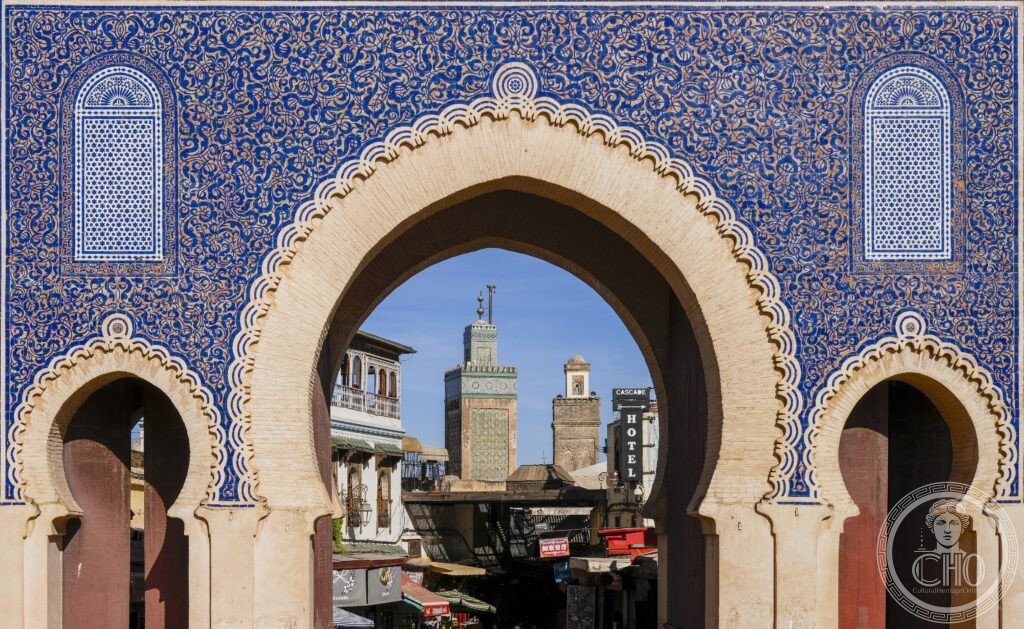
Zellige tilework covers walls and courtyards throughout the medina, each piece cut and set by hand in interlocking geometric patterns using techniques that craftsmen say have barely changed in a thousand years. The main gate into Fès el-Bali, Bab Bou Jeloud, was built in 1913 and faced in blue tiles on its outer side and green on the inner, colours associated respectively with the city and with Islam.
The Al-Qarawiyyin Mosque, said to be the largest in Africa by capacity, centres on a fountain courtyard surrounded by carved plaster and cedar-wood ceilings; non-Muslim visitors can view it from the gateways but not enter. At the Chouara Tannery, the circular stone vats of saffron yellow, poppy red and mint green dye are worked from raised platforms, where visitors are traditionally handed a sprig of mint to hold against the smell of the hides.
Practical information
- Getting around: no vehicles enter the medina; donkeys and mules carry goods through its narrow lanes, so comfortable footwear is essential.
- Guides: a local guide is widely recommended for first-time visitors, since the medina’s layout defeats most smartphone maps.
- Accommodation: many visitors stay in a riad, a traditional courtyard house converted into a guesthouse, within the medina itself.
- Current details: for opening arrangements and access to specific monuments, check with the site’s official tourism authority before travelling.
Getting there
Fez is reached by air via Fez-Saïss Airport, served by several European carriers, or via Casablanca’s Mohammed V Airport with an onward train connection to Fez. Once in the city, the medina itself is explored on foot.
Nearby
- Meknès — around 60 km west, the former imperial capital of Moulay Ismail, inscribed as a World Heritage Site in 1996; its Bab Mansour gate, built in 1732, is widely considered the finest city gate in Morocco.
- Volubilis — a further 30 km north of Meknès, the best-preserved Roman site in Morocco, with mosaics dating from the 1st to the 3rd century CE, inscribed as a World Heritage Site in 1997.
- Chefchaouen — around 200 km north, the Blue City founded in 1471 by refugees from Andalusia, its walls and steps painted in shades of blue against a backdrop of the Rif Mountains; it is not inscribed as a UNESCO World Heritage Site.
- Marrakech — around 530 km south, a World Heritage Site since 1985; its Jemaa el-Fna square was among the first sites recognised under UNESCO’s Intangible Cultural Heritage programme, and the Majorelle Garden, restored by Yves Saint Laurent and Pierre Bergé from 1980, holds Saint Laurent’s ashes.
Sources
- Wikipedia, Fes el-Bali
- Wikipedia, Chouara Tannery
- Wikipedia, Al-Qarawiyyin
- Wikipedia, Bou Inania Madrasa
- UNESCO, Medina of Fez, WHS reference 170
Find it on the map
See this place and what’s around it →📷 Become a Cultural Heritage Online photographer
Share your photos of places: they stay published under your name as the author. The more they're seen, the more you get noticed — and soon a contest will reward the most appreciated photos.
Log in or sign up free to add a photo