

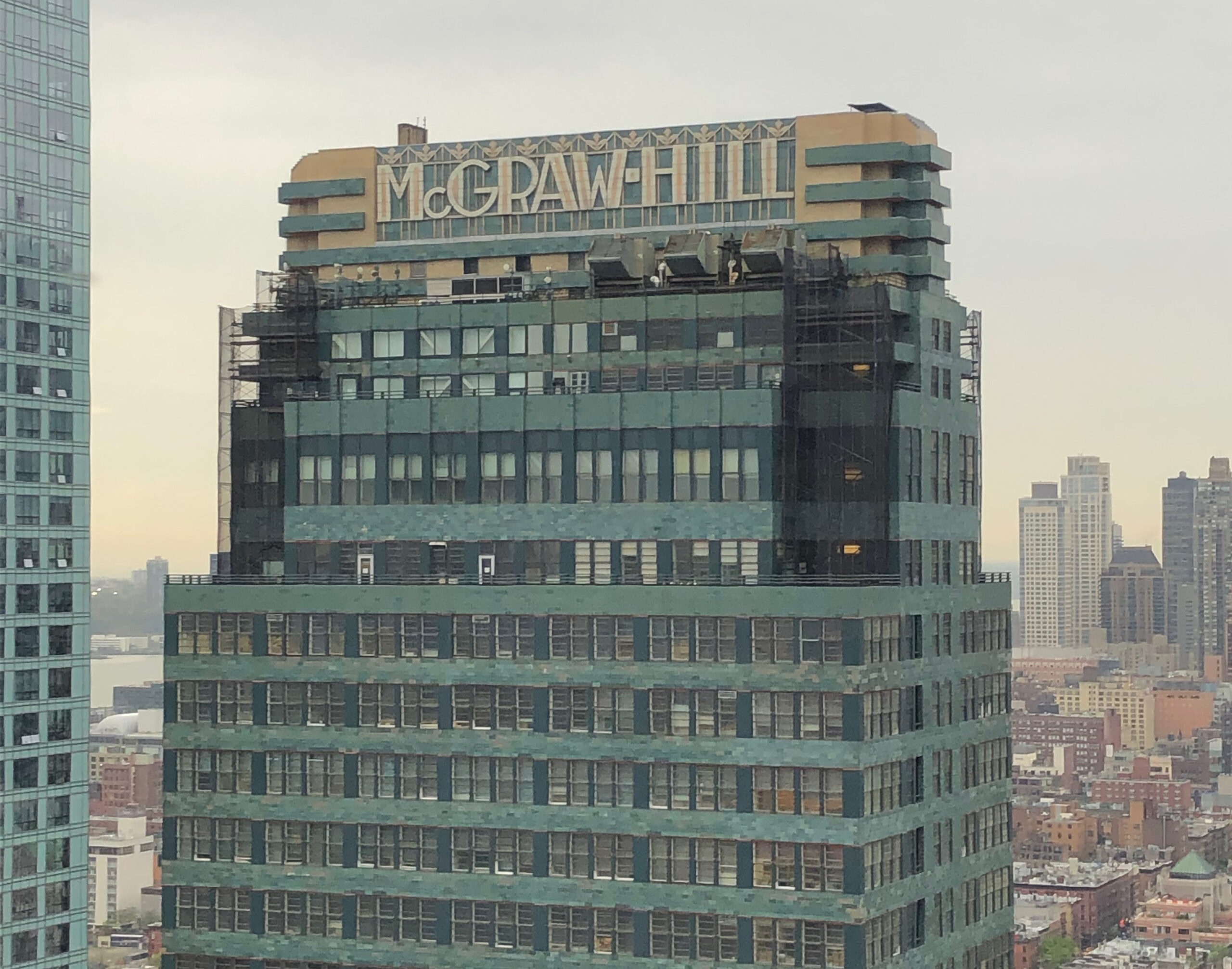
The McGraw-Hill Building at 330 West 42nd Street is a landmark 33-story skyscraper completed in 1931, designed by Raymond Hood and J. Andre Fouilhoux. Its daring blue-green terracotta facade and pronounced horizontal banding challenged the vertical orthodoxy of its era, earning it a place in MoMA’s landmark 1932 International Style exhibition alongside the finest modern buildings in the world.
At a glance
- Type
- Skyscraper / Office building
- Period
- 1930–1931
- Style
- Art Deco / Art Moderne / International Style
- Location
- 330 West 42nd Street, Hell’s Kitchen, Manhattan, New York City, NY 10036, USA
- Coordinates
- 40.7575° N, 73.9917° W
- Architect(s)
- Raymond Hood and J. Andre Fouilhoux (Hood, Godley and Fouilhoux)
Overview
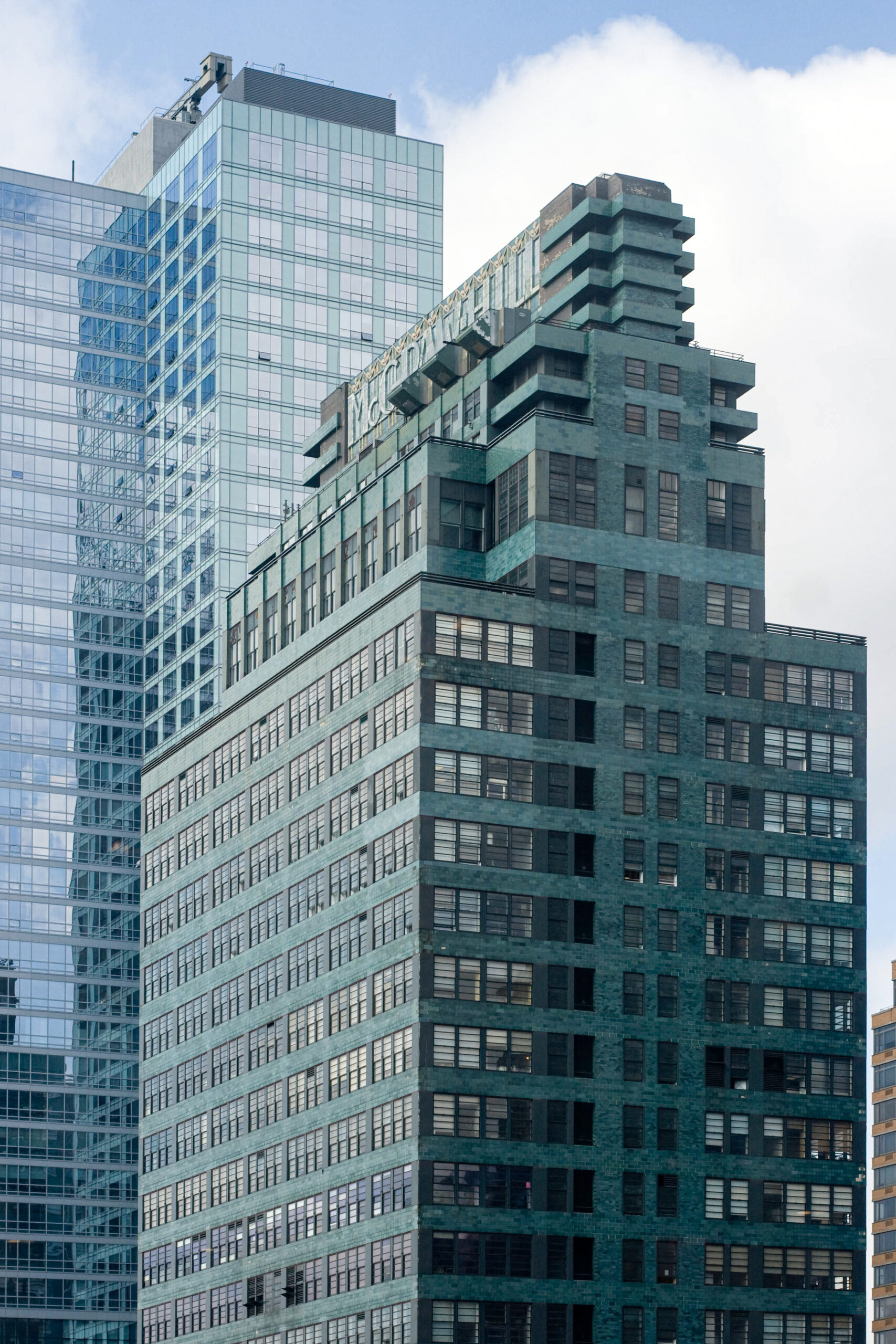
Rising 485 feet in 33 stories over Hell’s Kitchen, the McGraw-Hill Building is one of New York City’s most architecturally adventurous skyscrapers. Its surface is clad entirely in distinctive blue-green glazed terracotta tiles alternating with green-framed casement windows, creating a shimmering horizontal rhythm unlike anything else on the Manhattan skyline. Completed in just 14 months at a cost of $3.34 million, it originally housed the headquarters of McGraw-Hill Companies and is today an office building.
History
Construction began in 1930, and when the building was completed in 1931 McGraw-Hill occupied three-quarters of its 575,000 square feet, keeping its headquarters here until the company moved to 1221 Avenue of the Americas in 1972. The building later served Group Health Insurance under the name GHI Building before reverting to the McGraw-Hill name.
Architecture & Design
Where most New York skyscrapers of the period emphasised verticality, Hood and Fouilhoux deliberately inverted the convention. Strong horizontal spandrel bands in blue-green terracotta link every window bay across the facade, giving the tower a streamlined, machine-age quality closer to the emerging International Style than to traditional Art Deco ornamentalism. Hood chose the distinctive blue-green colour specifically for its ability to harmonise with the sky under all weather conditions. The building was selected as one of only two American skyscrapers represented in the Museum of Modern Art’s groundbreaking 1932 International Style exhibition curated by Henry-Russell Hitchcock and Philip Johnson, confirming its status as a bridge between Art Deco and the architectural modernism that followed.
Cultural significance
The McGraw-Hill Building occupies a rare hinge point in American architectural history. Built in 1930–31, as the Depression was bringing large-scale construction to a halt, it distilled Hood’s career-long move from Gothic Revival toward pure modernism. Its inclusion in MoMA’s 1932 exhibition gave the building international visibility and secured its place in architectural historiography. It was designated a New York City landmark in 1979, listed on the National Register of Historic Places in 1980 and named a National Historic Landmark in 1989. The American Institute of Architects has cited the building as one of New York City’s finest examples of the transitional moment between Art Deco and the International Style.
Visiting today
The building is best appreciated from the street, where the full extent of the blue-green facade can be seen. The lobby area is accessible during office hours. Nearby, the Theater District and Times Square offer additional architectural and cultural attractions within easy walking distance.
Getting there
The nearest subway stations are Times Square–42nd Street (A, C, E, N, Q, R, W, 1, 2, 3 lines) and Port Authority Bus Terminal (A, C, E lines), both within a five-minute walk. The M42 and M104 bus routes serve 42nd Street directly. As with all Midtown Manhattan locations, public transit is far preferable to driving.
Sources & resources
Gallery
Find it on the map
See this place and what’s around it →
Record researched and written by Luigi De Marchi for Cultural Heritage Online, 2026.
📷 Become a Cultural Heritage Online photographer
Share your photos of places: they stay published under your name as the author. The more they're seen, the more you get noticed — and soon a contest will reward the most appreciated photos.
Log in or sign up free to add a photoIs this page about you?
This page is read by travellers and heritage enthusiasts who find it on Google. Tell us how you are connected to this place and we will take it from there.