
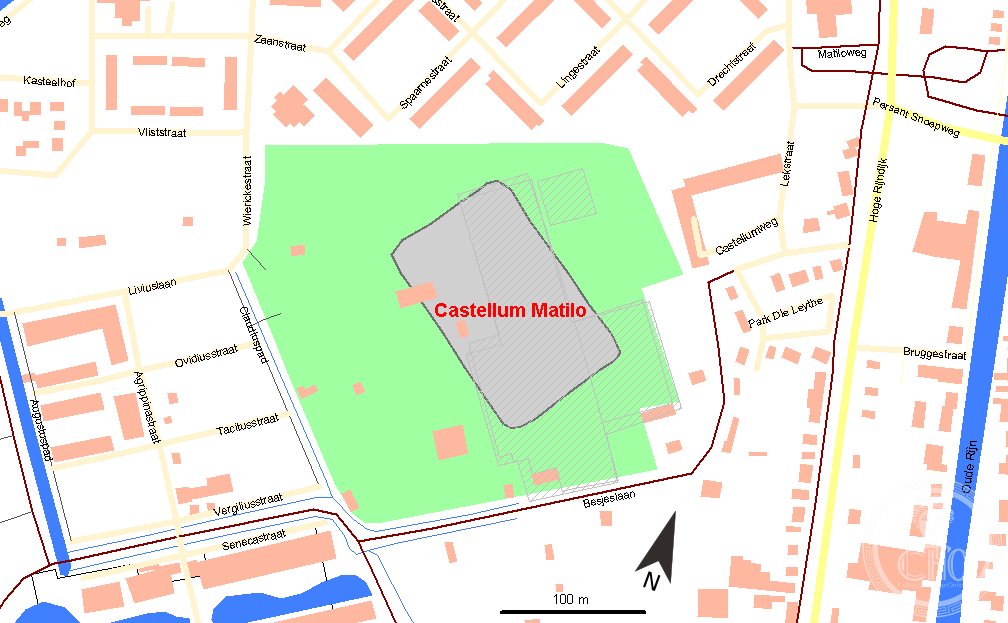
A Roman fort that once guarded the Rhine frontier, Matilo stood sentinel over Germania Inferior and the empire’s northern borders.
At a glance
Matilo was a Roman castellum positioned on the southern banks of the Oude Rijn in present-day Leiden. It formed part of the Limes Germanicus—the string of fortifications that secured Rome’s frontier against Germanic tribes. The fort lay strategically between the encampments of Albaniana to the west and Praetorium Agrippinae to the east, on the route mapped by the Peutinger Table.
History
Matilo served Rome’s military objectives in the province of Germania Inferior, protecting trade routes and territorial control along the Rhine. The site is documented in classical sources, including the seventh-century Ravenna Cosmography, which records the name in the accusative form as Matellionem—evidence of its continued recognition in late antiquity.
What you see
Little visible remains of the Roman fort survive above ground today. Archaeological investigation has revealed the footprint and logistics of the castellum, characteristic of Rhine frontier posts designed to accommodate auxiliary troops and supply chains.
Cultural significance
Matilo represents the physical expression of Roman imperial reach into northern Europe. Its position on the Limes Germanicus places it within one of the ancient world’s most consequential defensive systems—a frontier that shaped European history and the eventual boundaries of the Roman world.
Key facts
- Location: Leiden, Netherlands
- Coordinates: 52.1497°N, 4.5184°E
- Type: Roman castellum (fort)
- Province: Germania Inferior
- Strategic position: Between Albaniana and Praetorium Agrippinae on the Peutinger Map
Practical information & getting there
Matilo lies within modern Leiden, a city accessible by train and road from Amsterdam and other Dutch centres. The archaeological site itself offers no dedicated visitor infrastructure; material evidence is dispersed among local museums and scholarly collections.
Sources & resources
Find it on the map
See this place and what’s around it →📷 Become a Cultural Heritage Online photographer
Share your photos of places: they stay published under your name as the author. The more they're seen, the more you get noticed — and soon a contest will reward the most appreciated photos.
Log in or sign up free to add a photoIs this page about you?
This page is read by travellers and heritage enthusiasts who find it on Google. Tell us how you are connected to this place and we will take it from there.