
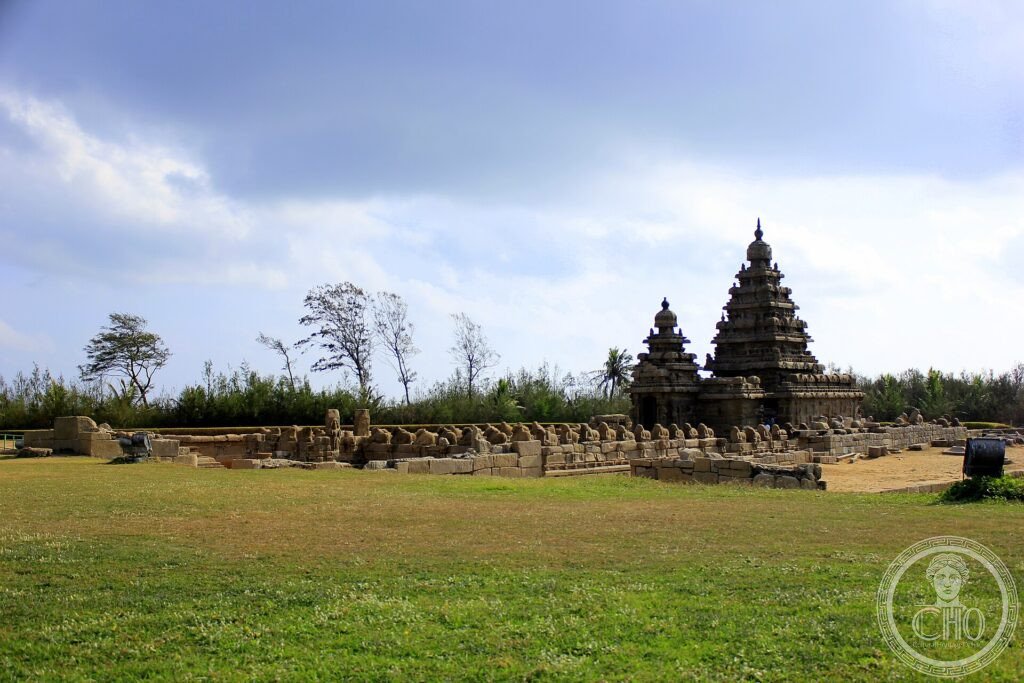
On the Coromandel coast, the Pallava kings turned a port into a gallery of sacred art carved from rock: monolithic chariot-shaped temples, cave shrines, and an immense relief telling the descent of the Ganges. Mahabalipuram is a masterpiece of South Indian art, facing the sea.
At a glance
Mahabalipuram (Mamallapuram), on the Coromandel coast south of Chennai, was a port and ceremonial centre of the Pallava kings in the 7th and 8th centuries. They left a group of monuments carved from the living granite: the Shore Temple by the sea, the monolithic “rathas” shaped like temple-chariots, rock-cut cave shrines, and the colossal open-air relief known as the Descent of the Ganges. Together they are a masterpiece of early South Indian art. They were inscribed by UNESCO in 1984.
Key facts
- UNESCO: World Heritage since 1984 (Group of Monuments at Mahabalipuram)
- Pallava dynasty: carved in the 7th–8th centuries
- Shore Temple: a structural temple standing by the sea
- The rathas: monolithic shrines carved as temple-chariots
- Descent of the Ganges: a vast open-air rock relief
- Cave shrines: rock-cut mandapas with fine sculpture
History
Under the Pallava kings, especially Narasimhavarman I (Mamalla), Mahabalipuram became a flourishing port and a workshop of sacred art in the 7th century. Sculptors cut shrines, halls and entire small temples directly from the granite outcrops, experimenting with forms that would shape the great temple architecture of South India.
The Shore Temple, built a little later, faces the Bay of Bengal, while inland stand the rathas, the cave shrines and the immense relief of the Descent of the Ganges, alive with gods, sages, animals and the elephant family. The sea has eroded some monuments — legend tells of submerged “seven pagodas” — but the surviving group remains a high point of Indian art.
What you see
The Shore Temple rises in tiers of carved granite at the water’s edge, its towers silhouetted against the sea. Inland lie the Five Rathas, each a different temple form cut from single boulders, accompanied by carved elephants and a lion; the cave mandapas with their reliefs; and the towering Descent of the Ganges, where a natural cleft becomes a celestial river.
The whole site is a gallery of Pallava sculpture in the open air.
Practical information
- Monuments: tickets cover the Shore Temple and the Five Rathas
- Time needed: half a day
- Note: a popular day trip from Chennai
- Setting: on the Coromandel coast of Tamil Nadu
Getting there
Mahabalipuram is on the Coromandel coast of Tamil Nadu, about 55 km south of Chennai, southern India. It is reached by road from Chennai. GPS: 12.6167° N, 80.1994° E.
Nearby
- Chennai — the Tamil Nadu capital, to the north
- Kanchipuram — the temple city of the Pallavas inland
- Coromandel coast — the beaches of the Bay of Bengal
Sources
- UNESCO World Heritage Centre — “Group of Monuments at Mahabalipuram” (ref. 249)
- Archaeological Survey of India — official body
- Encyclopaedia Britannica — Mahabalipuram; Pallava dynasty
Find it on the map
See this place and what’s around it →📷 Become a Cultural Heritage Online photographer
Share your photos of places: they stay published under your name as the author. The more they're seen, the more you get noticed — and soon a contest will reward the most appreciated photos.
Log in or sign up free to add a photo