
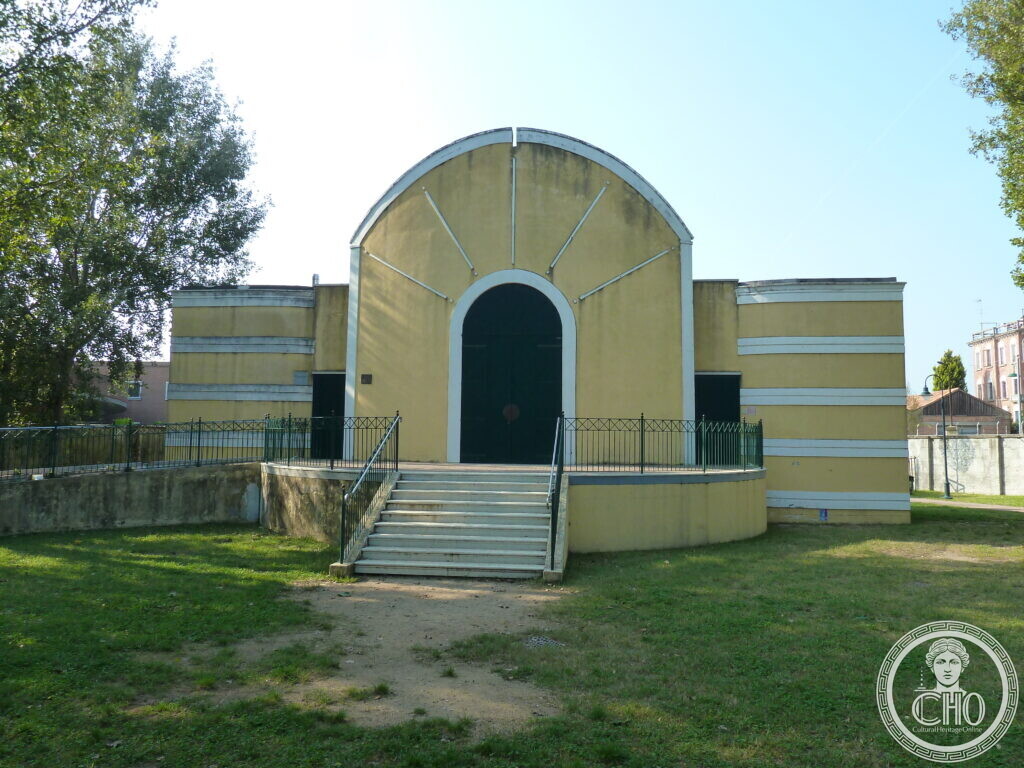
A seafront funfair of 1931–32, designed by the architect and architectural historian Antonio Cassi Ramelli, with a “Palazzo delle Feste” and a lit-up cascade. The site is now a club named after the Chilean poet Pablo Neruda.
At a glance
On the seafront near the San Nicolò end of the Lido di Venezia stood, from 1931–32, a Luna Park — a seaside funfair built by the Società Anonima Luna Park Venezia Lido, with gates on the Lungomare, ticket pavilions and a centrepiece called the Palazzo delle Feste, fitted with a lit fountain its own architect described as a “cascata luminosa,” a luminous cascade. It was designed by Antonio Cassi Ramelli, later a well-known historian of military architecture, with Alessandro Candiani. The site today is the Circolo Arci UISP “Pablo Neruda,” named after the Chilean poet.
Key facts
- Where: the seafront near San Nicolò, Lido di Venezia
- Built: 1931–1932
- Architect: Antonio Cassi Ramelli (Milan, 12 April 1905 – Capiago Intimiano, 23 August 1980), with Alessandro Candiani
- Client: Società Anonima Luna Park Venezia Lido
- The centrepiece: the Palazzo delle Feste, with a “luminous cascade” — a lit fountain feature, described by Cassi Ramelli himself in a 1932 article
- Today: the Circolo Arci UISP “Pablo Neruda”
A funfair on the beach, and the man who designed it
The Luna Park opened on the Lido’s seafront in 1931–32, built by the Società Anonima Luna Park Venezia Lido to a design by Antonio Cassi Ramelli, with the collaboration of Alessandro Candiani. Cassi Ramelli wrote up the project himself, twice, in the architectural press of the day — in Rassegna di Architettura and in L’illuminazione razionale, both in October 1932 — which is itself the clearest proof that this was his design. The contractors named in the surviving archive of his work are the building firm Greco e Ballerio, the electrical contractor Arcioni, and the glassworks Salviati and Venini of Murano, who supplied the decorative lighting.
Cassi Ramelli went on to a long career: he taught architectural composition at the Politecnico di Milano from 1937, rebuilt Milan’s Teatro Lirico in 1938, and worked on the restoration of Milan Cathedral between 1957 and 1965. He is remembered today chiefly as a historian of fortification, the author of Dalle caverne ai rifugi blindati (1964) and, with an introduction by Italo Calvino, Castelli e fortificazioni (1974). He died on 23 August 1980 at Capiago Intimiano, near Como.
The funfair itself did not last. We have not been able to find when it closed or when the site passed to the sports and cultural association that runs it today, the Circolo Arci UISP “Pablo Neruda,” named for the Chilean poet.
What you see
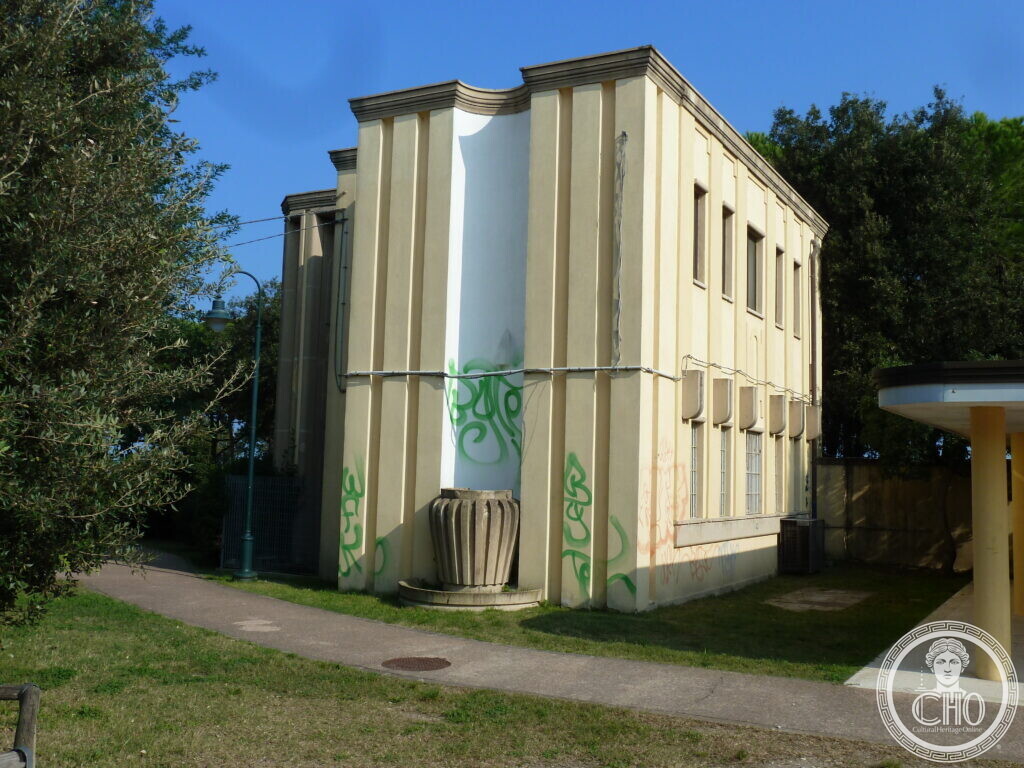
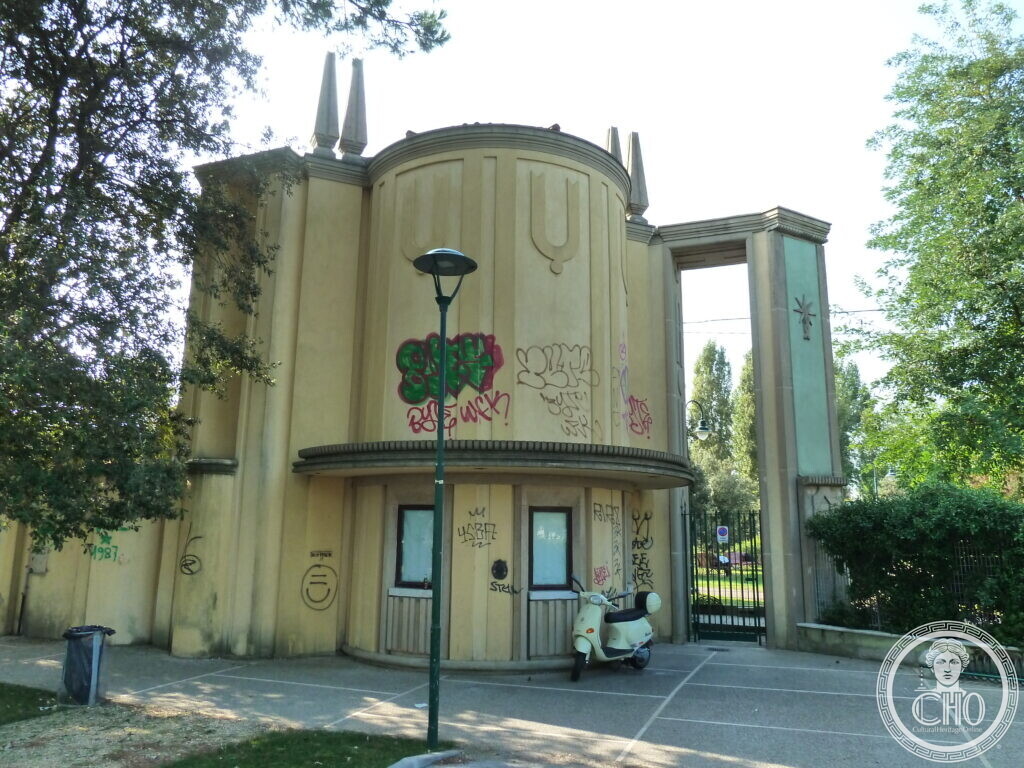
The surviving yellow pavilion has a rounded front with a fan of raised ribs radiating over a tall arched doorway, a gesture that recalls, even in outline, the “luminous cascade” Cassi Ramelli described. A plainer wing runs behind it in a stripped, pilastered idiom typical of the early 1930s, its stucco now marked by graffiti. Nearby stands a separate round pavilion with pointed finials at the roofline, beside a gated pedestrian entrance from the seafront promenade.
Getting there
The site is on the Lido’s seafront near San Nicolò, and functions today as a private members’ club.
Sources
- Lombardia Beni Culturali, official Regione Lombardia archive of Antonio Cassi Ramelli’s papers — on the Luna Park commission, its date, client, collaborator and contractors, and on Cassi Ramelli’s own 1932 articles about it.
- Wikipedia (English) and Wikidata — on Cassi Ramelli’s dates and career.
- Capitolium Art, auction-house biographical note, cross-checked against the two sources above.
- Portale ARCI (portale.arci.it) — on the Circolo Arci UISP “Pablo Neruda,” the club that occupies the site today.
- Stefano Vigolo, who photographed the building.
Gallery
Photographs by Stefano Vigolo, 2014.
Find it on the map
See this place and what’s around it →Record researched and written by Stefano Vigolo for Cultural Heritage Online, 2026.
📷 Become a Cultural Heritage Online photographer
Share your photos of places: they stay published under your name as the author. The more they're seen, the more you get noticed — and soon a contest will reward the most appreciated photos.
Log in or sign up free to add a photo