
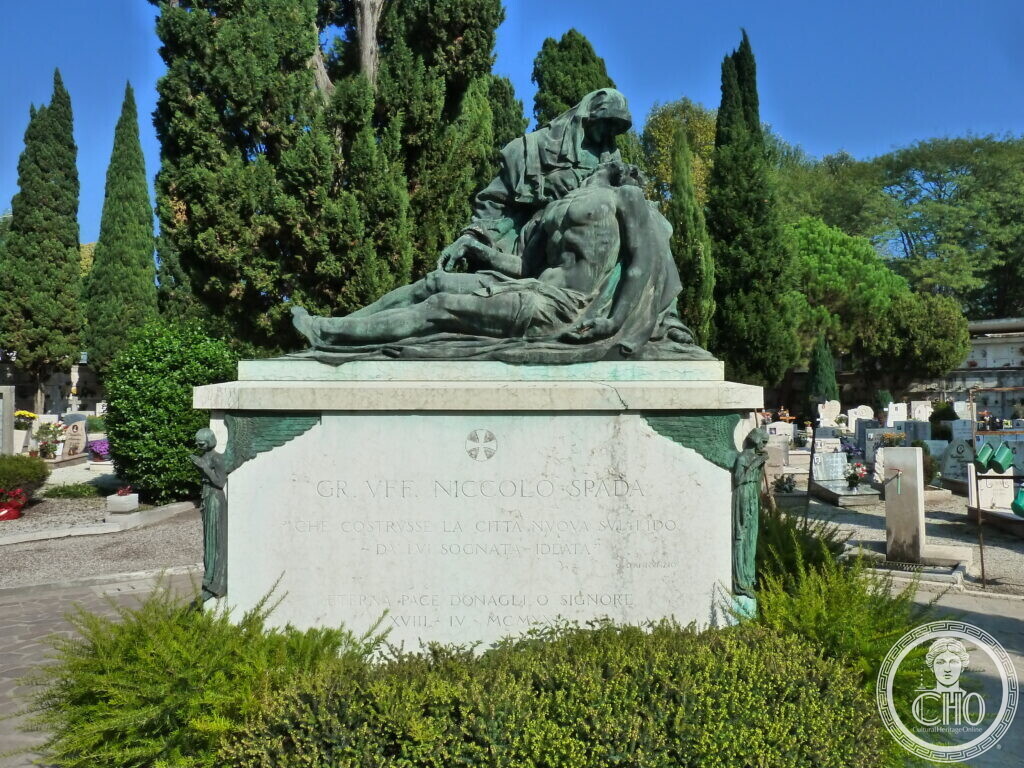
A bronze Pieta over a marble tomb at the San Nicolò cemetery, with an epitaph credited to Gabriele D’Annunzio. The man it commemorates built the Hotel Excelsior and co-founded the company that turned the Lido into a resort.
At a glance
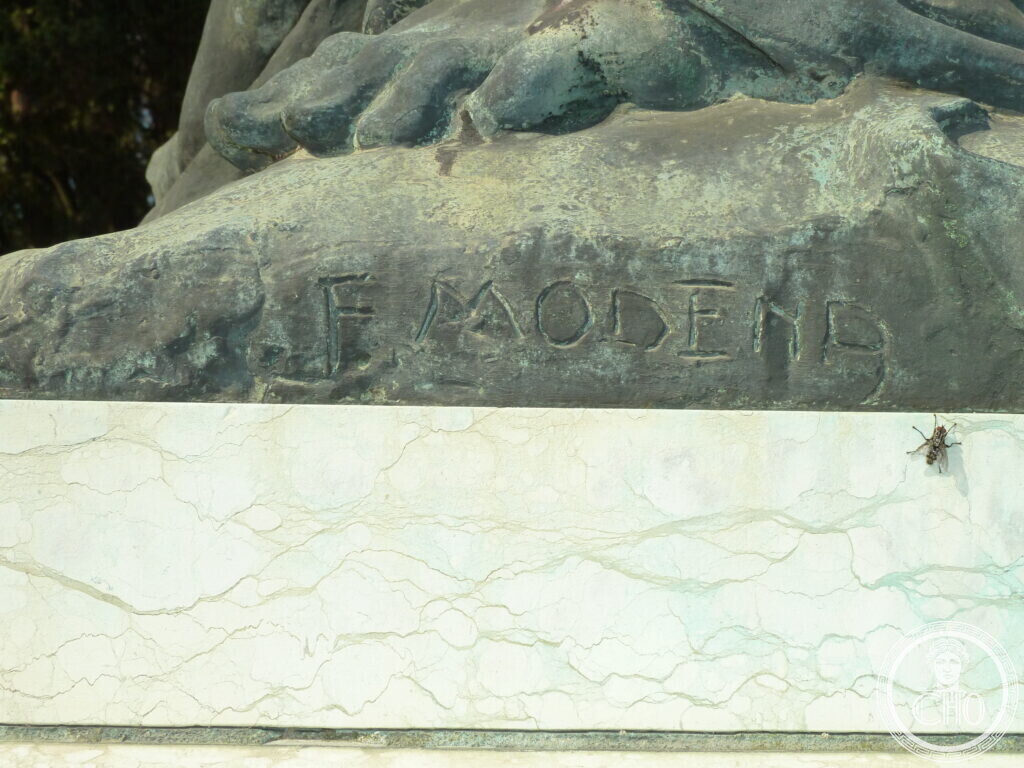
Inside the Catholic cemetery of San Nicolò, at the northern tip of the Lido di Venezia, a bronze group in the shape of a Pietà rests on a marble tomb. Below it, cut into the stone, is a name, a claim, and a date: Gr. Uff. Niccolò Spada, che costruì la città nuova sul Lido da lui sognata e ideata — “who built the new city on the Lido, dreamed and conceived by him” — a line the stone itself attributes to Gabriele D’Annunzio. Spada was a Venetian entrepreneur who died on 18 April 1929. The bronze figure carries a signature at its base, cut into the metal: F. MODENA.
Key facts
- Where: Cimitero di San Nicolò, at the northern end of the Lido di Venezia
- Who: Nicolò (Niccolò) Spada, Venetian entrepreneur, died 18 April 1929
- What he built: the Hotel Excelsior (opened 1908) and, with Massimo Guetta, the hotel company CIGA (founded 1905)
- The sculptor: signed on the bronze itself, F. Modena — Francesco Modena (Bovolone 1882 – Mestre 1960)
- The epitaph: attributed on the stone to Gabriele D’Annunzio
The man who dreamed the Lido
Before Nicolò Spada, the Lido was a strip of beach with a scatter of bathing establishments. Spada, a Venetian entrepreneur, was the driving force behind its transformation into an international resort: he built the Hotel Excelsior, designed by the architect Giovanni Sardi and opened on 21 July 1908, and in 1905 he co-founded, with Massimo Guetta, the Compagnia Italiana dei Grandi Alberghi (CIGA), the hotel group that would come to run some of Italy’s grandest hotels. In 1911, when cholera threatened Venice’s tourist season, Spada led the “Pro Venezia” campaign that organised the city’s response and its message to the foreign press. He died on 18 April 1929. In 2020 the city of Venice named a small square on the Lido, the piazzetta del buco, in his memory.
What you see
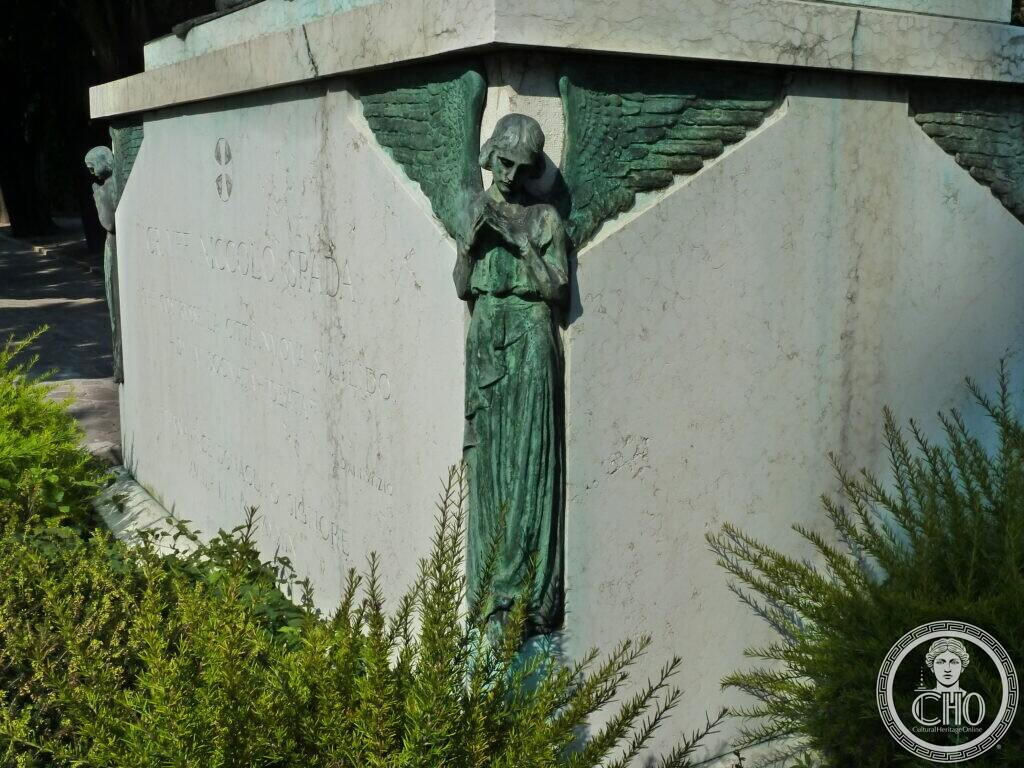
The tomb stands in the older, central part of the cemetery. A bronze group in the round — a seated, hooded figure supporting the body of a man across her lap, in the pose of a Pietà reworked in a plain, twentieth-century idiom — rests on a stepped marble base. At the base of the bronze, in the fold of drapery beneath the figures, a signature is cut into the metal: F. MODENA. At the two visible corners of the marble base stand smaller bronze angels with folded wings, heads bowed. The main inscription, below a small Maltese-cross emblem, gives Spada’s name and rank, the line attributed to D’Annunzio, the words Eterna pace donagli, o Signore, and a date in roman numerals reading XVIII · IV, the eighteenth of April.
Do you know more?
The signature on the bronze confirms Francesco Modena as the sculptor, but we have not found the year the tomb was made, or a written record of this work in the published lists of Modena’s sculpture. If you know when it was made, or anything else about it, write to Sofia, who looks after these pages.
Write to Sofiaor send a message on WhatsApp
Please start your message with the title of this page, so it reaches the right file. Every contribution is checked against independent sources before it goes on the page, and we always say where a piece of information came from.
Getting there
The Cimitero di San Nicolò is at the northern tip of the Lido di Venezia, next to the historic Jewish cemetery of Venice. It keeps normal cemetery visiting hours.
Sources
- The tomb itself — the inscription, the epitaph attributed to D’Annunzio, and the sculptor’s signature F. MODENA cut into the bronze, photographed in 2014.
- Il Ridotto and Veneto Economia, on Nicolò Spada’s role in building the Hotel Excelsior, co-founding CIGA in 1905, and leading the “Pro Venezia” campaign of 1911.
- Wikipedia, “Hotel Excelsior (Lido di Venezia)”, on the hotel’s design by Giovanni Sardi and its opening on 21 July 1908.
- Dizionario degli artisti Sartori, AGEC Verona, and the Archivio della scultura veronese — on the sculptor Francesco Modena (Bovolone 1882 – Mestre 1960), consulted to confirm his identity; none of them lists this specific tomb, which is instead confirmed by his signature on the bronze.
- Stefano Vigolo, who photographed the monument.
Gallery
Photographs by Stefano Vigolo, 2014.
Find it on the map
See this place and what’s around it →Record researched and written by Stefano Vigolo for Cultural Heritage Online, 2026.
📷 Become a Cultural Heritage Online photographer
Share your photos of places: they stay published under your name as the author. The more they're seen, the more you get noticed — and soon a contest will reward the most appreciated photos.
Log in or sign up free to add a photo