
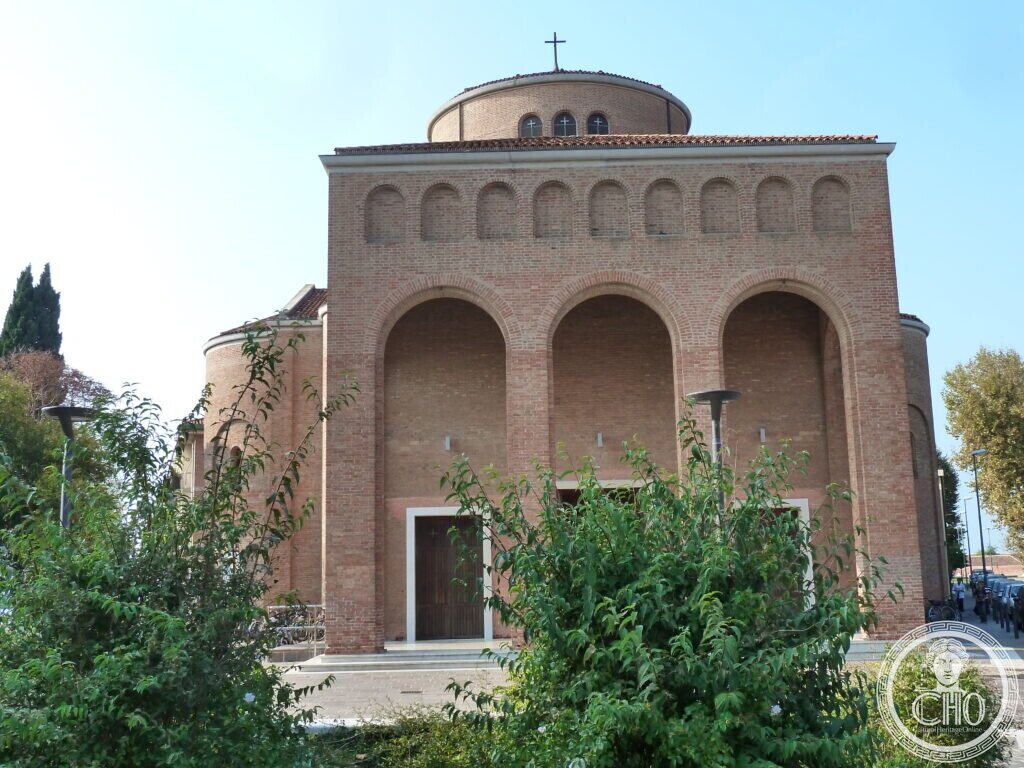
A neo-Romanesque parish church built in brick between 1933 and 1936, for a garden quarter of the Lido that had waited since 1920 with only a wooden chapel of its own.
At a glance
The Church of Sant’Antonio (di Padova) stands in the Città Giardino, a residential quarter of the Lido di Venezia laid out from 1914. It was built between June 1933 and its consecration on 7 June 1936, replacing a wooden chapel that had served the quarter since 1920, and it did not become a parish in its own right until 13 October 1948. The building is neo-Romanesque, in exposed brick, with a round apse, a drum and dome, and a three-arched narthex across the front.
Key facts
- Where: Città Giardino, Lido di Venezia
- Built: June 1933 – consecrated 7 June 1936
- Parish established: 13 October 1948
- Attributed to: the architect Virgilio Vallot and the engineer Giovanni Sicher — see the note below
- Style: neo-Romanesque, in exposed brick
- Inside: a marble statue of Saint Anthony by the Murano sculptor Napoleone Martinuzzi (1892–1977)
A church for the garden quarter
The Città Giardino is a residential quarter of the Lido built from 1914 on the garden-suburb model. For its first years, worship was held in a wooden chapel, put up around 1920 in what had been military huts; the quarter had to wait more than a decade for a permanent church. Building began in June 1933 and the new church was consecrated on 7 June 1936, but it was not made an independent parish until 13 October 1948, by decree of the Patriarch of Venice, Cardinal Adeodato Piazza; before that it belonged to the parish of Santa Maria Elisabetta. The church was reconsecrated in 1986 with a new main altar, under the parish priest Don Carlo Massari and Patriarch Marco Cé.
The architect usually credited with the design, Virgilio Vallot, is the same Vallot who later won the 1934 competition for Venice’s Santa Lucia railway station and worked on it with Angiolo Mazzoni between 1936 and 1943 — already recorded on this site in the entry on that station.
What you see
The church is built in the neo-Romanesque idiom fashionable for parish churches of the period, entirely in exposed brick. The apse is a broad drum, corbelled at the top, carrying a low dome with three round-arched clerestory windows and a small cross at the summit. Across the main front runs a narthex of three tall, deep-set round arches, echoed by a blind arcade of nine smaller arches above. Inside, one of the transept altars carries a marble statue of Saint Anthony by Napoleone Martinuzzi, the Murano sculptor known for his work in glass.
Do you know more?
Most published sources credit this church to Virgilio Vallot and Giovanni Sicher, but the official state archive inventory of Vallot’s own work lists only religious buildings of the 1950s and 60s, and does not mention this one. We have kept the attribution because it is the one repeated by the Diocese of Venice and by the historian of the quarter, but flag it here as not fully settled. If you have a firmer source, or know more about the church’s building history, write to Sofia, who looks after these pages.
Write to Sofiaor send a message on WhatsApp
Please start your message with the title of this page, so it reaches the right file. Every contribution is checked against independent sources before it goes on the page, and we always say where a piece of information came from.
Getting there
The church is in the Città Giardino quarter of the Lido di Venezia and holds regular parish services.
Sources
- Wikipedia, “Chiesa di Sant’Antonio (Venezia, Lido)”, and the Diocese of Venice’s own parish census (chiesacattolica.it) — on the building dates, consecration, and the parish’s establishment in 1948.
- SIUSA, SAN — Sistema Archivistico Nazionale, and the IUAV archive — on Virgilio Vallot’s biography and his work on the Santa Lucia railway station with Angiolo Mazzoni.
- F. Cosmai, “‘L’industria del forestiero’: Giuseppe e Giovanni Sicher e lo sviluppo del Lido,” in La città degli ingegneri, Marsilio, 2005 — on the engineer Giovanni Sicher.
- Stefano Vigolo, who photographed the church.
Find it on the map
See this place and what’s around it →Record researched and written by Stefano Vigolo for Cultural Heritage Online, 2026.
📷 Become a Cultural Heritage Online photographer
Share your photos of places: they stay published under your name as the author. The more they're seen, the more you get noticed — and soon a contest will reward the most appreciated photos.
Log in or sign up free to add a photo