
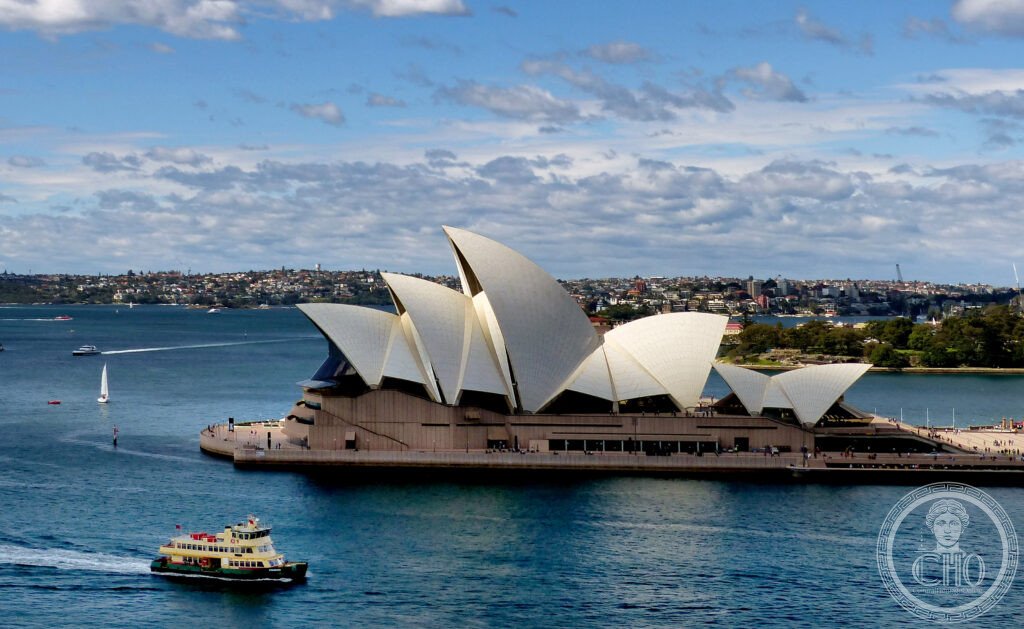
Jørn Utzon’s sail-like shells on Bennelong Point turned a competition sketch almost thrown away into the building that defines Sydney’s harbour. Solving the geometry of those curved roofs took years of engineering work with Ove Arup, and the result remains one of the most recognised silhouettes in world architecture.
At a glance
The Sydney Opera House stands on Bennelong Point, jutting into Sydney Harbour. It was one of the most contested building projects in architectural history, running years over schedule and far beyond its original budget, and its architect resigned before completion and never saw the finished building. Decades later, in 2003, Jørn Utzon received the Pritzker Architecture Prize, with the citation calling the Opera House one of the great buildings of the twentieth century.
Key facts
- Architect: Jørn Utzon, winner of the 1957 international design competition
- Opened: 20 October 1973, by Queen Elizabeth II
- Roof: covered in over one million ceramic tiles, specially developed with the Swedish manufacturer Höganäs, glazed in matt and gloss finishes that shed dirt in the rain
- Concert Hall: seats 2,679 and houses the Grand Organ, designed by Ronald Sharp and completed in 1979, the world’s largest mechanical action organ
- Opera Theatre: seats 1,507
- Status: inscribed as a UNESCO World Heritage Site in 2007
History
The international design competition of 1957 drew 233 entries from 32 countries. Utzon’s winning submission was a set of bold freehand sketches rather than technical drawings, and the shell forms it proposed posed an engineering problem so novel that Utzon and his engineer Ove Arup spent years searching for a workable structural solution. Utzon’s breakthrough came in 1961, when he realised that every shell surface could be derived from segments of the same sphere, which finally made it possible to prefabricate the concrete ribs.
Costs rose far beyond the original budget as construction dragged on, and a dedicated lottery was set up to help raise the funds needed to finish the building. In 1966 Utzon resigned after a dispute with the incoming New South Wales government over payments and control of the design, and he never saw the completed Opera House.
In 2003, by then 85 years old, Utzon agreed to provide design guidelines for future alterations, and a room inside the building, which he redesigned himself the following year, was named in his honour. The Sydney Opera House was inscribed as a UNESCO World Heritage Site in 2007.
What you see
Most visitors experience the Opera House from outside, but the interior rewards a closer look. The Concert Hall is clad entirely in brushbox and white birch plywood, with adjustable acoustic panels suspended from the ceiling to shape the sound. The Utzon Room, redesigned by the architect himself in 2004, is a quieter tribute to his return to the project late in life.
Outside, the roof’s tiles change character with the light, appearing white in full sun, cream-gold at sunset and grey-blue under cloud. The forecourt looks north across the harbour to the Sydney Harbour Bridge, giving one of the city’s defining views.
Practical information
- Address: Bennelong Point, Sydney NSW 2000
- Visiting the interior: guided tours give access to the Concert Hall and other interior spaces; self-guided and backstage tours are also offered, and booking ahead is advisable
- Attending a performance: Opera Australia, the Sydney Symphony Orchestra and the Sydney Theatre Company all perform here; ticket options range widely, and current pricing is best checked through the venue’s own booking channels
Getting there
Circular Quay station, a short walk from the Opera House, brings together train, ferry and bus services from across Sydney. Arriving by ferry, particularly from Darling Harbour, is generally considered the most scenic approach.
Nearby
- Royal Botanic Garden — immediately east of the Opera House, a harbourside garden established in 1816 and the pleasantest walking route to and from the site; Mrs Macquarie’s Chair, a sandstone seat cut into rock in 1810, gives a well-known view taking in both the Opera House and the Harbour Bridge
- Art Gallery of New South Wales — about 1 km away, roughly a 15-minute walk through the Domain, with collections of Australian impressionist painting, Aboriginal and Torres Strait Islander art and Asian art
- Bondi Beach — about 8 km east, reachable by bus from Circular Quay; a curved ocean beach with the Icebergs swimming club and the start of the Bondi to Coogee coastal walk
Sources
- Wikipedia, Sydney Opera House
- Wikipedia, Jørn Utzon
- Wikipedia, Sydney Opera House organ
- UNESCO, Sydney Opera House (World Heritage reference 166rev, inscribed 2007)
- Philip Drew, The Masterpiece: Jørn Utzon, a Secret Life, Hardie Grant, 1999
Find it on the map
See this place and what’s around it →📷 Become a Cultural Heritage Online photographer
Share your photos of places: they stay published under your name as the author. The more they're seen, the more you get noticed — and soon a contest will reward the most appreciated photos.
Log in or sign up free to add a photoIs this page about you?
This page is read by travellers and heritage enthusiasts who find it on Google. Tell us how you are connected to this place and we will take it from there.