
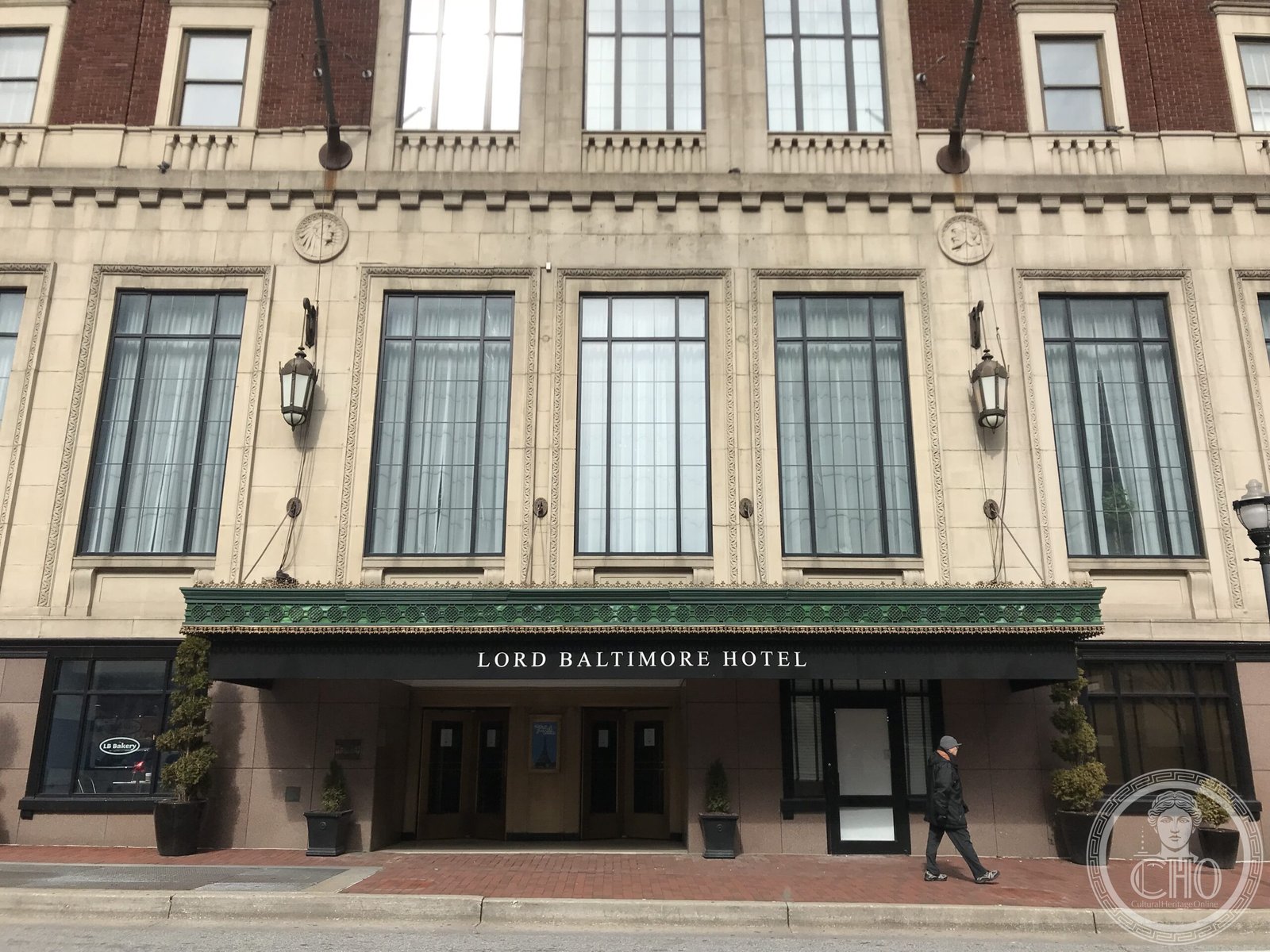
Baltimore’s grandest surviving Art Deco hotel, the 23-story Lord Baltimore at 20 W Baltimore Street opened in 1928 as the tallest building in Maryland — a tower of limestone and terra cotta whose French Gothic ornamental crown defines the downtown skyline a century after its completion.
At a glance
The Lord Baltimore Hotel opened on 23 December 1928 at 20 W Baltimore Street, in the heart of the city’s commercial district between Charles and Light Streets. At 23 stories it was the tallest building in Maryland at the time of its completion, and its French Gothic ornamental crown — gargoyles, terra cotta finials, and arched corner turrets above the twentieth floor — made it the most visually distinctive tall building in a city that had grown cautiously taller over the preceding three decades. Designed in the spirit of the great American hotel buildings of the 1920s, with public rooms of formal grandeur and guest rooms that set a new standard for Baltimore’s hospitality market, the Lord Baltimore attracted civic events, political gatherings, and distinguished guests from its opening year through the mid-twentieth century. Listed on the National Register of Historic Places, the hotel has operated continuously since 1928 and remains an active full-service hotel in downtown Baltimore.
Key facts
- Opened: December 23, 1928
- Style: Art Deco / French Gothic — limestone and terra cotta, gargoyles, arched corner turrets
- Height: 23 stories (tallest in Maryland at opening)
- Address: 20 W Baltimore Street, Baltimore, MD 21201
- GPS: 39.2904°N, 76.6122°W
- Status: National Register of Historic Places; active luxury hotel
History
Baltimore in the late 1920s was one of the largest cities in the United States, a port city of considerable industrial and commercial weight whose downtown core had been substantially rebuilt after the Great Fire of 1904. The blocks around Baltimore Street and Charles Street — the intersection that functions as Baltimore’s commercial center — had accumulated a dense collection of banks, office towers, department stores and hotels that made downtown Baltimore a genuinely urban environment by the standards of any American city. The Lord Baltimore was built to give this downtown the grand first-class hotel it lacked: a building whose scale, ornament and public rooms would attract the convention traffic, political events and distinguished guests that the city’s size and port-city status should have warranted.
The hotel’s 1928 opening coincided with the peak of the American hotel-building boom, a period in which cities across the country were commissioning tall, ornate hotels as symbols of civic ambition. At 23 stories, the Lord Baltimore established Baltimore’s first genuinely tall skyline element east of the Washington Monument column. Its French Gothic crown — with gargoyles projecting from the upper floors, terra cotta finials at the corners, and arched decorative elements above the twentieth story — gave the building a silhouette recognizable from a distance that pure Art Deco towers rarely achieved. The ground-floor public rooms, which extended through a full block of W Baltimore Street, were finished in the formal vocabulary of the 1920s grand hotel: marble columns, coffered ceilings, ornamental chandeliers, and ballrooms capable of hosting state-level events.
The hotel’s fortunes tracked those of downtown Baltimore through the mid-twentieth century: prosperous through the 1940s and 50s, challenged by suburban migration and downtown disinvestment in the 1960s and 70s, revived through the Inner Harbor renewal of the 1980s. The NRHP listing in 1984 recognized the building’s architectural significance and stabilized its preservation status. Subsequent renovations restored the lobby and public rooms while updating the guest accommodations to contemporary standards. The Lord Baltimore continues to serve as a full-service hotel and an anchor of the Baltimore Street commercial corridor.
What you see
The W Baltimore Street facade is a limestone-clad composition whose principal vertical movement is provided by a system of piers rising without interruption from the second floor to the cornice, subdividing the curtain wall into bays whose windows are grouped in pairs behind simple limestone surrounds. The ornamental program is concentrated at the top of the building: at the twentieth floor, the facade steps back slightly and the Gothic decorative vocabulary — applied terra cotta in the form of Gothic tracery panels, gargoyles projecting at the building’s corners, and arched openings linking the setback floors — begins its vertical crescendo, culminating in a crown of turrets and finials at the roof line that is most effectively read from the street below or from the cross-streets to the east and west.
Inside, the main lobby off Baltimore Street is a tall space of marble and ornamental plaster, with a coffered ceiling whose gilded panels recall the grandeur of the original design. The principal public rooms — the ballrooms, the formal dining spaces — occupy the lower floors and preserve considerable original fabric, including ornamental plasterwork, terrazzo floors and the original light fixture emplacements.
Practical information
- Access: 20 W Baltimore Street, Baltimore MD 21201; hotel lobby open to visitors; restaurant and bar open to non-guests
- Transit: Baltimore Metro Subway — Charles Center station, one block east; Light Rail — Convention Center stop, two blocks south on Howard Street; free Charm City Circulator stops on Baltimore Street
- Time needed: 20 minutes for lobby and exterior; lunch or dinner for a longer visit
Getting there
The Lord Baltimore Hotel is at the center of downtown Baltimore, one block east of the Light Rail Convention Center stop and two blocks from the Charles Center Metro Subway station. From Baltimore/Washington Thurgood Marshall Airport (BWI), take the MARC Penn Line to Baltimore Penn Station, then the Light Rail southbound to Convention Center — approximately 45 minutes total. Amtrak serves Baltimore Penn Station (2 miles north via Light Rail or taxi). By car from I-95, take I-395 north into downtown and approach via Howard Street or Pratt Street; the hotel is at the intersection of Baltimore Street and Light Street. The Inner Harbor and National Aquarium are six blocks south on Light Street. Johns Hopkins Hospital is two miles east.
Nearby
- Enoch Pratt Free Library Central Branch (1933) — the Art Deco civic library two blocks north at 400 Cathedral Street — one of the finest public library buildings in the country, free and open daily.
- Baltimore Trust Building (1929) — the Art Deco skyscraper and former B&O Railroad Building at 1 South Street, two blocks east — now an office complex with preserved ornamental lobby. See the CHO guide.
- Walters Art Museum — the encyclopedic art museum at 600 N Charles Street, three blocks north — free admission, with collections spanning ancient Egypt through the twentieth century.
- Baltimore’s Inner Harbor — the waterfront revitalization district five blocks south on Light Street, with the National Aquarium (1981), Maryland Science Center, and Harborplace pavilions.
Sources
- National Register of Historic Places nomination, Lord Baltimore Hotel
- Baltimore Sun archives — 1928 opening coverage and restoration features
- Maryland Historical Trust — historic property survey records
- Jefferson Hotel Group — Lord Baltimore Hotel current operation
- Baltimore Architecture Foundation — downtown walking tour documentation
Find it on the map
See this place and what’s around it →📷 Become a Cultural Heritage Online photographer
Share your photos of places: they stay published under your name as the author. The more they're seen, the more you get noticed — and soon a contest will reward the most appreciated photos.
Log in or sign up free to add a photoIs this page about you?
This page is read by travellers and heritage enthusiasts who find it on Google. Tell us how you are connected to this place and we will take it from there.