

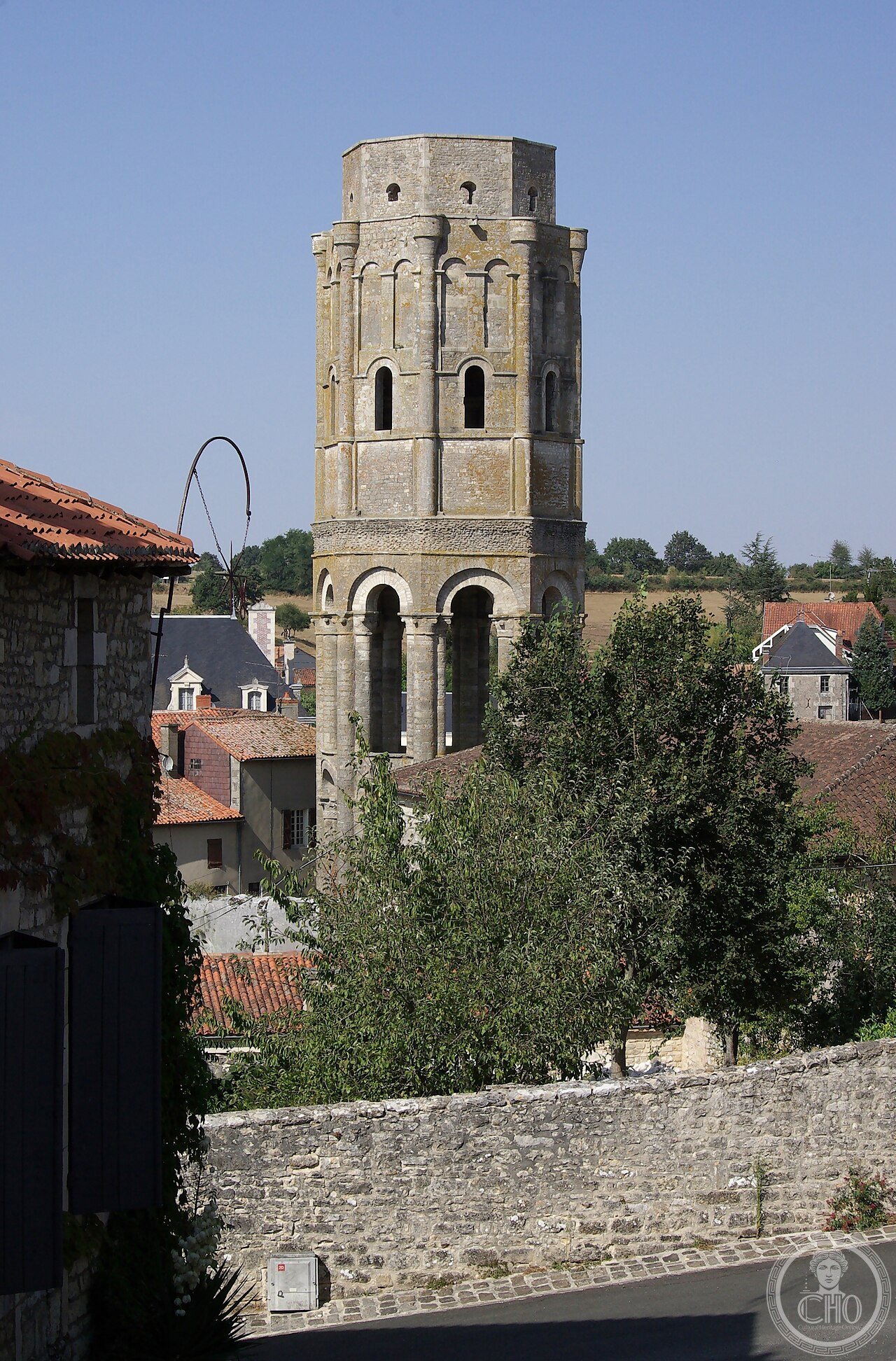
By tradition, Charlemagne gave the monks of Charroux an extraordinarily delicate relic, received during his journey to Jerusalem. Lost for centuries, it was found hidden in a wall in 1856, setting off a theological dispute with a rival shrine that had venerated it for centuries. In 1900 the Catholic Church settled the dilemma in the most drastic way: anyone who spoke or wrote about it would be excommunicated.
About Charroux Abbey
Charroux Abbey, a Benedictine monastery founded in 785 by Roger, Count of Limoges, grew to oversee as many as 213 affiliated abbeys and priories at its height. The abbey became particularly influential when it hosted the Council of Charroux in 989, where an assembly of clergy, under the patronage of William IV, Duke of Aquitaine, founded the Pax Dei (Peace of God) movement — an early and significant medieval effort to limit private warfare and protect non-combatants through ecclesiastical sanction. The abbey’s most extraordinary and controversial claimed possession was the Holy Prepuce, said to have been given to the monks by Charlemagne himself, who reportedly received it during his own journey to Jerusalem before donating it to Charroux. The relic was displayed to a church council at Charroux in 1082, but at some later point it went missing entirely, remaining lost for centuries until 1856, when a workman repairing the abbey claimed to have discovered a reliquary hidden inside a wall, containing what was said to be the same relic. This rediscovery ignited a genuine theological controversy, directly clashing with the rival Holy Prepuce of Calcata in Italy, which had already been officially venerated by the Church for centuries. In 1900, the Roman Catholic Church resolved the dispute in the most decisive way possible: it ruled that anyone thenceforth writing or speaking publicly about the Holy Prepuce would be excommunicated — a prohibition that effectively ended official discussion of the relic. Today, the only surviving structure of the church is the 11th-century lantern tower, known as the Tour Charlemagne (Charlemagne Tower), which originally formed the central rotunda of the abbey; the space was more brightly lit than the rest of the church thanks to eight tall windows, giving the “lantern tower” its name.
Key facts
- Foundation: 785, by Roger, Count of Limoges
- Scale: up to 213 affiliated abbeys and priories
- 989 Council of Charroux: founded the Pax Dei (Peace of God) movement under Duke William IV of Aquitaine
- Holy Prepuce relic: said to be a gift from Charlemagne; displayed 1082; lost and rediscovered hidden in a wall in 1856
- 1856 rediscovery controversy: clashed with the rival Holy Prepuce of Calcata, Italy
- 1900 Church ruling: excommunication threatened for anyone discussing the Holy Prepuce publicly
- Surviving structure: the 11th-century octagonal Tour Charlemagne (lantern tower)
History
The 989 Council of Charroux’s establishment of the Pax Dei movement represents a genuinely significant development in medieval European history, one of the earliest organised ecclesiastical efforts to limit the endemic warfare of the feudal period by declaring certain categories of people — clergy, peasants, merchants — and certain periods off-limits to violence, backed by the threat of excommunication for violators. This movement, originating specifically at Charroux, would spread across France and beyond in the following decades, representing one of the medieval Church’s most consequential attempts to civilise and constrain aristocratic warfare through purely spiritual sanction.
The Holy Prepuce controversy, culminating in the Church’s unusual 1900 decree banning further discussion, represents one of the more genuinely remarkable episodes in the history of medieval relic veneration reaching into the modern era — few other disputed relics generated a formal Vatican prohibition on public discussion specifically to avoid an unresolvable dispute between rival claimant institutions. The controversy’s specific theological awkwardness, involving a relic connected to Christ’s own body in an area medieval and modern sensibilities alike found genuinely difficult to discuss, made the 1900 “silence” ruling a pragmatic institutional solution to an irresolvable historical and theological problem rather than any definitive verdict on either relic’s authenticity.
What you see
The Tour Charlemagne, the sole surviving structure of the original abbey church, offers visitors direct access to an 11th-century octagonal lantern tower, its eight tall windows giving the space its distinctive light and its name. The tower’s survival amid the otherwise vanished abbey complex makes it a particularly poignant physical remnant of Charroux’s once-vast monastic network of 213 affiliated houses. The site’s documented connection to both the Pax Dei movement and the centuries-long Holy Prepuce controversy gives Charroux a genuinely unusual dual historical significance.
Practical information
- Opening hours: generally open daily during the visitor season, check current hours before visiting; admission fee
- Address: Rue de Rochemeau, 86250 Charroux, France
Getting there
Charroux is reachable by car from Poitiers (approximately 45 minutes) in the Vienne department, Nouvelle-Aquitaine. GPS: 46.1435° N, 0.4044° E.
Nearby
- Charroux village — a historic medieval town surrounding the abbey ruins
- Poitiers — approximately 45 minutes away; a major historic city with significant Romanesque churches
- Futuroscope — a major theme park near Poitiers, within reach
Sources
- Wikipedia — “Charroux Abbey” (en.wikipedia.org)
- Abbaye de Charroux — official portal, “History of Charroux Abbey” and “The lantern tower” (abbaye-charroux.fr)
- Tourisme Vienne — “Abbey of Saint Sauveur de Charroux” (tourisme-vienne.com)
Find it on the map
See this place and what’s around it →📷 Become a Cultural Heritage Online photographer
Share your photos of places: they stay published under your name as the author. The more they're seen, the more you get noticed — and soon a contest will reward the most appreciated photos.
Log in or sign up free to add a photo