
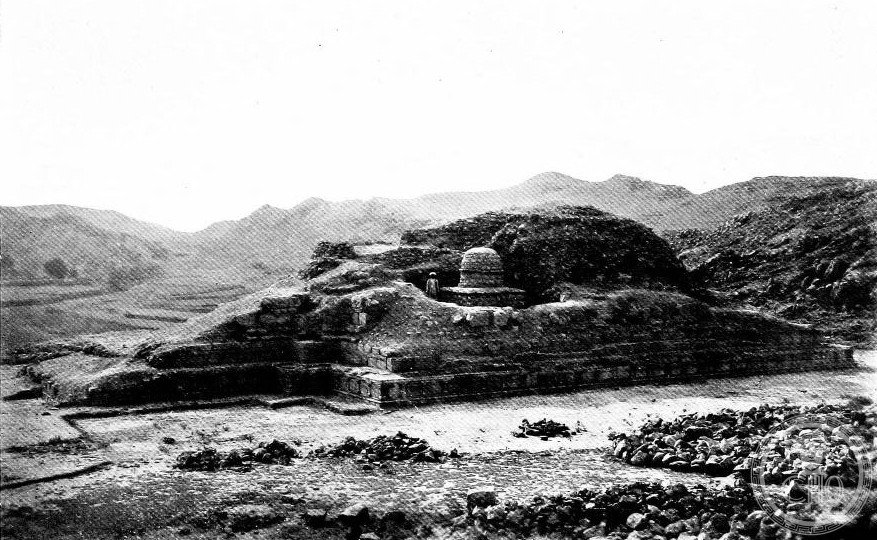
A Kushan-era Jain monastery complex built to honour Kunala, the blinded son of Emperor Ashoka, where pilgrims sought healing for eye afflictions.
At a glance
Kunala Stupa rises on a hill southeast of Taxila, overlooking the ancient Indo-Greek city of Sirkap. This distinctive religious complex combines Jain and Buddhist traditions—a reflection of the syncretism characteristic of Kushan-era Punjab. The site draws its significance from both imperial patronage and a centuries-old narrative of blindness, redemption, and healing.
History
Emperor Samprati, a Mauryan ruler, commissioned the stupa in honour of his father Kunala. The legend surrounding the site is rooted in the Mauryan court: Kunala, the legitimate heir to Emperor Ashoka’s throne, was blinded by Tishyaksha, one of Ashoka’s queens, in an act of jealous rage over his exceptional beauty. After years of exile and wandering, Kunala was reunited with his father and treated by a physician from Taxila. During Samprati’s reign, Jain monastic practice expanded dramatically across the region, bringing this monastery into prominence as a centre of religious learning. The Chinese pilgrim Xuanzang visited the stupa and recorded his observations, cementing its place in the documented history of South Asian Buddhism.
What you see
The physical remains reflect a hybrid sanctuary. Buddhist pilgrims with eye impairments arrived hoping for miraculous cures, drawn by the site’s association with Kunala’s affliction and recovery. The stupa’s architecture and layout reveal the architectural conventions of the Kushan period, when Greek, Persian, and Indian traditions converged in the Punjab region.
Cultural significance
Kunala Stupa embodies the religious pluralism of early South Asia. Named after an Mauryan prince whose tale combines palace intrigue, suffering, and redemption, the site attracted devotees from multiple faiths seeking solace and healing. Its prominence in the travel accounts of Xuanzang testifies to its renown along the networks of pilgrimage that connected China to India.
Key facts
- Location: Near Sirkap, approximately 200 metres south, Taxila, Pakistan
- Coordinates: 33.7504, 72.8305
- Period: 2nd century CE (Kushan era)
- Patron: Emperor Samprati
- Religious affiliation: Jain monastery with Buddhist pilgrimage significance
Practical information & getting there
The stupa sits on elevated terrain south of Sirkap in the Taxila valley, making it accessible as part of a broader exploration of this UNESCO World Heritage Site. The surrounding landscape preserves multiple periods of occupation and religious activity. Visitors should consult local guides familiar with the site’s topography and archaeological significance.
Sources & resources
Find it on the map
See this place and what’s around it →📷 Become a Cultural Heritage Online photographer
Share your photos of places: they stay published under your name as the author. The more they're seen, the more you get noticed — and soon a contest will reward the most appreciated photos.
Log in or sign up free to add a photoIs this page about you?
This page is read by travellers and heritage enthusiasts who find it on Google. Tell us how you are connected to this place and we will take it from there.