
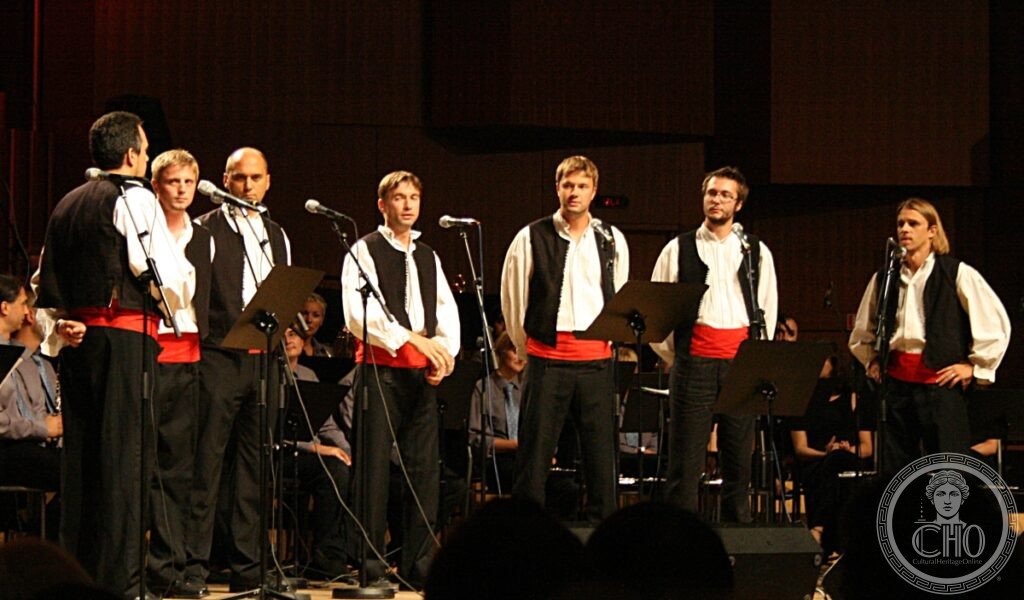
A centuries-old a cappella tradition from the Dalmatian coast, where groups of male singers create intricate harmonies celebrating love, homeland, and the sea.
In UNESCO’s words
Klapa singing is a multipart singing tradition of the southern Croatian regions of Dalmatia. Multipart singing, a capella homophonic singing, oral tradition and simple music making are its main features. The leader of each singing group is the first tenor, followed by several tenori, baritoni and basi voices. During performances, the singers stand in a tight semicircle. The first tenor starts the singing and is followed by the others. The main aim is to achieve the best possible blend of voices. Technically, klapa singers express their mood by means of open guttural, nasal sotto voce and falsetto singing, usually in high-pitched tessitura. Another feature is the ability to sing freely, without the help of notation. Topics of klapa songs usually deal with love, life situations, and the environment in which they live. Bearers and practitioners are skilled amateurs who inherit the tradition from their predecessors. Their ages vary with many younger people singing with older singers. In ‘traditional klapa’, knowledge is transferred orally. ‘Festival klapa’ is more formally organized with a focus on performance and presentation. In ‘modern klapa’, young singers gain experience by attending performances and listening to recordings. Local communities see klapa singing as a central marker of their musical identity, incorporating respect for diversity, creativity and communication.
Official description, UNESCO Intangible Cultural Heritage List — Klapa multipart singing of Dalmatia, southern Croatia
At a glance
Klapa is a multipart singing tradition from southern Croatian regions, performed entirely without instruments. Singers use their voices to create homophonic harmonies, relying on oral tradition and simple music making. The singers work together to achieve the best possible blend of voices, using open guttural, nasal sotto voce, and falsetto techniques in high-pitched registers. They sing freely, without notation.
Origins & history
Klapa traces its roots to liturgical singing in littoral churches, where the vocal techniques and harmonic sensibilities of sacred music gradually merged with secular themes. Over centuries, the practice evolved from religious contexts into a living social tradition, becoming inseparable from Dalmatian coastal life and identity.
The practice
A klapa group is led by a first tenor, who starts the singing and is followed by several other tenors, baritones, and bass singers. During performances, the singers stand in a tight semicircle. Knowledge is transferred orally in traditional klapa, while festival klapa is more formally organized with focus on presentation. Younger people often sing alongside older singers. Modern klapa singers gain experience by attending performances and listening to recordings. Songs typically address love, life situations, and the local environment.
Cultural significance
Local communities regard klapa singing as a central marker of their musical identity. The tradition incorporates respect for diversity, creativity, and communication. Bearers and practitioners are skilled amateurs who inherit and maintain the tradition from their predecessors. Klapa singing connects generations through a living cultural practice.
Key facts
- Country: Croatia
- Inscribed: 2012
- UNESCO list: Representative List of the Intangible Cultural Heritage of Humanity
- UNESCO reference: 00746
- UNESCO vocabulary: Men; Polyphonic singing; Vocal music
- Map: Dalmatia — the locality named in UNESCO’s official description of this element
- Related World Heritage site: Historical Complex of Split with the Palace of Diocletian (a different UNESCO designation, not the place of the tradition)
Where to experience it
Klapa singing thrives throughout the southern Croatian region of Dalmatia, where local communities maintain it as a central marker of their musical identity. Visitors encounter the tradition at festivals, community celebrations, and informal social gatherings where skilled amateur singers—ranging from older practitioners to younger learners—perform together. The singers stand in their distinctive tight semicircle, their voices blending in a cappella harmony as they sing freely about love, life situations, and their environment. Many towns across Dalmatia host klapa festivals and competitions, offering opportunities to witness both traditional and modern interpretations of this multipart singing heritage.
Sources & resources
- UNESCO — official element page: Klapa multipart singing of Dalmatia, southern Croatia
- UNESCO — open data record: Intangible Heritage List, reference 00746
- UNESCO — official video: UNESCO film on this element — embedded on this page
- UNESCO — official photograph: Photograph of this element — Zdenka Krunić — Ministry of Culture of Croatia, 2011
- Reference — Wikipedia (secondary): Klapa — consulted as a secondary reference, not as confirmation
- Cultural Heritage Online: Our archive and city guides

Find it on the map
See this place and what’s around it →📷 Become a Cultural Heritage Online photographer
Share your photos of places: they stay published under your name as the author. The more they're seen, the more you get noticed — and soon a contest will reward the most appreciated photos.
Log in or sign up free to add a photo