
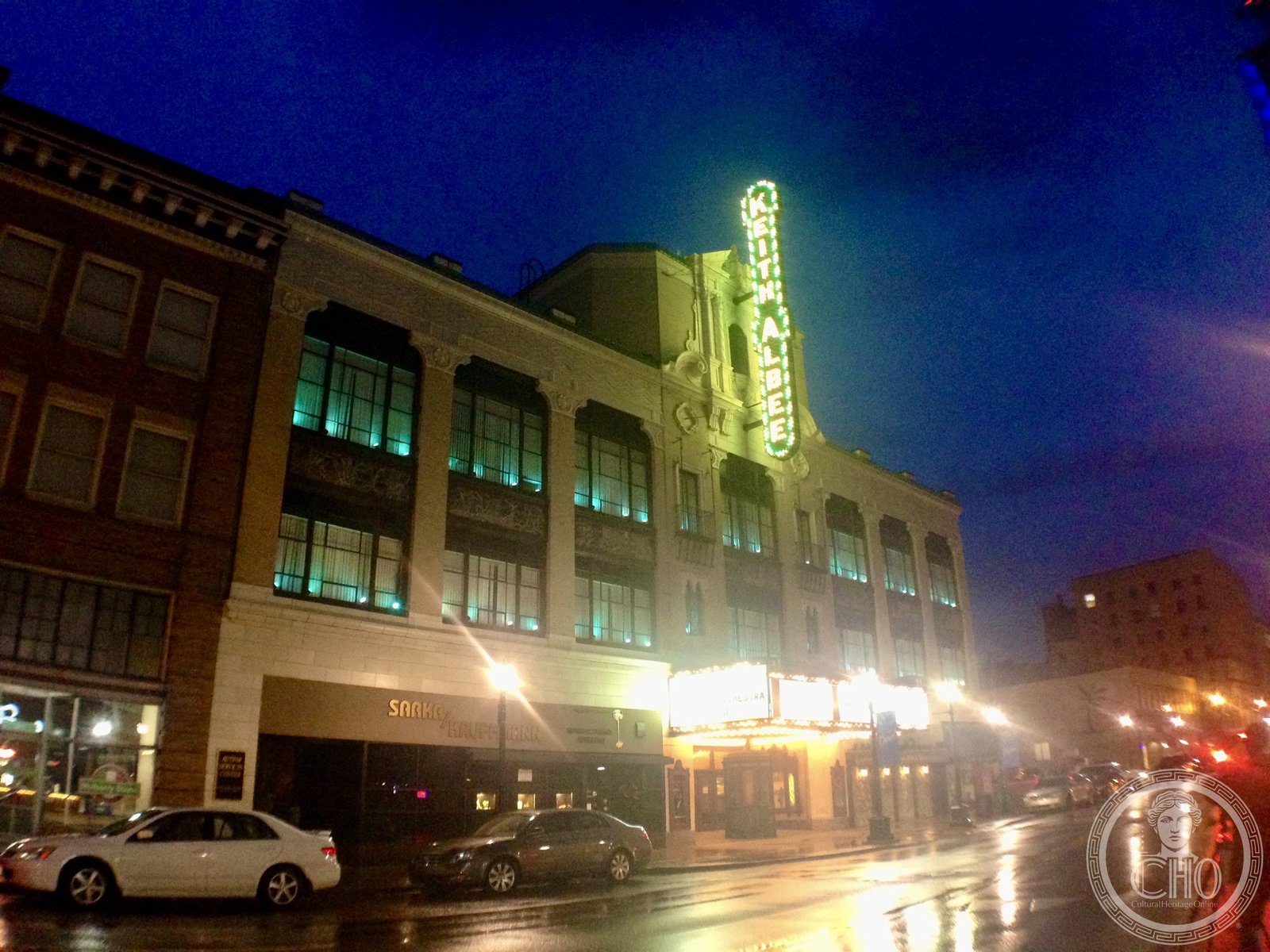
On the banks of the Ohio River in West Virginia’s largest city, the Keith-Albee Performing Arts Center has anchored downtown Huntington since 1928 — an Art Deco palace built for vaudeville and cinema that has outlasted both, serving today as the city’s primary cultural stage.
At a glance
The Keith-Albee Performing Arts Center at 321 4th Avenue is one of the finest surviving movie palaces in the Appalachian South and the anchor of Huntington’s historic downtown. Opened in 1928 as part of the Keith-Albee vaudeville and cinema circuit — the national entertainment network built by impresarios Benjamin Franklin Keith and Edward Franklin Albee — it brought first-class theatrical production values to a West Virginia city defined by its railroads, steel, and Ohio River trade. The building’s elaborate Art Deco interior, grand lobby, and large auditorium were designed to impress: to assure audiences that attending a Keith-Albee performance was an event worth dressing for. Preserved through community effort and restoration, it continues to serve Huntington and the surrounding region as a performing arts center and the city’s most important architectural landmark.
Key facts
- Address: 321 4th Avenue, Huntington, WV 25701
- Completed: 1928
- Named for: B.F. Keith and E.F. Albee, founders of the Keith-Albee vaudeville circuit
- Style: Art Deco movie palace
- Current use: Active performing arts center; concerts, film, community events
- Designation: National Register of Historic Places
History
Huntington in 1928 was West Virginia’s most dynamic city. Founded in 1871 as the western terminus of the Chesapeake and Ohio Railway by railroad magnate Collis P. Huntington (whose name it bears), it had grown rapidly through the coal, steel, and lumber trades to become the state’s largest city and a major Ohio River port. Its downtown commercial district along 4th Avenue was one of the most active retail corridors in the state.
Into this prosperous environment, the Keith-Albee organization brought its touring circuit. The Keith-Albee company had built a national network of theaters in the 1910s and 1920s offering a combination of vaudeville acts and silent films, and later sound cinema. The Huntington Keith-Albee was designed to the standards the circuit had established at its flagship houses: a large auditorium of over 2,000 seats, an ornate lobby and interior with Art Deco detailing, and an exterior that announced to 4th Avenue that something important was inside.
The circuit transitioned from vaudeville to cinema as talkies arrived in the late 1920s; the Keith-Albee name itself was absorbed into the Radio-Keith-Orpheum (RKO) film circuit. The Huntington theater carried successive names and owners through the twentieth century, declining with downtown Huntington as suburban development drew residents and commerce away from the city center. A community preservation effort secured the building’s future, and extensive restoration has returned it to use as a performing arts center for the tristate region of West Virginia, Kentucky, and Ohio.
What you see
The 4th Avenue facade presents the Keith-Albee’s public face: a detailed composition with an elaborate marquee, vertical sign element, and ornate terracotta and tile decoration in the Art Deco vocabulary of the late 1920s. The entrance canopy and lobby vestibule invite audiences in through a sequence of increasingly ornate spaces — the standard Keith-Albee progression from street to auditorium designed to shift the visitor’s attention from the everyday world to the theatrical event ahead.
The auditorium interior showcases the lavish standards the Keith-Albee organization applied to its major houses: an ornate proscenium arch with sculptural detailing, tiered balconies with decorative fronts, and plasterwork that covers the walls and ceiling in a continuous pattern of Art Deco ornament. The scale is impressive — the theater was designed to hold large vaudeville audiences — and the restoration has preserved the period character while meeting contemporary technical requirements.
Practical information
- Events: Check the Keith-Albee Performing Arts Center schedule for concerts, touring productions, and special events
- Tours: Building tours may be available; contact the theater directly
- 4th Avenue district: The surrounding blocks of 4th Avenue include historic commercial buildings; the area is undergoing revitalization as part of Huntington’s downtown investment program
Getting there
Huntington is in the western panhandle of West Virginia, on the Ohio River at the convergence of West Virginia, Kentucky, and Ohio. Tri-State Airport (HTS) provides regional air service. The city is accessible from Charleston, WV (50 miles east on Interstate 64) and from the Columbus, Ohio area (150 miles north). Marshall University, one of the state’s main universities, is five blocks from the Keith-Albee on 5th Avenue.
Nearby
- Marshall University — the public university whose campus begins five blocks from the Keith-Albee on 5th Avenue; the Marshall Memorial Fountain commemorates the 1970 plane crash that killed the football team and support staff, one of the most devastating sports tragedies in American history
- Huntington Museum of Art — the largest art museum in West Virginia, with collections spanning glass, American painting, and Appalachian craft traditions; four miles east of downtown
- Ohio River waterfront — Huntington’s Ritter Park and riverfront offer views across the Ohio into Kentucky; the river has been central to the city’s history since its founding as a railway terminus in 1871
- Camden Park — one of the oldest continuously operating amusement parks in the United States, dating to 1903; a local institution on the western edge of Huntington
Sources
- National Register of Historic Places, Keith-Albee Theatre nomination
- West Virginia Division of Culture and History records
- Keith-Albee Performing Arts Center, institutional history
- Marshall University Library Special Collections — Huntington history
- Tri-State Theater Foundation documentation
Find it on the map
See this place and what’s around it →Record researched and written by Luigi De Marchi for Cultural Heritage Online, 2026.
📷 Become a Cultural Heritage Online photographer
Share your photos of places: they stay published under your name as the author. The more they're seen, the more you get noticed — and soon a contest will reward the most appreciated photos.
Log in or sign up free to add a photoIs this page about you?
This page is read by travellers and heritage enthusiasts who find it on Google. Tell us how you are connected to this place and we will take it from there.