

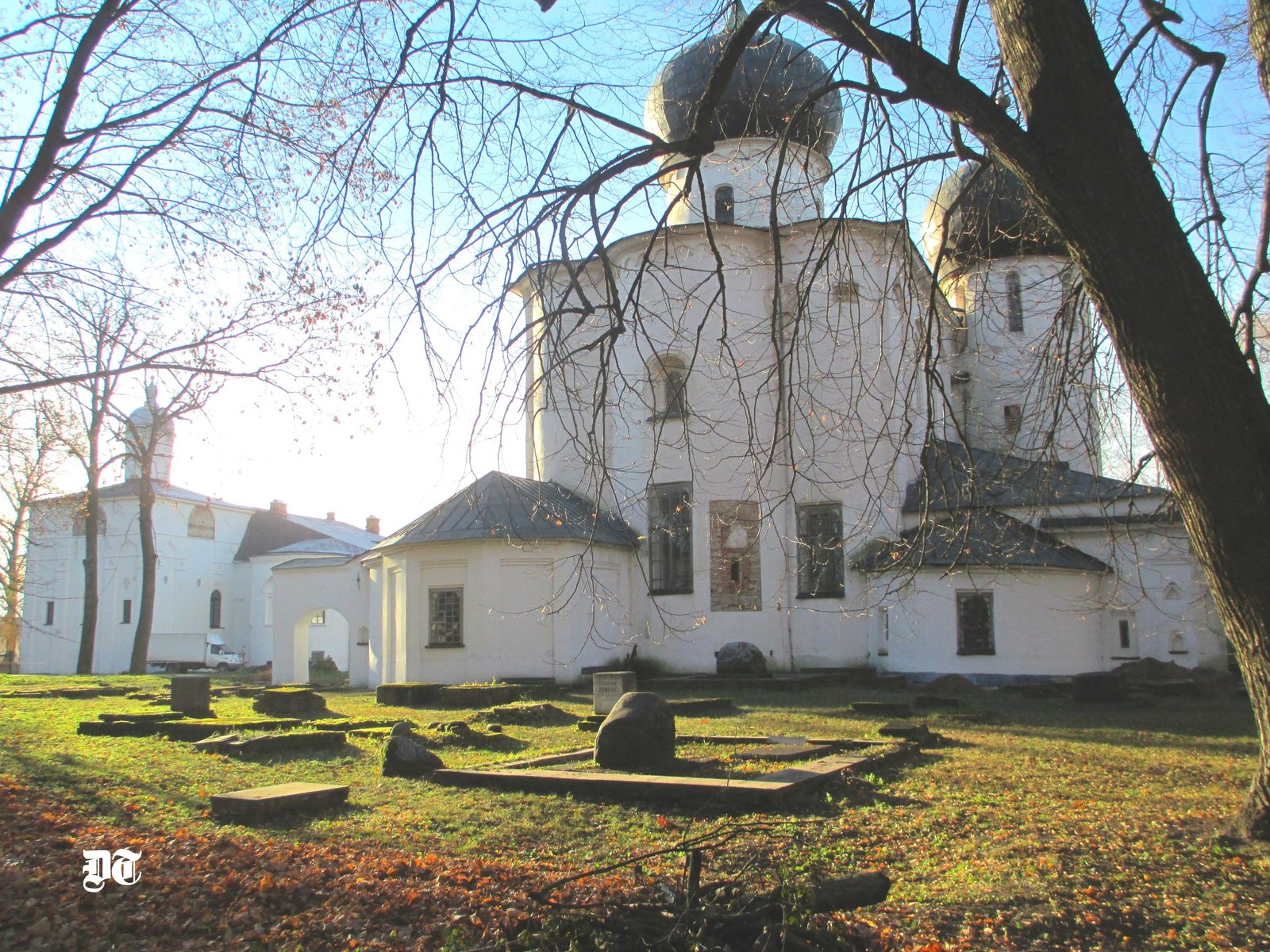
Completed in 1122, the Church of the Nativity of the Theotokos is one of Russia’s rare surviving brick churches from the early 1100s, its plain walls holding frescoes painted just three years after construction ended.
At a glance
This is the katholikon, or main church, of the Monastery of St. Antony, founded in 1106. Building began in 1117. It stands out among Novgorodian churches of its era for being raised in brick from the start, rather than built first in wood. Three domes crown the structure, a feature usually reserved for princely foundations, yet a private patron paid for it.
History
Construction unfolded in two distinct campaigns. Between 1117 and 1119 builders raised a square nave with three apses and the main dome. Light poured through many windows. The plan then changed. Why remains unclear. From 1119 to 1122 a narthex with choir lofts was added on the west side, and the old western wall was dismantled, its corners reworked into new columns. A round stair tower rose at the north-west corner, topped by its own dome, giving access to the choir loft above. A third dome was set at the south-east corner to balance the composition and add light. Later centuries brought more change: a porch in the 16th century, a narthex honouring St. Antony in 1671, another for John the Apostle in 1681, and a full-length narthex in 1699. These additions forced an odd fix. The old building’s floor had sunk under its own weight, so masons raised it by a full metre to match the new wings. Windows were later widened and the eaves straightened, altering the church’s original silhouette.
What you see
Inside, the space feels compact but unified. Columns near the walls fuse the lateral aisles with the space beneath the dome. The western pair is octahedral; the eastern pair, square. This contrast was deliberate. The stair tower still leads to the choir loft, its dome one of three visible from outside. Frescoes from 1125 survive in fragments, most vividly on the eastern columns, where a tall iconostasis once shielded them from later renovation. The Annunciation appears at the top of these columns, Gabriel and the Virgin painted on separate supports so the scene seems to inhabit the church itself. Below, the Holy Unmercenaries hold vessels and scrolls, linking bodily and spiritual healing. In the apses, scenes from the Virgin’s infancy and John the Baptist’s martyrdom remain partly legible, alongside a rare pairing of Moses and Aaron near the altar.
Cultural significance
Few brick buildings from this period survive anywhere in Russia. The frescoes matter as much as the architecture. Systematic study began in 1919 and continued through the 1990s, gradually revealing paintings hidden under 19th-century redecoration applied after 1837, when most ancient frescoes were removed for decrepitude. The 1125 layer, once uncovered, showed iconographic choices rare in Byzantium but common in early Russian churches, including the placement of monastic saints close to the altar. Scholars link the painting program’s specific themes to the monastery’s founder, suggesting a patron closely involved in shaping the church’s meaning.
Key facts
- Dedication: Nativity of the Theotokos
- Construction: 1117–1122, in two building phases
- Frescoes: painted 1125; renovated 17th century; largely replaced 1837
- Location: Monastery of St. Antony, Veliky Novgorod, Russia
- Heritage status: listed cultural heritage site
Practical information & getting there
The church stands within the Antoniev Monastery grounds in Veliky Novgorod, part of the Novgorod Museum-Reserve complex. You can reach Veliky Novgorod by train or bus from St. Petersburg or Moscow, then continue locally to the monastery. Check the museum’s official site before visiting, since access to the historic interior and fresco fragments may be limited or scheduled around conservation work.
Sources & resources
Find it on the map
See this place and what’s around it →📷 Become a Cultural Heritage Online photographer
Share your photos of places: they stay published under your name as the author. The more they're seen, the more you get noticed — and soon a contest will reward the most appreciated photos.
Log in or sign up free to add a photoIs this page about you?
This page is read by travellers and heritage enthusiasts who find it on Google. Tell us how you are connected to this place and we will take it from there.