
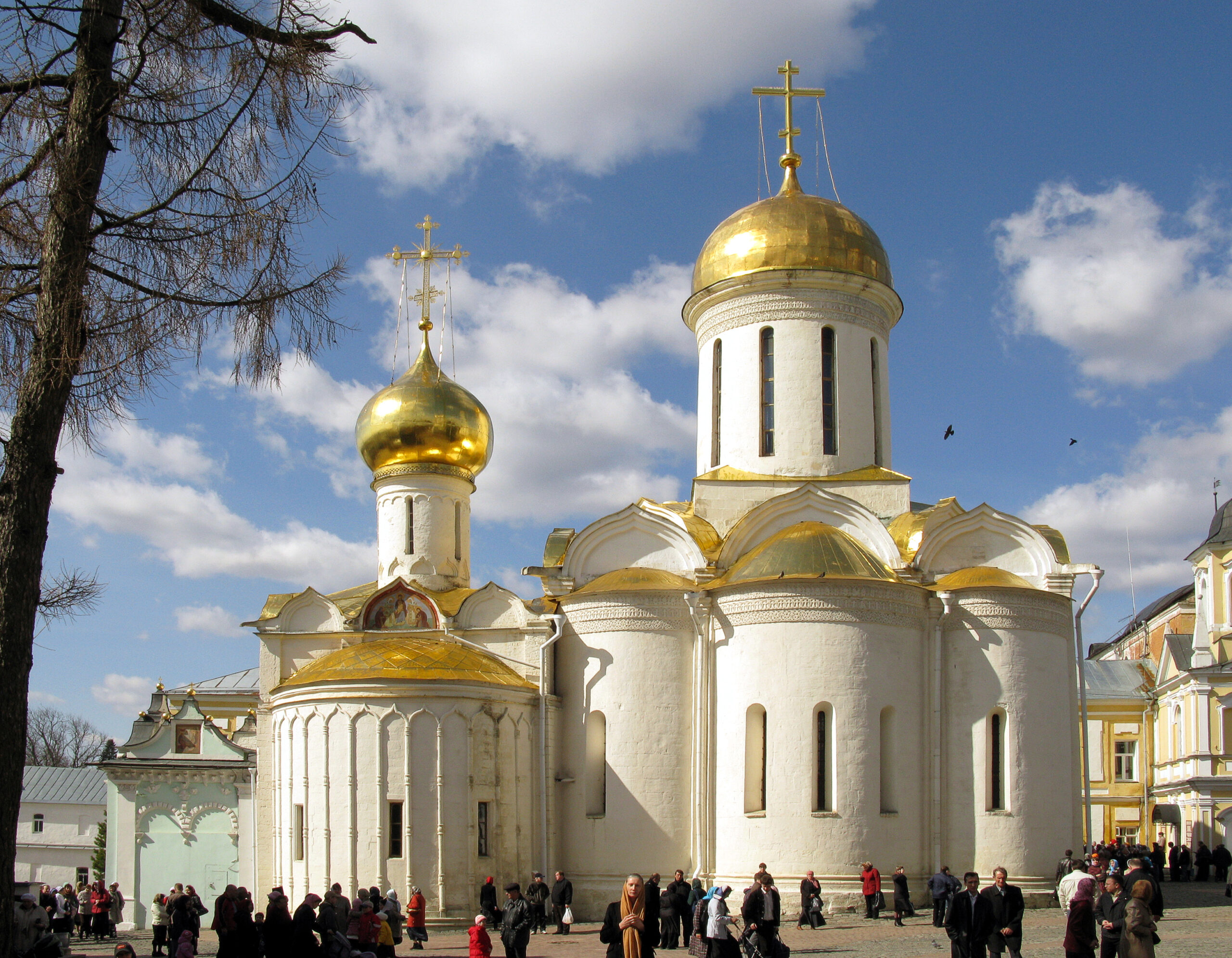
White stone and quiet gravity define the oldest surviving building of the Trinity Lavra, raised to honour the monastery’s founder and still holding some of the greatest icons of medieval Russia.
At a glance
Built in 1422–1423 by Nikon of Radonezh, the cathedral predates every other structure on the Lavra grounds. It stands near Moscow, in Sergiyev Posad, as the ceremonial and spiritual core of the monastery complex. Heritage protection recognises its status today.
History
Nikon built the cathedral to “honour and praise” Sergius of Radonezh, the monk whose relics it enshrines. Sergius founded the Lavra; the cathedral’s construction effectively marks the start of the monastery’s written history. Between 1425 and 1427, Andrei Rublev and Daniel Chorny covered its walls with paintings. That original decoration is lost. What survives today dates from 1635, when painters reproduced the earlier iconographic scheme rather than inventing a new one.
What you see
The cathedral is built entirely of white stone, a material choice that set the tone for early Muscovite church architecture. Its scale is modest. The interior, though, holds weight beyond its size: a five-tier iconostasis rises across the sanctuary, most of its icons painted in the first third of the 15th century by Rublev and his workshop. Among them sits Rublev’s own icon of The Trinity, along with a copy commissioned later by Boris Godunov.
Cultural significance
Few buildings in Russia carry this density of association. The cathedral is the main object of veneration within the Lavra, drawing pilgrims to Sergius’s relics for centuries. Its role in early Muscovite architecture is frequently cited by historians. The survival of Rublev’s Trinity icon, even as the surrounding wall paintings vanished and were later redone, has made the cathedral a touchstone for the study of Russian icon painting.
Key facts
- Location: Sergiyev Posad, Russia, within the Trinity Lavra of St. Sergius
- Built: 1422–1423, by Nikon of Radonezh
- Material: white stone
- Iconostasis: five tiers, icons largely by Andrei Rublev and colleagues, first third of the 15th century
- Original wall paintings by Rublev and Daniel Chorny (1425–1427) are lost; present paintings date to 1635
- Heritage-listed status confirmed
Practical information & getting there
The cathedral sits inside the Trinity Lavra complex in Sergiyev Posad, a short trip from Moscow. You reach the monastery grounds on foot once inside the walls; the cathedral is one of several churches sharing the site, so expect to walk between buildings. Check the Lavra’s official website before visiting for current access and service times, since the cathedral remains an active place of worship.
Sources & resources
Find it on the map
See this place and what’s around it →📷 Become a Cultural Heritage Online photographer
Share your photos of places: they stay published under your name as the author. The more they're seen, the more you get noticed — and soon a contest will reward the most appreciated photos.
Log in or sign up free to add a photoIs this page about you?
This page is read by travellers and heritage enthusiasts who find it on Google. Tell us how you are connected to this place and we will take it from there.