
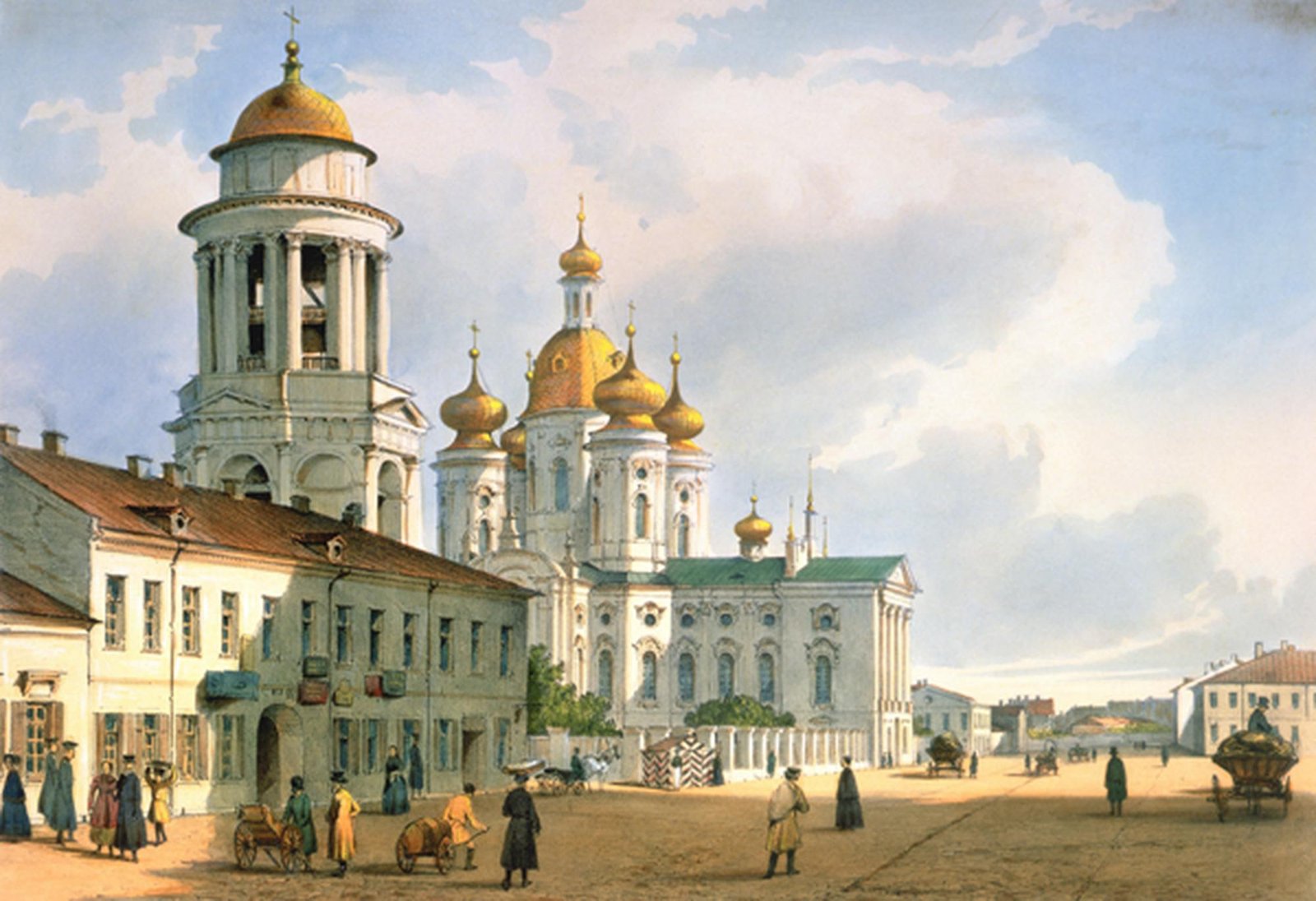
A five-domed parish church turned cathedral, standing beside Vladimirsky Market where Baroque massing meets an emerging Neoclassical calm.
At a glance
Built between 1761 and 1769, the church is often attributed to Pietro Antonio Trezzini, though the design sits at the seam of two architectural languages. It gave its name to the avenue outside. Today it functions as a working cathedral, easily reached from two metro lines.
History
Construction began in 1761 next to the bustling Vladimirsky Market. By 1769 the main structure was complete. Quarenghi added the detached belfry in 1791, a mature Neoclassical addition that contrasts with the earlier Baroque body. Further elements followed. A portico, chapel, fence, and outbuildings arrived over the 19th century, gradually enclosing the site. In 1808 an elaborate Baroque iconostasis was moved here from the Anichkov Palace chapel, adding imperial provenance to the interior. The church closed in 1932, a casualty of Soviet religious policy. It was returned to the Russian Orthodox Church only in 1989. In 2000 it was elevated to cathedral status.
What you see
Five domes crown the main volume, a familiar silhouette against the surrounding streets. The building rises over two stories. Its lower church is dedicated to Saint John Damascene, a quieter counterpart to the grander upper space. Wikidata records the fabric as Baroque, though the article notes the design straddles Baroque and Neoclassicism, a tension visible in the detailing. Quarenghi’s freestanding belfry, finished in 1791, reads as pure Neoclassicism, restrained where the church body is more animated. Inside, the transferred Baroque iconostasis brings a note of aristocratic ornament borrowed directly from palace life.
Cultural significance
The cathedral lends its name to Vladimirsky Avenue and Vladimirskaya Square, embedding it in the city’s everyday geography. Its most celebrated parishioner was Fyodor Dostoevsky, who lived and worked nearby. The 1888 restoration, timed to the 900th anniversary of Russia’s Christianisation, underscored its national symbolic weight. Closure in 1932 and reopening in 1989 mark it as a witness to Russia’s shifting religious history across the Soviet century and beyond.
Key facts
- Location: 20 Vladimirsky Prospect, St. Petersburg, Russia
- Built: 1761–1769; belfry added 1791
- Architect: Pietro Antonio Trezzini (attributed); belfry by Giacomo Quarenghi
- Style: Baroque, transitional toward Neoclassicism
- Status: Heritage-listed cathedral, active since 1989; cathedral rank since 2000
Practical information & getting there
You can reach the cathedral via the Vladimirskaya station on Metro Line 1 or Dostoyevskaya on Line 4, both a short walk from the entrance. The surrounding market square remains lively, much as it was when the church was first built beside it.
Sources & resources
Find it on the map
See this place and what’s around it →📷 Become a Cultural Heritage Online photographer
Share your photos of places: they stay published under your name as the author. The more they're seen, the more you get noticed — and soon a contest will reward the most appreciated photos.
Log in or sign up free to add a photoIs this page about you?
This page is read by travellers and heritage enthusiasts who find it on Google. Tell us how you are connected to this place and we will take it from there.