
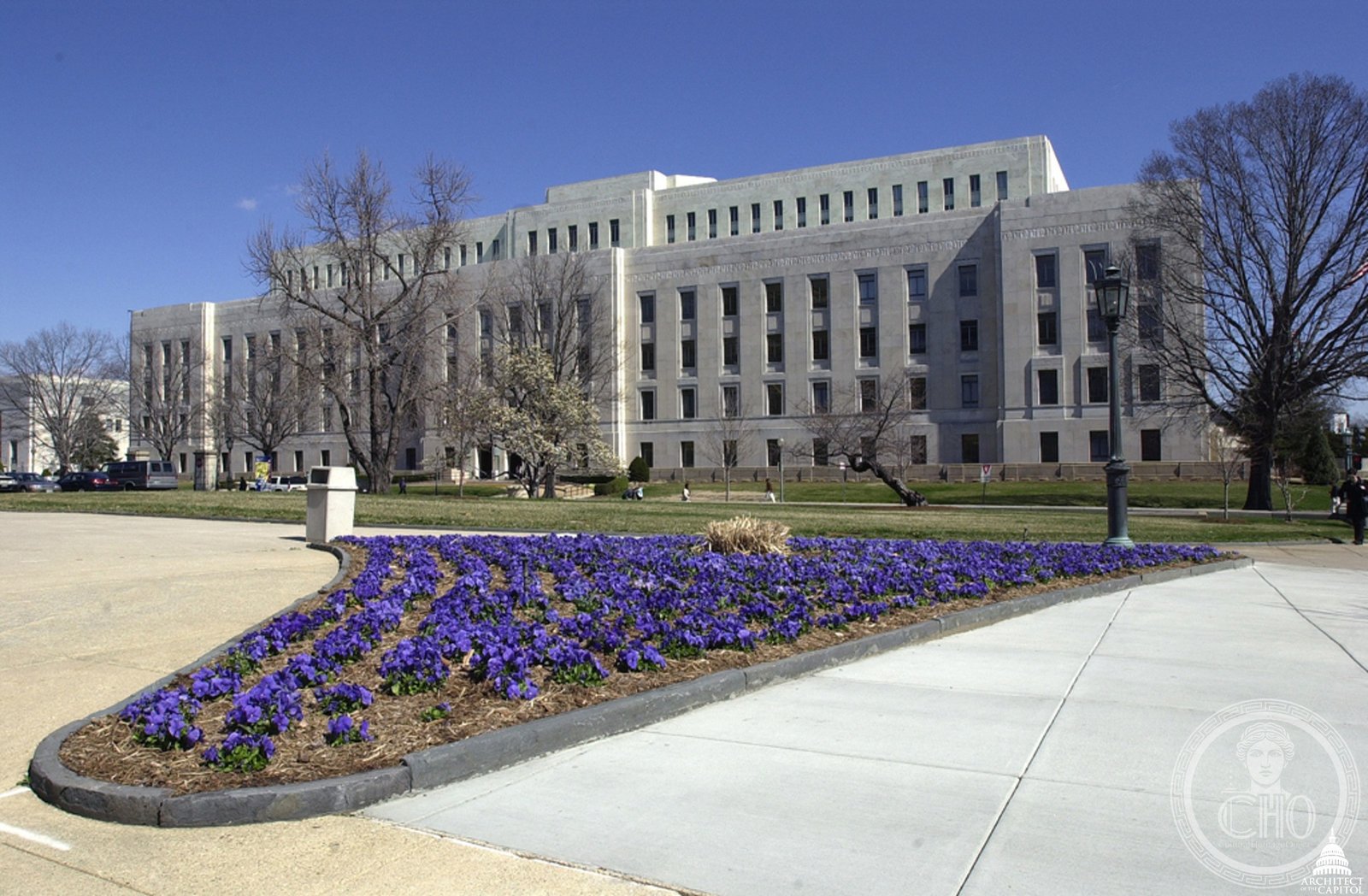
The second building of the Library of Congress, opened in 1939 in a restrained Art Deco style — its white marble facade and aluminium owl reliefs marking a deliberate shift from the Beaux-Arts ornament of the original Jefferson Building next door.
At a glance
The John Adams Building stands on Second Street SE in Washington’s Capitol Hill district, directly behind the Library of Congress Thomas Jefferson Building. Designed by architectural firm Pierson & Wilson and supervised by Alexander B. Trowbridge, it opened to researchers on April 5, 1939. For four decades it was called simply “The Annex” before Congress renamed it in honor of John Adams in 1980 — Adams had signed the original 1800 legislation establishing the Library of Congress. Today it houses the Library’s copyright records office, several reading rooms, and a substantial portion of the stacks, and is connected underground to both the Jefferson Building and the James Madison Memorial Building.
Key facts
- Address: Second Street SE (at Independence Avenue), Capitol Hill, Washington, DC 20540
- Architect: Pierson & Wilson; Alexander B. Trowbridge (supervising architect)
- Style: Art Deco / Stripped Classical
- Opened: April 5, 1939
- Named for John Adams: 1980 (previously “The Annex”)
- Material: White Georgia marble, fluted aluminium columns
History
By the 1920s, the Library of Congress Jefferson Building — opened in 1897 after a decade of construction — was already dangerously overcrowded. Congress authorized a second building in 1930, but the Depression delayed the start of construction until 1935. The commission went to Pierson & Wilson, a Washington firm that produced a design consciously different in tone from the Italian Renaissance exuberance of the Jefferson Building: stripped, geometric, and monumental, but without the carved stone foliage and bronze lanterns of its neighbor.
The building was known as “The Annex” from its opening in 1939 through 1980, when an act of Congress renamed it in honor of John Adams, the second president, who had signed the legislation creating the Library of Congress in 1800. John Adams had a particular interest in books and amassed one of the largest private libraries in early America. After the British burned the Capitol and Library of Congress in August 1814, it was Thomas Jefferson who sold his personal library of approximately 6,500 volumes to Congress in 1815 to restock the collection — a connection that gives both presidents enduring ties to the institution.
A third Library of Congress building — the James Madison Memorial Building, the largest federal office building in Washington — opened in 1980 on Independence Avenue. The three buildings are linked underground and function as a single institution housing the world’s largest library collection.
What you see
The Adams Building’s exterior is faced in gleaming white Georgia marble set in large, smooth blocks with minimal joint reveal — the opposite of the rusticated stone used in most earlier Washington federal buildings. The main entrance on Second Street is flanked by fluted aluminium columns, and aluminium owl reliefs appear above the windows, symbolizing wisdom and scholarship. The detailing is precisely Art Deco in vocabulary: geometric, symmetrical, and machined-looking, with no classical entablature or pediment, yet unmistakably civic in scale.
Inside, the reading rooms are finished in terrazzo and aluminium with the same geometric restraint. The Main Reading Room of the adjacent Jefferson Building gets most of the attention from tourists; the Adams Building’s spaces are quieter and more workmanlike, designed for researchers who come to consult specific collections rather than to admire a cathedral of books. The underground connection between the three buildings passes beneath Independence Avenue and is open to credentialed researchers.
Practical information
- Free admission: The Library of Congress buildings are open to the public free of charge
- Hours (Adams Building): Monday–Saturday 8:30 am–4:30 pm; closed Sunday and federal holidays
- Researchers: A free reader identification card is required to access most reading rooms; obtain one at the Jefferson Building
- Exhibits: Rotating exhibits in the Adams Building lobbies are open to all visitors without registration
- Photography: Permitted in public areas for personal use
Getting there
The closest Metro station is Capitol South on the Blue, Orange, and Silver lines, a five-minute walk north on Second Street SE. The Eastern Market station (also Blue/Orange/Silver) is another option if coming from southeast Washington. The Adams Building is between the Jefferson Building (facing First Street SE) and the Madison Building (facing Independence Avenue SE), and is signed from both. Capitol Hill is well served by Citi Bike, and the Capitol Visitor Center is a short walk across East Capitol Street.
Nearby
- Thomas Jefferson Building, Library of Congress — the ornate 1897 Beaux-Arts main building is immediately adjacent on First Street SE
- United States Supreme Court — the Cass Gilbert building (1935) is across Second Street NE
- United States Capitol — the dome is visible one block west along East Capitol Street
- Folger Shakespeare Library — the Art Deco research library (1932) is two blocks east on East Capitol Street
Sources
- Library of Congress, About the Buildings, loc.gov/visit
- Wikipedia, “John Adams Building”
- Historic American Buildings Survey (HABS), Library of Congress
- United States Capitol Historical Society, Capitol Hill architectural survey
Find it on the map
See this place and what’s around it →Record researched and written by Luigi De Marchi for Cultural Heritage Online, 2026.
📷 Become a Cultural Heritage Online photographer
Share your photos of places: they stay published under your name as the author. The more they're seen, the more you get noticed — and soon a contest will reward the most appreciated photos.
Log in or sign up free to add a photoIs this page about you?
This page is read by travellers and heritage enthusiasts who find it on Google. Tell us how you are connected to this place and we will take it from there.