
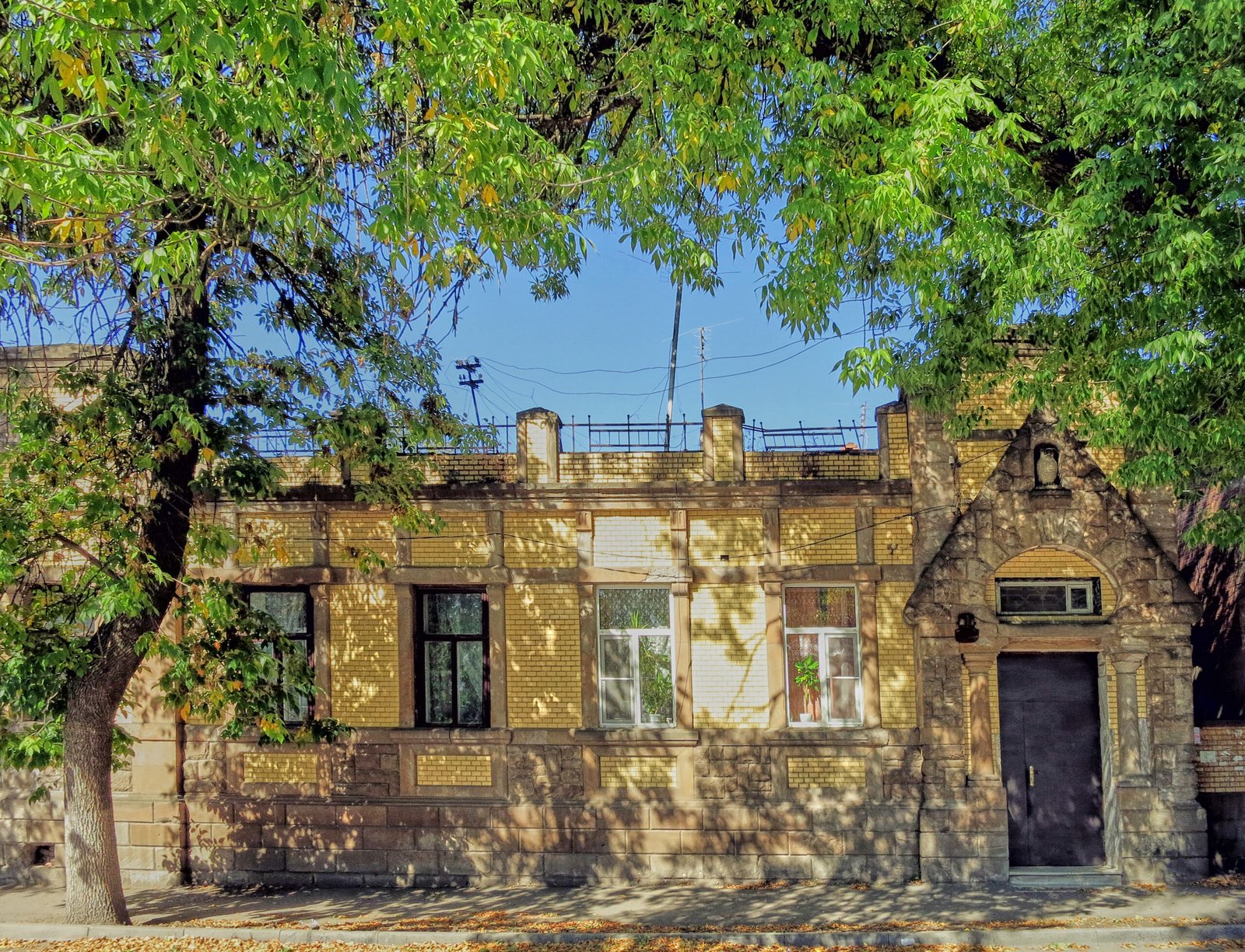
At the junction of Sovetskaya and Dubovskogo streets, a small marble owl watches over an apartment house that closes the view down Atamanskaya street.
At a glance
Built in 1910, this Art Nouveau apartment house takes its popular name from a carved marble owl set above its entrance. It stands as a heritage-listed building in Novocherkassk, a town in Rostov Oblast known for its Cossack history. The structure was first the property of G. G. Krivtsov, head of a mutual loan company, before passing to M. M. Grishin, a professor at South Russian State Polytechnic University.
History
The house rose in 1910 as a private residential commission. Its first owner, Krivtsov, ran a mutual loan company in the town. Ownership later shifted to Grishin, who taught at the local polytechnic institute and lived until 1979. The building also entered fiction: it appears in G. A. Semenikhin’s novel Novocherkassk, though placed at a different address than its real one.
What you see
Art critic V.I. Kulishov described the style as “Finnish modern.” He pointed to the facade’s mix of contrasting textures, a hallmark of northern European design. Wild stone borders the entrance portal and lower plinth. Glazed tiles, glossy and olive-toned, cover much of the wall above. That pairing of rough gray stone against smooth ceramic recalls medieval building traditions. Above the entrance, in the groove of a pointed gable, sits the marble owl that gives the house its name. In folk symbolism, the owl stands for family well-being and happiness. The building’s position at the street junction lets it terminate the sightline along Atamanskaya street, giving it added visual weight in the townscape.
Cultural significance
The house is a modest but telling example of Art Nouveau’s reach into provincial Russian towns. Its texture play and symbolic ornament mark it as a considered architectural statement rather than a purely functional apartment block. Its appearance, reshuffled, in Semenikhin’s novel shows how the building had already become a recognizable local landmark by the time it entered literature.
Key facts
- Location: junction of Sovetskaya and Dubovskogo streets, Novocherkassk, Rostov Oblast, Russia
- Built: 1910
- Style: Art Nouveau, described locally as “Finnish modern”
- Early owners: G. G. Krivtsov; later M. M. Grishin (1891–1979)
- Heritage status: listed
- Notable feature: marble owl sculpture above the entrance gable
Practical information & getting there
The house sits in central Novocherkassk, at the corner formed by Sovetskaya and Dubovskogo streets. It functions as a residential building, so you should view it respectfully from the street. Walking the surrounding blocks lets you take in how the facade anchors the view along Atamanskaya street.
Sources & resources
Find it on the map
See this place and what’s around it →📷 Become a Cultural Heritage Online photographer
Share your photos of places: they stay published under your name as the author. The more they're seen, the more you get noticed — and soon a contest will reward the most appreciated photos.
Log in or sign up free to add a photoIs this page about you?
This page is read by travellers and heritage enthusiasts who find it on Google. Tell us how you are connected to this place and we will take it from there.