
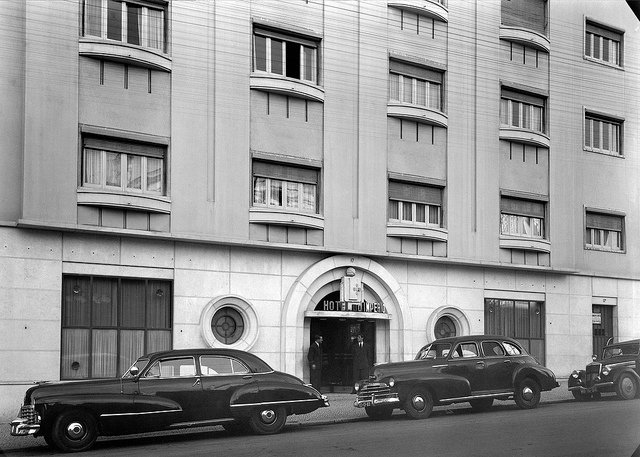

Lisbon’s Art Deco hotels mostly didn’t survive the twentieth century intact. This one did, cork floors, chrome fittings and all.
At a glance
Cassiano Branco, the architect who gave Lisbon some of its boldest modernist buildings, designed this five-storey hotel on Rua Rodrigues Sampaio, just off Avenida da Liberdade. It opened on 13 October 1944 as the Hotel do Império, an experiment in apartment-style hospitality unprecedented in Portugal: each unit had its own anteroom, sitting room, bedroom and bathroom. Renamed Hotel Britania in the mid-1970s, it is now considered the only hotel from Lisbon’s Art Deco period to have survived largely unaltered, its 1944 cork mosaic floors restored on the building’s sixtieth anniversary in 2004.
Key facts
- Address: Rua Rodrigues Sampaio 17, Lisbon
- Opened: 13 October 1944, as Hotel do Império; renamed Hotel Britania in the mid-1970s
- Architect: Cassiano Branco (1897-1970), Portuguese modernist
- Structure: five floors, reinforced concrete with double walls and a terrace roof
- Heritage status: classified Imóvel de Relevante Valor Arquitectónico (1995) and Relevante Interesse Histórico-Cultural (1998); awarded Lisbon’s Prémio Municipal Eugénio dos Santos (1999)
- Rooms: 33 (32 rooms and one suite)
- Recognition: named one of Europe’s four best Art Deco hotels by The Guardian (2010) and among the world’s most striking Art Deco hotels by The Telegraph (2019)
History
Cassiano Branco built his reputation in the 1930s on Lisbon buildings that broke sharply with the city’s older architectural habits, and the Hotel do Império was one of his most complete statements: a reinforced-concrete structure with double walls and a terrace roof, wrapped in the rounded windows and stepped massing of international Art Deco. Its apartment-style rooms, each with its own anteroom and bathroom, offered a kind of privacy and self-containment no Lisbon hotel had tried before.
The hotel changed its name to Britania in the mid-1970s and continued operating through the following decades without the kind of demolition or heavy remodelling that erased most of the city’s other Art Deco hotels. Lisbon’s tourism authority classified it as an Imóvel de Relevante Valor Arquitectónico in March 1995 and gave it Relevante Interesse Histórico-Cultural status in 1998, formal recognition of what had by then become a rarity.
In 2004, on its sixtieth anniversary, the hotel restored the original cork mosaic flooring laid in 1944 by Fábrica Mundet, one of Portugal’s leading cork manufacturers. International recognition followed: The Guardian named it one of Europe’s four best Art Deco hotels in 2010, and The Telegraph included it among the world’s most striking Art Deco hotels in 2019.
What you see
The street facade still carries Branco’s signature: round stone-framed windows, a curved arched entrance, and the disciplined horizontal massing typical of late Art Deco in Portugal. Inside, the public rooms keep their original cork flooring, brass fittings and period lighting, alongside marble-clad bathrooms that were part of the hotel’s founding pitch of private, self-contained comfort.
A vintage barber shop survives on the ground floor, one of the small period details that separates Britania from hotels that restored their Art Deco look rather than simply kept it.
Practical information
- Rooms: 33 total, 32 rooms plus one suite
- On site: hotel bar, library of Portuguese cultural books, original 1940s barber shop
- Time needed: the lobby and public rooms can be appreciated in a short visit; the cork floors and fittings reward a longer look
Getting there
The hotel sits just off Avenida da Liberdade, Lisbon’s main boulevard, within walking distance of the Rosío and Marquês de Pombal metro stations. Lisbon Humberto Delgado Airport is about 20 minutes away by taxi or metro.
Nearby
- Avenida da Liberdade, Lisbon’s tree-lined boulevard of early-20th-century architecture
- Rosío Square and the Baixa Pombalina, Lisbon’s rebuilt 18th-century downtown
- Eleútero Cerdeira House and other Art Deco and Art Nouveau buildings scattered through the surrounding streets
Sources
Find it on the map
See this place and what’s around it →📷 Become a Cultural Heritage Online photographer
Share your photos of places: they stay published under your name as the author. The more they're seen, the more you get noticed — and soon a contest will reward the most appreciated photos.
Log in or sign up free to add a photoIs this page about you?
This page is read by travellers and heritage enthusiasts who find it on Google. Tell us how you are connected to this place and we will take it from there.