
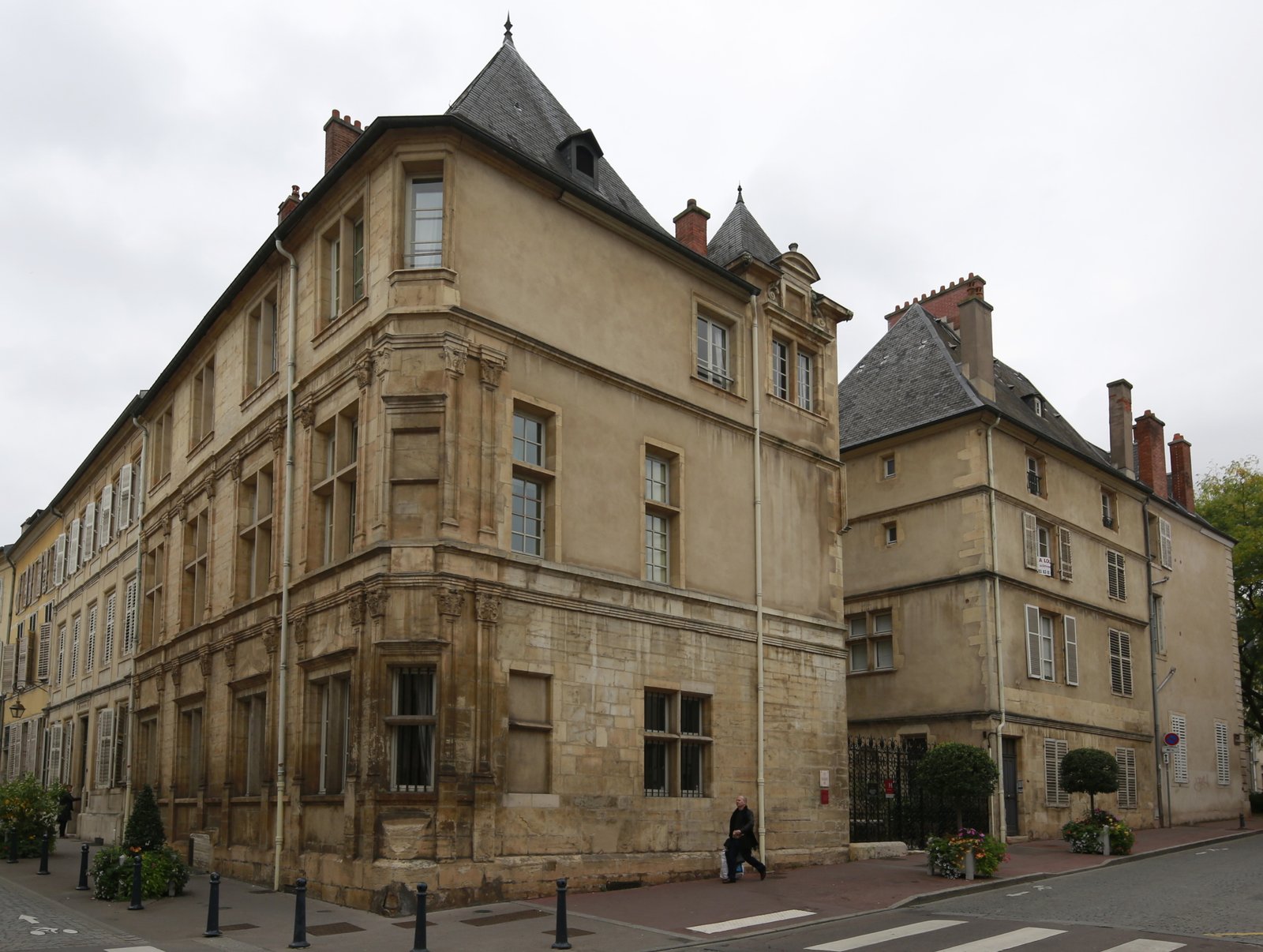

A Lorraine seneschal built himself a Renaissance courtyard five centuries ago, in a city that would later reinvent itself as the capital of French Art Nouveau. Both eras still meet at the same address.
At a glance
Jean d’Haussonville, seneschal of Lorraine, built this mansion between 1528 and 1543 at the corner of what are now rue Monseigneur-Trouillet and rue Saint-Michel, in Nancy’s old town. Its sober street facades give no hint of what lies behind them: an open courtyard framed by two galleries, one still Gothic in feel, the other decisively Renaissance, centred on a Neptune fountain. The Haussonville family sold the house in the eighteenth century and bought it back in the nineteenth; it stayed in family hands until 1924. Since 2003 it has operated as a small four-star hotel, its historic rooms protected as a Monument Historique.
Key facts
- Address: 9 Rue Monseigneur-Trouillet, 54000 Nancy
- Built: 1528-1543, for Jean d’Haussonville, sénéchal (seneschal) of Lorraine
- Style: Renaissance hôtel particulier, with a Gothic-inspired gallery alongside a Renaissance one around the courtyard
- Monument Historique status: facades, roofs and courtyards classified by decree of 6 December 1984; ground- and first-floor rooms with 18th-century decor listed in the same decree
- Later ownership: sold by the Haussonville family in the 18th century; repurchased 1849-1851 by Joseph d’Haussonville; left the family after 1924
- Hotel since: 2003, opened by Laurence and Jean-Claude Capelli after restoration; fewer than 10 rooms and suites
History
Nancy’s old town holds a handful of Renaissance mansions built by the officers of the Dukes of Lorraine, and the Hôtel d’Haussonville is counted among the finest, alongside the Palais Ducal and the Hôtel de Lillebonne. Jean d’Haussonville raised it between 1528 and 1543 as his own residence, choosing a plan that turned its back on the street: plain facades on rue Saint-Michel conceal a courtyard whose two open galleries mix a lingering Gothic vocabulary with the new Renaissance one arriving from Italy and the Loire.
The house passed out of Haussonville hands in the eighteenth century, then back into them when Joseph d’Haussonville bought it again between 1849 and 1851. His son Paul-Gabriel held it until his death in 1924, after which the heirs sold the property on. It changed hands and uses through the twentieth century before Laurence and Jean-Claude Capelli restored it and opened it as a four-star hotel in 2003, working within the constraints of a building whose facades, roofs, courtyards and several period rooms had been under state protection since 1984.
The building’s five centuries sit inside a city that later became something else entirely: from the 1890s, Nancy’s glassmakers, cabinetmakers and architects built the École de Nancy, the movement that gave French Art Nouveau its second capital after Paris. The Haussonville courtyard predates that movement by three and a half centuries, a reminder that Nancy’s reputation for design didn’t start with Gallé and Majorelle.
What you see
The street gives almost nothing away: sober, load-bearing facades typical of a Lorraine town house built for defence as much as display. The courtyard behind them is the opposite, an open Renaissance stage with two galleries facing each other across a Neptune fountain, one still carrying Gothic tracery, the other fully classical in its columns and arches — a building caught mid-transition between two architectural languages.
A square tower holds a stone spiral staircase that still carries guests to their rooms, one of the few functional medieval elements the 2003 restoration kept in daily use rather than behind glass.
Practical information
- Rooms: fewer than 10 rooms and suites, four-star classification
- Mobility: no lift, as required by the Monument Historique protection — the stone staircase serves all floors
- Distance to Place Stanislas: about 4 minutes on foot
- Time needed: the courtyard can be seen briefly by respectful visitors; a stay lets you see the galleries at different hours of light
Getting there
The hôtel sits in Nancy’s Ville-Vieille, a short walk from Place Stanislas, the UNESCO-listed 18th-century square at the city’s centre. Nancy-Ville train station is about 15 minutes on foot or a short taxi ride; Metz-Nancy-Lorraine Airport is roughly 45 minutes away by car.
Nearby
- Place Stanislas, Place de la Carr&iegrave;re and Place d’Alliance, the UNESCO World Heritage ensemble at the city’s heart
- Palais Ducal and the Hôtel de Lillebonne, Nancy’s other great Renaissance mansions
- Musée de l’École de Nancy, dedicated to the city’s Art Nouveau movement
Sources
Find it on the map
See this place and what’s around it →📷 Become a Cultural Heritage Online photographer
Share your photos of places: they stay published under your name as the author. The more they're seen, the more you get noticed — and soon a contest will reward the most appreciated photos.
Log in or sign up free to add a photoIs this page about you?
This page is read by travellers and heritage enthusiasts who find it on Google. Tell us how you are connected to this place and we will take it from there.