
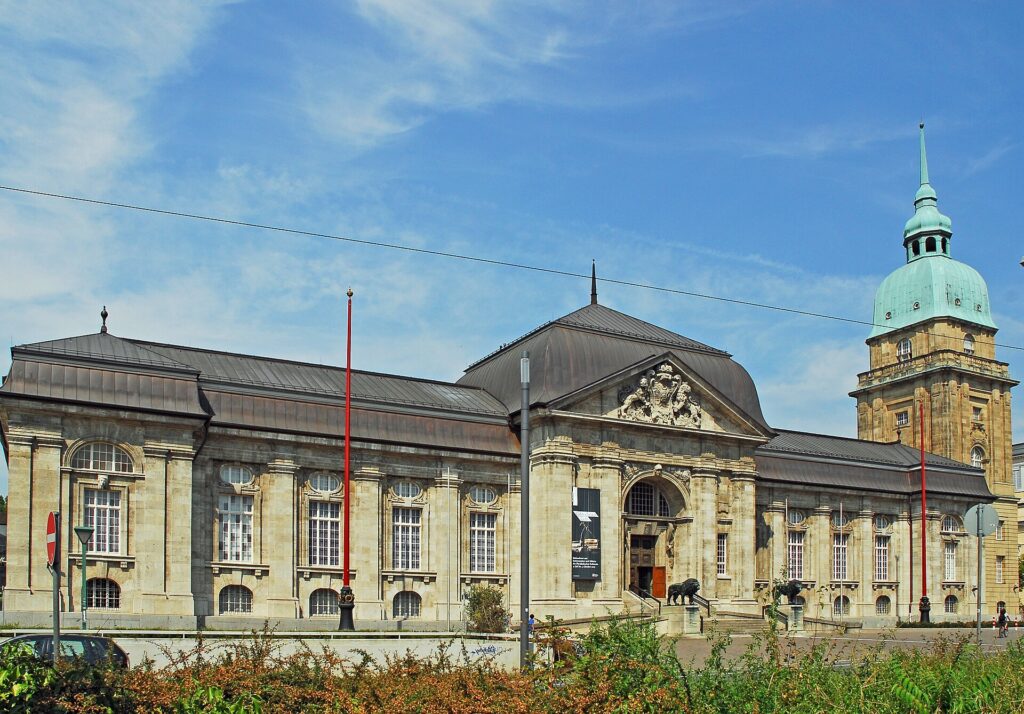

The state museum of Hesse, one of the oldest public museums in Germany, has lived since 1906 in a building that the Darmstadt-born architect Alfred Messel designed room by room for the objects it was to hold. Burned in 1944, rebuilt in its historic forms and restored again between 2007 and 2014, it is listed as a cultural monument of the State of Hesse.
At a glance
The Hessisches Landesmuseum Darmstadt (HLMD) is a universal museum: art from antiquity to the twentieth century, applied arts and Jugendstil, arms, archaeology, zoology, and the fossils of the Messel Pit, a UNESCO World Heritage site near the city. The collections go back to the landgraves of Hesse-Darmstadt and were made public in 1820. The building that houses them was raised between 1897 and 1902 to plans by Alfred Messel on the north side of the Friedensplatz, opposite the Residenzschloss, and opened on 27 November 1906. The Hessian monument authority lists it as a cultural monument for artistic and urban-design reasons.
Key facts
- Where: Friedensplatz 1, 64283 Darmstadt, Hesse, Germany
- Built: 1897–1902 as the Grand Ducal Museum (Großherzogliches Museum); opened 27 November 1906
- Architect: Alfred Messel (1853–1909), commissioned by Grand Duke Ernst Ludwig
- Sculpture: bronze lions and flagpoles by Heinrich Jobst (1912); façade and interior sculpture by Ludwig Habich
- Name: Hessisches Landesmuseum since 1919
- Later history: largely destroyed in the air raid of 1944; rebuilt and reopened in 1955; extension by Reinhold Kargel completed in 1984; closed 2007 and reopened after restoration on 13 September 2014
- Protection: Kulturdenkmal under § 2(1) of the Hessian Monument Protection Act, DenkXweb entry 8539
- Coordinates: 49.87492, 8.65351 · open in Google Maps
History
The art and natural-history collections of the landgraves of Hesse-Darmstadt were gathered from the seventeenth century onwards and greatly enlarged after 1790. In 1820 Grand Duke Ludwig I gave them to the state and opened them to the public. For most of the century they were shown in rooms of the Residenzschloss, and from the 1870s the crowding was openly criticised. Plans for a new museum had existed since 1855, but a competition held in the early 1890s produced no design that satisfied Grand Duke Ernst Ludwig, who came to the throne in 1892.
Ernst Ludwig turned instead to Alfred Messel, who had been born in Darmstadt and had made his name in Berlin, among other things with ideas for an “ideal” museum. According to the Hessian monument record, Messel arranged the interior around the needs of the existing collections. The curators took part in the planning: Friedrich Back, head of the art collections, proposed that the display rooms should show the historical setting of the objects, and so the building received a Romanesque passage, a Gothic church, a medieval courtyard, a Romanesque courtyard and a room for Roman antiquities with a Roman mosaic floor excavated at Vilbel in 1849. The Darmstadt city encyclopedia credits the zoologist Gottlieb von Koch with the dioramas of the natural-history rooms. The shell was built from 1897 to 1902 on the site of the old exercise hall of Landgrave Ludwig IX, and the furnished museum opened on 27 November 1906.
The twentieth century was hard on the house. In 1937 the Nazi confiscations of “degenerate art” took many modern works, and Karl Freund, head of the print room, who had brought the artistic avant-garde into the museum, was dismissed as a Jew and murdered at Auschwitz in 1943. The collections had been moved to the countryside, but the building was largely destroyed in the fire raid of 1944. It was rebuilt in its historic forms and reopened in 1955. In the early 1970s a storey was added on the Zeughausstraße side, turning the pitched roof into a higher mansard, and in 1984 an extension by Reinhold Kargel was completed; it now holds the picture gallery. From 2007 the museum closed for seven years of restoration, meant to bring back Messel’s sequences of rooms and sight lines, and it reopened on 13 September 2014.
What you see
The photograph shows the long south front on the Friedensplatz: a building of two main storeys in pale stone under dark metal-clad roofs, kept low and plain in its articulation, as the monument record puts it, so as to sit between the low houses to the west and the tall theatre building to the east. The upper windows are tall and rectangular with small oval windows set above them; on the ground floor the windows are round-arched. Near the centre, a projecting entrance pavilion rises under its own steep roof, with a triangular pediment filled by a carved coat of arms with its supporters and, below it, a deep round-arched doorway above a flight of steps. The monument record links this entrance with its tympanum to the doorway of the exercise hall that stood here before.
Two bronze lions by Heinrich Jobst guard the steps, and the tall flagpoles in front of the building are also his. At the east end rises the tower: a square stone shaft with a balustraded gallery, a green copper dome pierced by small round windows, an open lantern and a spire. It was added at the wish of the Grand Duke, who had Messel take up an unexecuted eighteenth-century design by Louis Remy de la Fosse for a tower of the Residenzschloss.
Practical information
- The building is in use as the Hessisches Landesmuseum Darmstadt, a public museum of the State of Hesse. Opening days and times are published on the museum’s website.
- Among the collections: the Jugendstil and applied arts collections, Joseph Beuys’s Block Beuys (acquired in 1989), the paintings by Arnold Böcklin given in 1924 by Maximilian von Heyl, the fossils of the Messel Pit, and the zoological rooms with their restored historic dioramas.
- The historic period rooms inside, such as the Gothic church and the Romanesque passage, are part of the museum route.
Getting there
The museum stands in the city centre on the Friedensplatz, directly north of the Residenzschloss. The tram and bus stop Schloss is a few minutes’ walk away and can be reached by tram from Darmstadt Hauptbahnhof, about 1.8 kilometres to the west. The Mathildenhöhe is about 1 kilometre to the east, a walk of around a quarter of an hour.
Nearby
- Residenzschloss Darmstadt, the former residence of the landgraves and grand dukes, where the collections were shown before 1906, across the Friedensplatz.
- On the Friedensplatz itself: the equestrian monument to Grand Duke Ludwig IV by Fritz Schaper (1898), and the Langes Bäuche, a Baroque stable building of about 1730, rebuilt in 1959–1960.
- The Mathildenhöhe, Ernst Ludwig’s artists’ colony, and the Ernst Ludwig House, about 1 kilometre east.
Sources
- Landesamt für Denkmalpflege Hessen, DenkXweb, entry 8539 “Hessisches Landesmuseum”: construction 1897–1902, the 1892 competition, Messel’s commission, the tower after Remy de la Fosse, the tympanum, the period rooms and the Vilbel mosaic, the opening on 27.11.1906, the 1970s roof, Jobst’s lions and flagpoles, Habich’s sculpture, the grounds of protection.
- Stadtlexikon Darmstadt, “Hessisches Landesmuseum Darmstadt (HLMD)”, and “Friedensplatz”: the curators and von Koch’s dioramas, the name of 1919, Karl Freund, the 1944 destruction and 1955 reopening, the Kargel extension (1984), the Block Beuys (1989), the tram stop Schloss.
- Restauro, “Wiedereröffnet: Das Hessische Landesmuseum” (10 September 2014): the 2007–2014 closure and restoration, reopening on 13 September 2014, the picture gallery in the 1984 wing, the dioramas.
- Hessisches Landesmuseum Darmstadt, official site: current use, collections and visiting information.
- Wikipedia (de), Hessisches Landesmuseum Darmstadt: the princely collections, the 1820 foundation, the Böcklin donation of 1924.
- Wikipedia (de), Liste der Kulturdenkmäler in Darmstadt / Darmstadt Mitte: position of the monument and of its neighbours on the Friedensplatz (entries 8537, 8539, 8542).
Find it on the map
See this place and what’s around it →📷 Become a Cultural Heritage Online photographer
Share your photos of places: they stay published under your name as the author. The more they're seen, the more you get noticed — and soon a contest will reward the most appreciated photos.
Log in or sign up free to add a photoIs this page about you?
This page is read by travellers and heritage enthusiasts who find it on Google. Tell us how you are connected to this place and we will take it from there.