
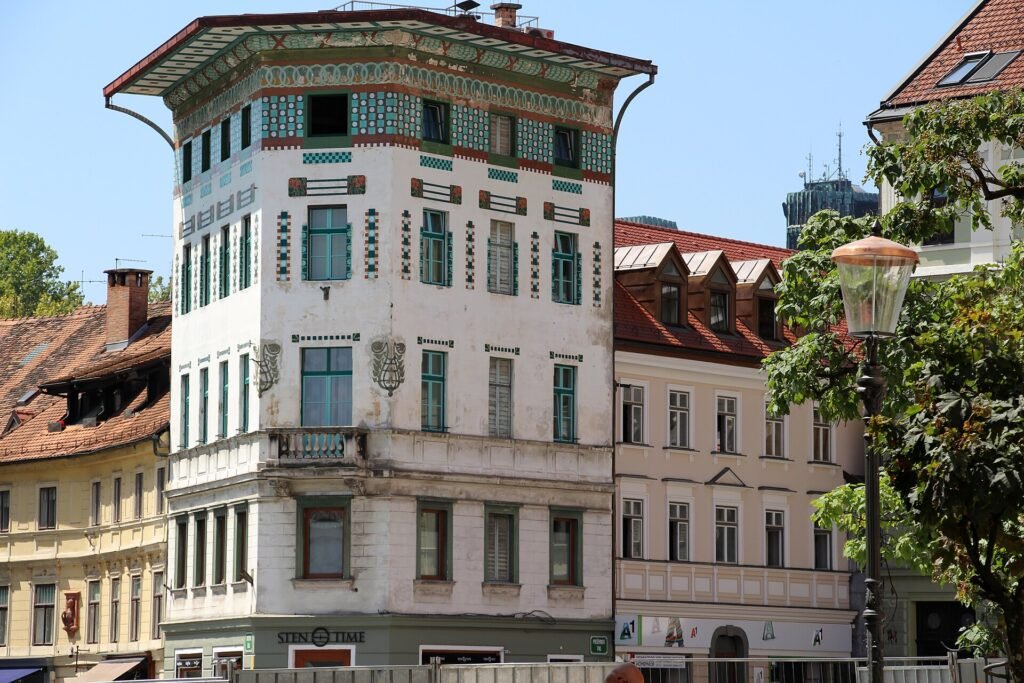
After an earthquake, a plain house got a new skin of coloured tile, and became the brightest corner of the square.
At a glance
The Hauptmann House is the lone Art Nouveau building on Prešeren Square, the heart of Ljubljana. After the earthquake of 1895 shook the city, the architect Ciril Metod Koch refaced an older building in 1904 in the Vienna Secession style, wrapping it in bands of brightly coloured geometric tiles. It is the most photographed façade on the square after the pink church.
Key facts
- Location: Prešernov trg, Ljubljana
- Architect: Ciril Metod Koch
- Refaced: 1904
- Style: Vienna Secession (Art Nouveau)
- Function: residential and commercial building
History
The 1895 earthquake gave Ljubljana the chance to rebuild, and the city embraced the new architecture, much of it inspired by Vienna. Koch took an existing corner building on the main square and gave it a Secession face.
He kept the structure but clad it in patterned tile in green, blue and red, with restrained ornament. It survives as the only Art Nouveau building directly on Prešeren Square, a bright note among its neighbours.
What you see
The corner façade is banded in coloured geometric tiles in contrasting green, blue and red, with a curved oriel and delicate ironwork. It is Secession at its most graphic, decoration achieved with flat pattern rather than sculpture, holding its own beside the square’s baroque church.
Practical information
- Open: private building; exterior viewable any time
- Cost: free to view from the square
- Best for: the tiled corner façade on Prešeren Square
- Time needed: 10–15 minutes
Getting there
The house stands on Prešeren Square in the centre of Ljubljana, beside the Triple Bridge and the old town, all pedestrian.
Nearby
- Triple Bridge (Tromostovje) — Plečnik’s bridge beside the square
- Franciscan Church — the pink church on Prešeren Square
Sources
- Wikipedia — Hauptmann House
- Visit Ljubljana / Slovenian heritage register — building information
- Wikimedia Commons — image source and licence
Find it on the map
See this place and what’s around it →Record researched and written by Luigi De Marchi for Cultural Heritage Online, 2026.
📷 Become a Cultural Heritage Online photographer
Share your photos of places: they stay published under your name as the author. The more they're seen, the more you get noticed — and soon a contest will reward the most appreciated photos.
Log in or sign up free to add a photoIs this page about you?
This page is read by travellers and heritage enthusiasts who find it on Google. Tell us how you are connected to this place and we will take it from there.