
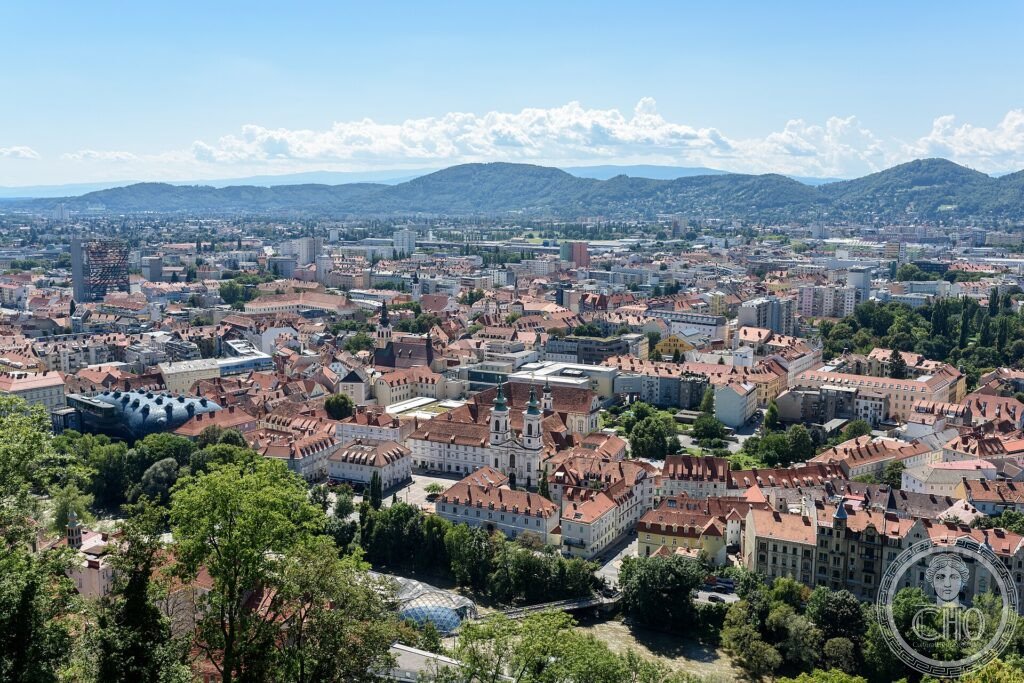
Capital of Styria, Graz preserves one of Central Europe’s most complete historic centres, blending German, Italian and Balkan influences. Beneath the Schlossberg hill, crowned by its clock tower, stretches a labyrinth of Renaissance courtyards and red roofs that has stayed almost intact through the centuries.
At a glance
Graz, the capital of Styria, preserves one of the best-kept old towns in Central Europe, an ensemble where German, Italian and Balkan influences meet. Long a frontier city of the Habsburgs facing the Ottoman threat, it drew Italian Renaissance architects who gave it arcaded courtyards and a distinctive grace. The old town sits below the wooded Schlossberg hill, crowned by the clock tower that is the city’s symbol. Graz was inscribed by UNESCO in 1999, with the Eggenberg Palace added in 2010.
Key facts
- UNESCO: World Heritage since 1999; extended in 2010 to Schloss Eggenberg
- Best-preserved: one of the most complete historic centres in Central Europe
- Schlossberg: the hill above the town, crowned by the Uhrturm clock tower
- Italian influence: Renaissance courtyards and the architect Domenico dell’Allio
- Schloss Eggenberg: a Baroque palace whose design encodes the calendar
- Styrian capital: the second-largest city in Austria
History
Graz developed below its castle hill as a Habsburg residence and a bastion on the empire’s south-eastern frontier against the Ottomans. In the 16th century Italian masters were brought to modernise its defences and palaces, leaving arcaded courtyards and the great armoury, the Landeszeughaus, still stocked with the weapons of the frontier wars.
When the imperial court moved to Vienna, Graz kept its old fabric rather than being rebuilt, which is why its medieval and Renaissance streets survive so completely. On the city’s edge the Eggenberg family built a Baroque palace laid out as an image of the cosmos, added to the World Heritage site in 2010.
What you see
From the Schlossberg, reached by funicular or a stair cut into the rock, the Uhrturm clock tower looks down over a sea of red roofs. Below wind the lanes of the old town, opening into Renaissance courtyards and the arcaded Landhaus, with the Landeszeughaus armoury nearby.
On the western edge, Schloss Eggenberg surrounds its formal gardens; its rooms, windows and staircases are counted to match the days, weeks and months of the year.
Practical information
- Old town: compact and walkable; the funicular climbs the Schlossberg
- Eggenberg: the palace lies a short tram ride west of the centre
- Time needed: a full day for the old town and a palace
- Note: the Landeszeughaus armoury is among the largest historic arsenals in the world
Getting there
Graz is in south-eastern Austria, capital of Styria. It has an airport and direct trains from Vienna (about 2.5 hours). From the station, trams reach the old town and Eggenberg. GPS: 47.0708° N, 15.4382° E.
Nearby
- Schloss Eggenberg — the Baroque palace, part of the World Heritage site
- Styrian wine roads — the vineyards of southern Styria
- Vienna — the capital, about 2.5 hours north by train
Sources
- UNESCO World Heritage Centre — “City of Graz – Historic Centre and Schloss Eggenberg” (ref. 931)
- Stadt Graz — official city authority
- Encyclopaedia Britannica — Graz
Find it on the map
See this place and what’s around it →📷 Become a Cultural Heritage Online photographer
Share your photos of places: they stay published under your name as the author. The more they're seen, the more you get noticed — and soon a contest will reward the most appreciated photos.
Log in or sign up free to add a photo