
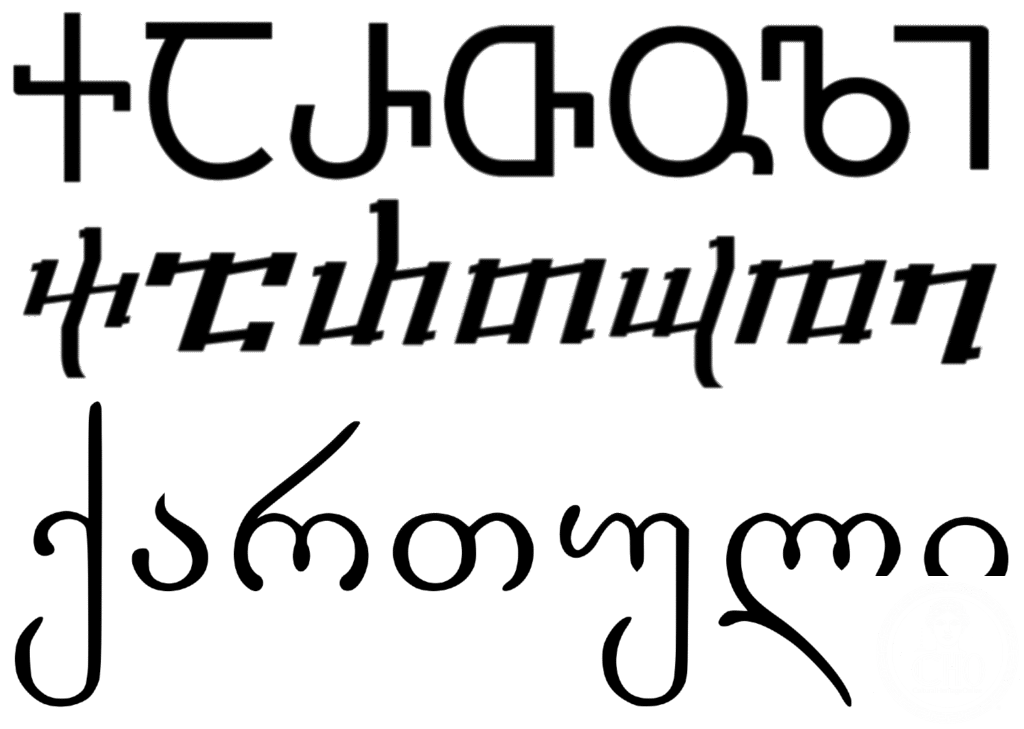
Three distinct writing systems—Asomtavruli, Nuskhuri and Mkhedruli—preserve the living tradition of written Georgian, each carrying the same alphabetical order yet serving different ceremonial and everyday purposes across nearly two millennia.
At a glance
Georgian scripts form a unique family of related alphabets, each visually distinctive yet structurally unified. All three systems write the Georgian language horizontally from left to right, sharing identical letter names and alphabetical sequence. Mkhedruli serves as the modern standard for contemporary Georgian and related Kartvelian languages. Asomtavruli and Nuskhuri remain active in the liturgical and iconographic practice of the Georgian Orthodox Church, maintaining continuity with centuries of religious tradition.
Origins & history
The precise origin of Georgian scripts remains undetermined. Structurally, their alphabetical order largely corresponds to the Greek alphabet, with additional letters positioned at the end to represent sounds unique to Georgian. Originally comprising 38 letters, the Georgian alphabet has evolved to its present 33-letter form, with five letters falling into disuse. Mkhedruli, historically the official script of the Kingdom of Georgia and favored for royal charters, became the standard writing system for modern Georgian.
The practice
Each script maintains its own visual character while preserving the same underlying system. Asomtavruli, the earliest form, appears in monumental religious inscriptions and ecclesiastical manuscripts. Nuskhuri developed as a more compact variant, widely adopted in religious texts and liturgical books. Mkhedruli evolved as a cursive, flowing script suited to everyday administrative and literary use. The three systems extend beyond Georgian to serve the Kartvelian language family: Mingrelian uses 36 letters (including two unique to that language), Laz employs 35 letters (with one borrowed from Greek), and Svan, rarely written, draws on the Georgian system supplemented by diacritics to represent its complex vowel system.
Cultural significance
Georgian scripts embody a distinctive cultural identity and linguistic continuity. Their survival across three parallel systems reflects both the stability of Georgian orthography and the practice of ritual differentiation—sacred texts demand one visual register, contemporary communication another. The scripts connect Georgian speakers to centuries of ecclesiastical heritage while remaining functional in modern life. Recognition as intangible cultural heritage affirms that the living practice of maintaining and transmitting these writing systems is itself a cultural treasure worthy of protection.
Key facts
- Three scripts: Asomtavruli (monumental), Nuskhuri (ecclesiastical cursive), Mkhedruli (modern standard)
- Current alphabet: 33 letters; originally 38
- Direction: left to right, horizontal
- Anchor community: Tbilisi, Georgia (41.72704, 44.79643)
- Used by: Georgian Orthodox Church (Asomtavruli, Nuskhuri); all modern Georgian speakers (Mkhedruli)
- Also used for: Mingrelian, Laz, and Svan (Kartvelian languages)
- UNESCO ICH inscription: 2016 (reference 01205)
- Georgian national ICH status: 2015
Where to experience it
Tbilisi and throughout Georgia remains the heartland of this living practice. Visitors may encounter Georgian scripts in daily signage (Mkhedruli), liturgical manuscripts in the Sioni Cathedral and other Orthodox churches (Asomtavruli and Nuskhuri), and in the holdings of the National Centre for Manuscript Preservation. The scripts appear in printed books, street names, and official documents—embedded in the visual and written culture of everyday Georgian life.
Sources & resources
- Georgian scripts — Wikipedia
- Living culture of three writing systems of the Georgian alphabet — UNESCO Intangible Cultural Heritage
- Cultural Heritage Online
Find it on the map
See this place and what’s around it →📷 Become a Cultural Heritage Online photographer
Share your photos of places: they stay published under your name as the author. The more they're seen, the more you get noticed — and soon a contest will reward the most appreciated photos.
Log in or sign up free to add a photo