

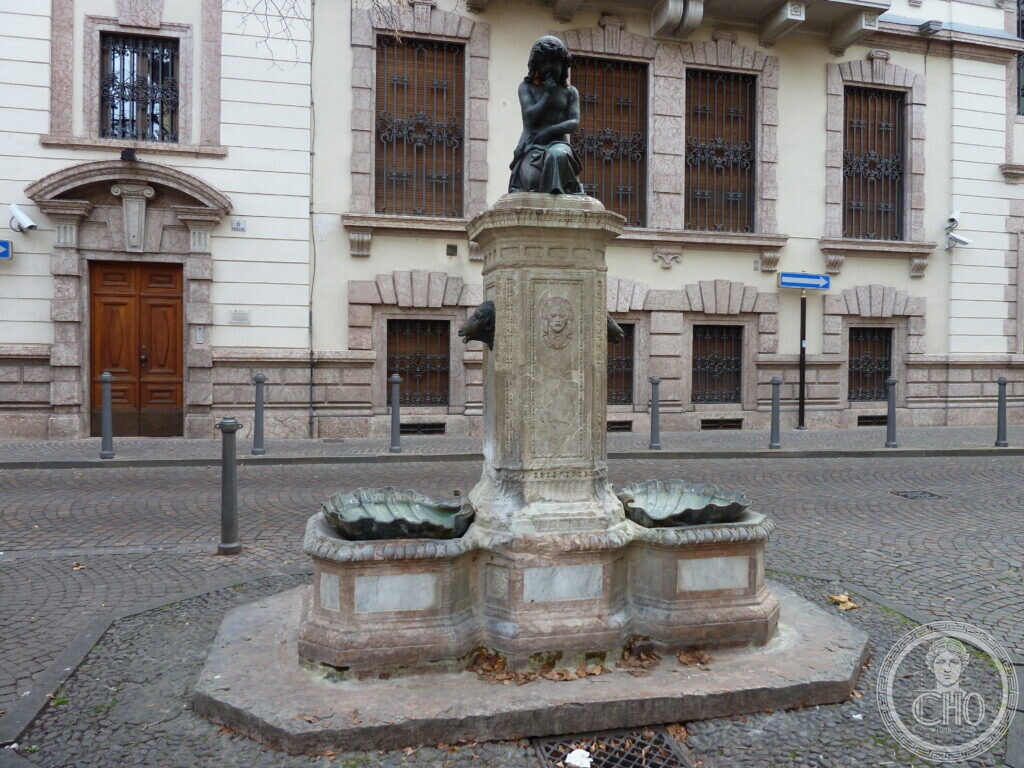
A late nineteenth-century fountain in Piazza delle Erbe, Trento, known popularly for the two bronze ram’s heads from which its water flows.
At a glance
The fountain stands in Piazza delle Erbe, one of Trento’s market squares, and is fed by two bronze ram’s heads set on opposite sides of its column. The municipal cultural heritage record describes it as a monument with free access at all hours.
Key facts
- Where: Piazza delle Erbe, Trento
- What: Fountain
- When: 1867, according to the Comune di Trento; other sources give the late nineteenth century
- GPS: 46.0675, 11.1239 · Open in Google Maps
History
The Comune di Trento records that the fountain was executed at the end of the nineteenth century and realised in 1867 by the sculptor Stefano Varner, to a design by the engineer Saverio Tamanini. Italia Nostra’s Trentine section, however, states that it was executed to a design by Andrea Malfatti at the end of the nineteenth century. The fountain was originally placed where the monument to Alessandro Vittoria now stands in the square of that name, before being moved to Piazza delle Erbe. Trentino History adds that the move took place at the beginning of the twentieth century. In the past it was nicknamed “osteria dei do’ castradi”, an ironic allusion to the abundant free water it offered. The Comune also notes that Piazza delle Erbe has been a market square for a very long time, citing a document of 1288 that mentions a square “ubi venditur caseus”, where cheese was sold.
What you see
The photograph shows a stone fountain with two shell-shaped basins and a central pillar. On the top of the column a kneeling girl is depicted beside a serpent; the Comune di Trento describes this as a bronze copy of a stucco by Andrea Malfatti. Italia Nostra adds that the base has a mixtilinear plan, the plinth has a scale border, and the upper edge is decorated with ovuli; the column has a square base with chamfered corners and decorations of rudentature, fusarole, girali and dentelli. Two bronze ram’s heads occupy two sides of the column, while the other two sides bear low-relief female heads.
Do you know more about this place?
If you know a date, a name, a document, a plaque or a photograph that tells its story, write to Sofia at sofia@culturalheritageonline.com or through the contact page. What arrives with a source goes into this page, with your name as the contributor.
Nearby
- Palazzo delle Poste di Trento – Cultural Heritage Online — a short walk away
- Casa Cazuffi-Rella, Trento — nearby in the historic centre
- Fontana del Nettuno, Trento — another historic fountain in the centre
- Piazza Cesare Battisti and the Sas Quarter — Trento — close to Piazza delle Erbe
- Galleria dei Legionari Trentini and the Mosaic of the Empire — Trento — close to Piazza delle Erbe
Sources
- Comune di Trento, Fontana dei do’ castradi: designation as a monument, location, description, designer, sculptor and 1867 date.
- Italia Nostra – Sezione Trentina, Il nostro restauro: detailed description of materials and decoration, attribution to Andrea Malfatti, original location and 1988 restoration.
- Trentino History, Piazza delle Erbe e Piazza Vittoria: due piazze di mercato e scultura: relocation to Piazza delle Erbe at the beginning of the twentieth century and the nickname “osteria dei do’ castradi”.
- La voce del Trentino, Trento raccontata: Piazza Pasi e la storia della fontana del Fauno: reference to Andrea Malfatti as author of the fountain known as “Do’ castradi” in Piazza delle Erbe.
- OpenStreetMap, Fontana dei do castradi: address and coordinates.
- Stefano Vigolo, photographs and notes to the editorial staff (2026): identification of the subject and the photograph’s date. Not a published source.
Find it on the map
See this place and what’s around it →📷 Become a Cultural Heritage Online photographer
Share your photos of places: they stay published under your name as the author. The more they're seen, the more you get noticed — and soon a contest will reward the most appreciated photos.
Log in or sign up free to add a photo