
The stone quarter was pulled down and rebuilt in three years. The square that replaced it has been called three different things, and what was underneath it turned out to be a Roman town.
At a glance
- What — a rationalist square and the blocks around it, built on the site of a cleared medieval quarter
- Where — between via San Pietro, via Diaz and via Manci, historic centre of Trento
- Built — 1934–1937, by the engineers Emilio Gaffuri and Guido Segalla and the architect Efrem Ferrari, with Giovanni Lorenzi, Guido de Unterrichter and Renzo Masè
- Beneath it — the SASS, about 1,700 m² of Roman Tridentum, open to visitors
History
The quarter was called the Sas — dialect for stone, after the material its houses were built of. Between 1934 and 1937 the regime demolished it entirely and put up a new district in its place, with a rectangular square at the centre. The square was named Piazza Littorio. After the Second World War it became Piazza Italia, and in the 1960s it was dedicated to Cesare Battisti, the Trentino irredentist executed by Austria–Hungary in 1916. Three names in thirty years, on the same paving.
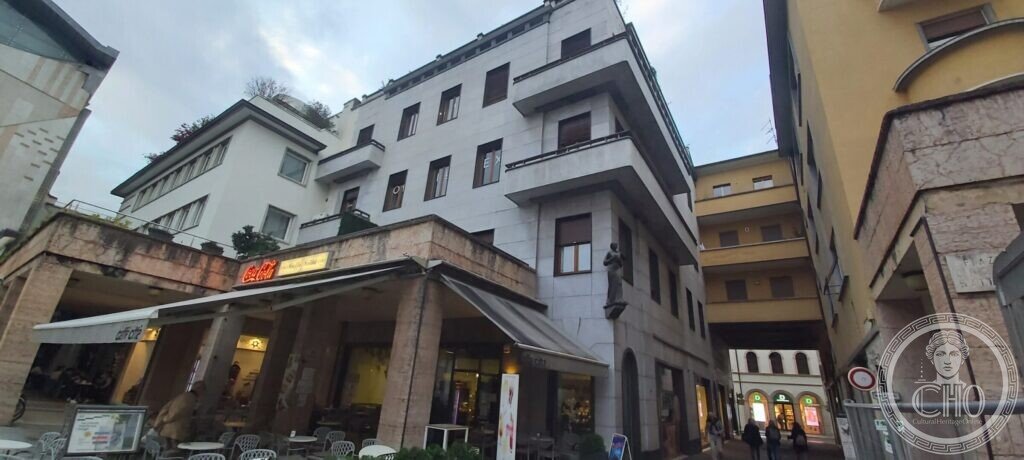
The rebuilding was shared out among the designers then working in the city. Emilio Gaffuri and Guido Segalla, both engineers, handled the reconstruction as a whole. The architect Efrem Ferrari (Trento, 1910–1997), fresh from his degree at Venice in 1935, built what was known as the bar città and the provincial fire-service institute. Giovanni Lorenzi — the architect of the Grand Hotel Trento — built the Vittoria cinema, and Guido de Unterrichter with Renzo Masè built the Casa Rigoni. Ferrari would go on to become the province’s most prolific church architect, and to design the ten-storey ITAS tower that closes this same square, drawn in 1947 and built between 1952 and 1954.
The demolition had one consequence nobody planned. Digging under the new square eventually exposed a large section of Roman Tridentum — streets, houses, mosaic floors — and from 1999 that level was opened to the public as the SASS, the underground archaeological space, about 1,700 square metres beneath the pavement.
What you see
The block in the photograph is Ferrari’s: a corner building faced in pale stone, with cantilevered balconies wrapping the angle, deep-set windows in plain rectangular openings, and a flat cornice. Below, an arcade of squat piers in veined pink marble carries a broad planted terrace, and under it, behind its awnings, is the café that has given the building its name since the 1930s — still trading as the Caffè Città. A stone figure of a woman stands in a niche on the corner pier.
The manner is rationalism in its official, moderate register: symmetrical, stone-clad, stripped of ornament but not of monumentality, and set on an arcade so that the ground floor stays public. It is the same language used across the square and in the gallery that opens off it, and the effect is deliberately unified — the whole quarter was designed to be read as one work.
Cultural significance
This is a clean example of what the interwar risanamento did to Italian towns: an old quarter judged insanitary and inconvenient was removed in its entirety and replaced with a piece of modern city, complete with square, cinema, café and offices. The judgement on it has swung more than once — a loss of medieval fabric, or a coherent piece of twentieth-century urbanism — and Trento has kept both readings in view.
What makes the square unusual is the vertical section. Roman street level, cleared medieval quarter, 1930s square, and postwar tower, stacked in one place, with the Roman layer now the visitable one. The renaming of the square is part of the same record: Littorio, Italia, Battisti — the political history written into the address.
Practical information & getting there
The square is in the middle of the historic centre, a few minutes from the cathedral and from Trento station, and is open ground — it holds part of the Christmas market and most of the city’s public events. The SASS below has its own entrance on the square, with ticketed opening hours; the arcades and the café are open to the street.
Sources & resources
- Efrem Ferrari (1910–1997) — for the rebuilding of the Sas quarter in 1934–1937, the division of work among Gaffuri, Segalla, Ferrari, Lorenzi, de Unterrichter and Masè, and the ITAS building of 1947–1954.
- Comune di Trento — Piazza Cesare Battisti, for the successive names of the square and the archaeological space beneath it.
- Architettura fascista a Trento — context on the city’s interwar building programme.
Find it on the map
See this place and what’s around it →Record researched and written by Stefano Vigolo for Cultural Heritage Online, 2026.
📷 Become a Cultural Heritage Online photographer
Share your photos of places: they stay published under your name as the author. The more they're seen, the more you get noticed — and soon a contest will reward the most appreciated photos.
Log in or sign up free to add a photoIs this page about you?
This page is read by travellers and heritage enthusiasts who find it on Google. Tell us how you are connected to this place and we will take it from there.