
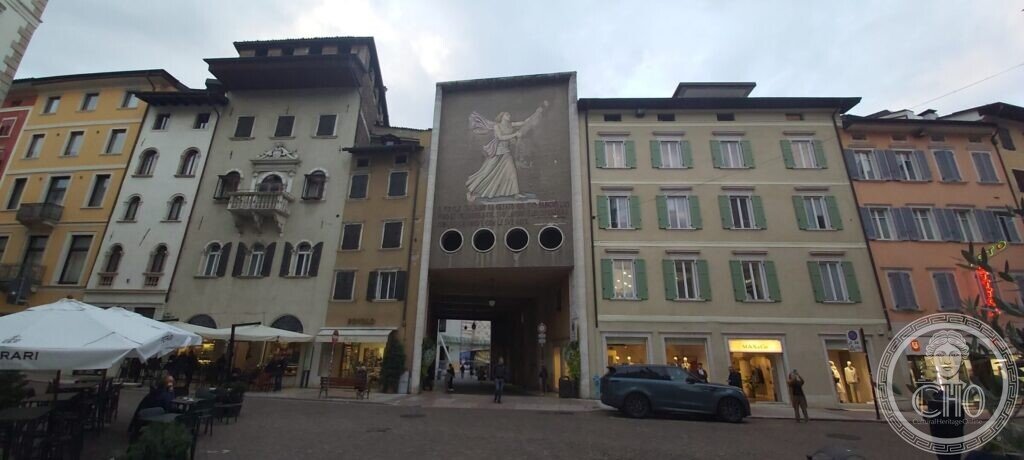
A public passage driven through a block of the old city, with a mosaic over its mouth that still carries the gap where a name was cut away.
At a glance
- What — a covered pedestrian gallery through a city block, with a monumental mosaic on its facade and a painted lunette under the portico
- Where — between Piazza Cesare Battisti and via San Pietro, historic centre of Trento
- The mosaic — 1937, by Gino Pancheri (Trento, 1905 – Trento, 1943)
- Access — a public street, open at all hours
History
Between 1934 and 1937 the quarter known as the Sas — the stone quarter, named for what its houses were built of — was demolished and rebuilt. It was one of the largest interventions the regime made in Trento, and it produced the square now called Piazza Cesare Battisti together with the streets and passages around it. This gallery was cut through as part of that work, connecting the new square to via San Pietro and named for the Trentino legionaries.
Its facade was given to a competition, open to artists enrolled in the Fascist union, and Gino Pancheri won it. The mosaic he made in 1937 is his best-known work. He was then in his early thirties, trained at the Brera academy in Milan and secretary of the fine-arts union of the region; he also painted at the post office and at Adalberto Libera’s Raffaello Sanzio schools. On 2 September 1943 he was hit by shrapnel in Piazza Dante during the Allied bombing of Trento — the raid remembered as the Portela massacre — and died of his wounds three months later, at thirty-eight.
What you see
The gallery front is a tall flat panel of grey render, framed in pale stone and set between two older painted houses, with the arched mouth of the passage at its foot. Filling the upper half is the mosaic: a single female figure, larger than life, striding forward in a white pleated gown with a rose-coloured mantle streaming behind her, one arm raised. Below her runs the inscription in Roman capitals, and below that four round openings punched through the wall.
The figure is an allegory of Italy or Victory, made to celebrate the proclamation of the Italian empire in May 1936. The raised hand originally carried the fascio littorio, the emblem of the regime, and the inscription — the closing sentence of Mussolini’s speech of 9 May 1936, «the Italian people has created the empire with its blood, will make it fruitful with its labour and will defend it against anyone with its arms» — ended with his name. After the war the fasces was removed and the name chiselled out. Both erasures are visible from the street, and they are now part of what the work says: a monument that was edited rather than destroyed. Locally it has long been called simply la donna del fascio, the woman with the fasces; in the literature it is the Mosaic of the Empire.
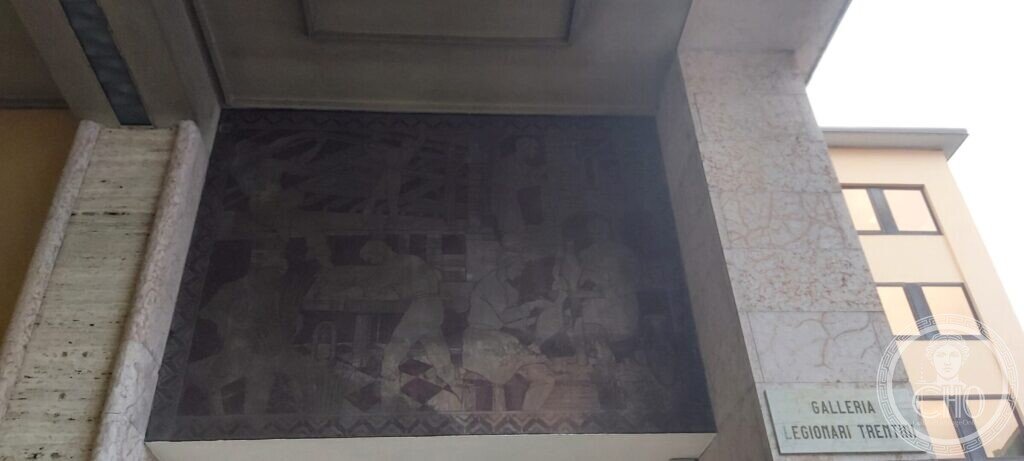
Under the portico, on the soffit wall, a second and much quieter painting survives: a broad rectangular panel, bordered with a zigzag band, showing men at work in what reads as a series of workshops — figures bent over a bench, a beam or loom structure above, tools and baskets on the ground, a raised scaffold behind. Where the mosaic outside is imperial and rhetorical, this is the other subject the period liked: labour, and specifically the artisan trades. It is badly darkened and has no legible signature; we have not found a published attribution, and none is offered here.
Cultural significance
Italy has thousands of these erasures. Fasces knocked off keystones, dedications cut out of architraves, a blank oval where a portrait was: the standard postwar treatment was to remove the emblem and keep the building. The Trento mosaic is a particularly legible case, because the figure survives intact and only the two politically loaded elements are gone — so a passer-by can see both the work and the decision that was taken about it, in the same glance.
It is also the principal surviving public work of an artist who did not survive the war. Pancheri’s reputation now rests mainly on his paintings of rural Trentino, of peasant labour and mountain fields; the mosaic is the piece the whole city knows, and the one that has kept its history most visibly on its surface.
Practical information & getting there
The gallery is a public passage in the centre of Trento, five minutes from the cathedral and from the station, and can be walked through at any hour. Under the square at its northern end is the SASS, the underground archaeological space, where about 1,700 square metres of Roman Tridentum are open to visitors. The mosaic faces the street and is best photographed in flat light; the erasures are easier to see in person than in reproduction.
Sources & resources
- Gino Pancheri (1905–1943) — biography, the 1937 mosaico dell’Impero, the competition, and the postwar defacement.
- Wikimedia Commons — Mosaico della donna col fascio, with photographs recording the removal of the name and the fasces.
- Efrem Ferrari — for the rebuilding of the Sas quarter, 1934–1937.
- Comune di Trento — Piazza Cesare Battisti, for the square and the archaeological space beneath it.
Find it on the map
See this place and what’s around it →Record researched and written by Stefano Vigolo for Cultural Heritage Online, 2026.
📷 Become a Cultural Heritage Online photographer
Share your photos of places: they stay published under your name as the author. The more they're seen, the more you get noticed — and soon a contest will reward the most appreciated photos.
Log in or sign up free to add a photo