

It opened three days before Malaya became independent, to house the guests who had come to watch, and it is still standing on the same corner of Jalan Bukit Bintang while everything around it has been rebuilt twice.
At a glance
The Federal opened on 28 August 1957 on Jalan Bukit Bintang, three days before the Federation of Malaya took its independence on 31 August. It was built to lodge the foreign dignitaries invited to the Merdeka celebrations, and is described by its owners and by the Malaysian press as the country’s first international-class hotel. The original block was nine storeys, which made it one of the tallest buildings in Kuala Lumpur at the time. It is not on Malaysia’s National Heritage Register as far as we have been able to establish, but its date, its role and its architecture are documented in the national press and in the company’s own archive, now displayed in a gallery inside the building.
Key facts
- Where: 35 Jalan Bukit Bintang, Bukit Bintang, 55100 Kuala Lumpur
- Opened: 28 August 1957, by Tunku Abdul Rahman
- Founder: the businessman Low Yat; the hotel is still held by the Low Yat Group
- Architect: Lee Yoon Thim (1905–1977) is named as the architect of the original nine-storey building by Wikipedia and by accounts that follow it. We have not found this attribution in an official or primary source, and give it as reported.
- Original height: nine storeys, among the tallest in the city in 1957
- Revolving restaurant: the Bintang, post-independence Malaya’s first, in a drum on the roof; it stopped revolving after mechanical trouble and is now the Bintang Lounge
- Protection: no national or state heritage listing found
- Renovation: begun 2024, first phase reopened August 2026, official reopening ceremony 18 September 2026; a second phase is announced
- Coordinates: 3.144315, 101.708866 · open in Google Maps
History
Kuala Lumpur in the middle 1950s had hotels, but not the kind a new state needs when it invites the world to watch it become a country. The Federal was built for exactly that occasion. It was opened by Tunku Abdul Rahman on 28 August 1957; on the eve of the first Merdeka Day an official reception was held in its Banquet Room, and the building has been called the Hotel for Merdeka ever since. Its nine storeys made it one of the tallest things in the city.
What followed was a long second act as a Kuala Lumpur institution rather than as a monument. A taller wing was added carrying the Bintang, the first revolving restaurant in post-independence Malaya, turning slowly above a skyline that had almost nothing else at that height; the mechanism eventually failed and the room stopped moving, but it stayed open as a lounge and became the place people went to watch the National Day and New Year fireworks. Around the hotel, Bukit Bintang turned from a quiet corner into the city’s densest run of shopping malls and nightlife, and the Federal spent the 2000s in the middle of it.
A renovation began in 2024 and the hotel reopened in August 2026 with 150 rooms, with an official ceremony on 18 September attended by the chairman of the Malaysia Tourism Promotion Board. The work was as much archaeology as refurbishment: the team uncovered concrete beams still carrying the imprint of their timber formwork, and a mosaic staircase of 1957 that was then conserved, along with the original gilded cast-iron metalwork of the entrance. The circular Art Deco windows in the façade were restored. The Low Yat Group executive director Datuk Low Gee Teong called the building “a living piece of Malaysian heritage”; the group’s business development manager described finding pipes hidden inside pillars and walls that were not where the sixty-nine-year-old drawings said they would be. A second phase of work is announced for the following year.
What you see
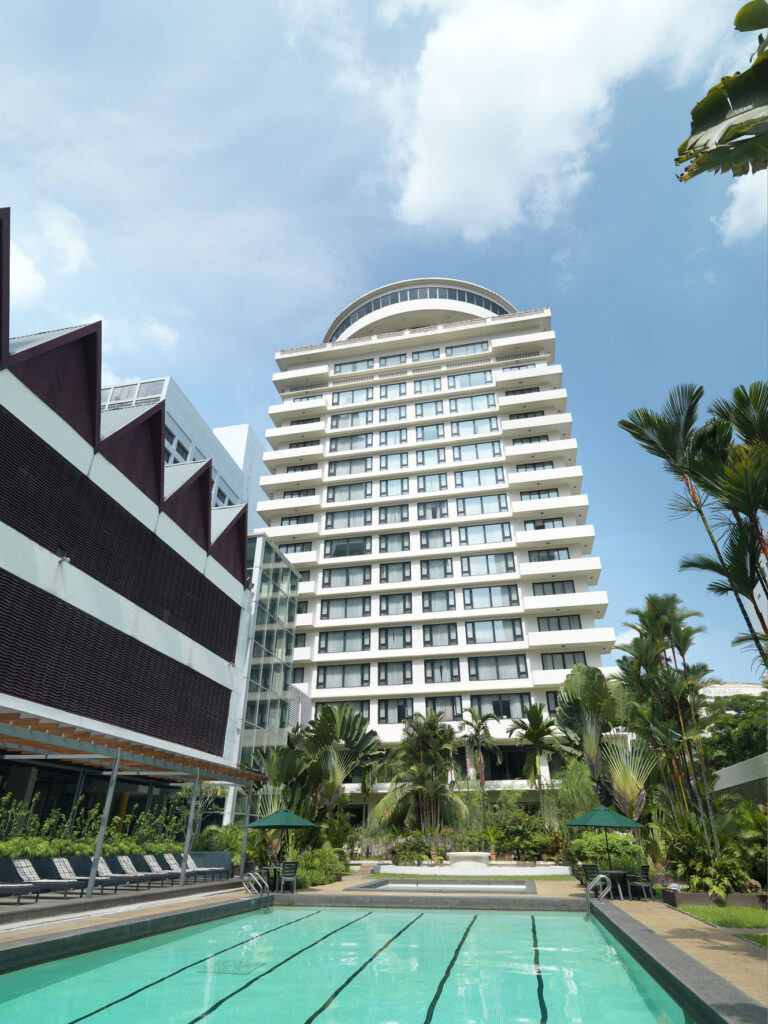
From the pool terrace behind the hotel the main block reads as a plain white slab, its façade divided into a dozen or more horizontal bands by continuous projecting balcony slabs that run the full width and turn the corners. The bands are the whole composition: no ornament, no vertical accent, just floor after floor of white concrete shelf over dark glazing, which is what a modernist hotel of the late 1950s and early 1960s looked like in a hot climate, the slabs shading the rooms below them. At the top the slab stops and a shallow glazed drum sits back from the parapet under a curved roof — the room built for the revolving restaurant.
To one side, a lower block is faced in dark brown tile above a white band, its roofline broken into a row of steep triangular gables, with a glazed stair tower joining it to the slab. Palms and travellers’ trees screen the base of the building, and a straight lap pool runs across the foreground. From Jalan Bukit Bintang, on the other side, the hotel is entered under a porte cochère; a pair of white marble lions from the original building still stand at the door.
Practical information
- The building is a working hotel. Its ground-floor gallery displays photographs, archival material and memorabilia tracing the hotel’s history, and is the part of the building most worth a visitor’s time.
- The marble lions and the gilded entrance metalwork are at the Jalan Bukit Bintang door and can be seen from the street.
- The Bintang Lounge at the top no longer revolves, but keeps the view.
- The exterior is best read from the rear terrace or from across Jalan Bukit Bintang.
Getting there
The hotel stands at the western end of Jalan Bukit Bintang. Bukit Bintang station on the MRT Kajang line and the Bukit Bintang monorail station are both a short walk away, and the covered pedestrian bridge from KLCC ends nearby. From Kuala Lumpur International Airport the KLIA Ekspres runs to KL Sentral, about twenty minutes further by rail or road.
Nearby
- The Bukit Bintang crossing and the length of Jalan Alor, a few minutes on foot.
- The Coliseum Theatre on Jalan Tuanku Abdul Rahman, a cinema of 1920 in the old commercial centre.
- Kuala Lumpur Railway Station, A. B. Hubback’s Indo-Saracenic terminus of 1910.
- The Cathedral of St. John the Evangelist on Bukit Nanas.
Sources
- Malay Mail, 19 September 2026 — “Inside The Federal Kuala Lumpur’s revamp”: the opening date of 28 August 1957, the renovation begun in 2024, the exposed beams and timber formwork imprints, the conserved 1957 mosaic staircase, the gilded cast-iron entrance metalwork, the restored circular Art Deco windows, the new gallery, the quotations from Low Yat Group, the ceremony of 18 September 2026 and the announced second phase.
- Malay Mail, 19 August 2026 — “A hotel born with Merdeka”: the August 2026 reopening with 150 rooms, the pair of original white marble lions at the entrance and the porte cochère.
- KL Lifestyle, “The Federal Kuala Lumpur”: the opening by Tunku Abdul Rahman on 28 August 1957, the purpose of housing dignitaries invited to the Merdeka celebrations, the nine-storey building as one of the tallest in the city, the reception in the Banquet Room on the eve of the first Merdeka Day, and the revolving restaurant that stopped revolving.
- Free Malaysia Today, “5 Malaysian hotels that have stood the test of time”: context on Kuala Lumpur’s long-lived hotels.
- OpenStreetMap / Nominatim — position, returned as The Federal Kuala Lumpur, 35, Jalan Bukit Bintang, Bukit Bintang, Kuala Lumpur, 55100.
- The attribution of the original building to the architect Lee Yoon Thim rests on Wikipedia and on accounts that repeat it; no official or archival confirmation was found. Searches of Malaysia’s National Heritage Register and of the Department of National Heritage turned up no listing for this building.
Find it on the map
See this place and what’s around it →📷 Become a Cultural Heritage Online photographer
Share your photos of places: they stay published under your name as the author. The more they're seen, the more you get noticed — and soon a contest will reward the most appreciated photos.
Log in or sign up free to add a photoIs this page about you?
This page is read by travellers and heritage enthusiasts who find it on Google. Tell us how you are connected to this place and we will take it from there.