
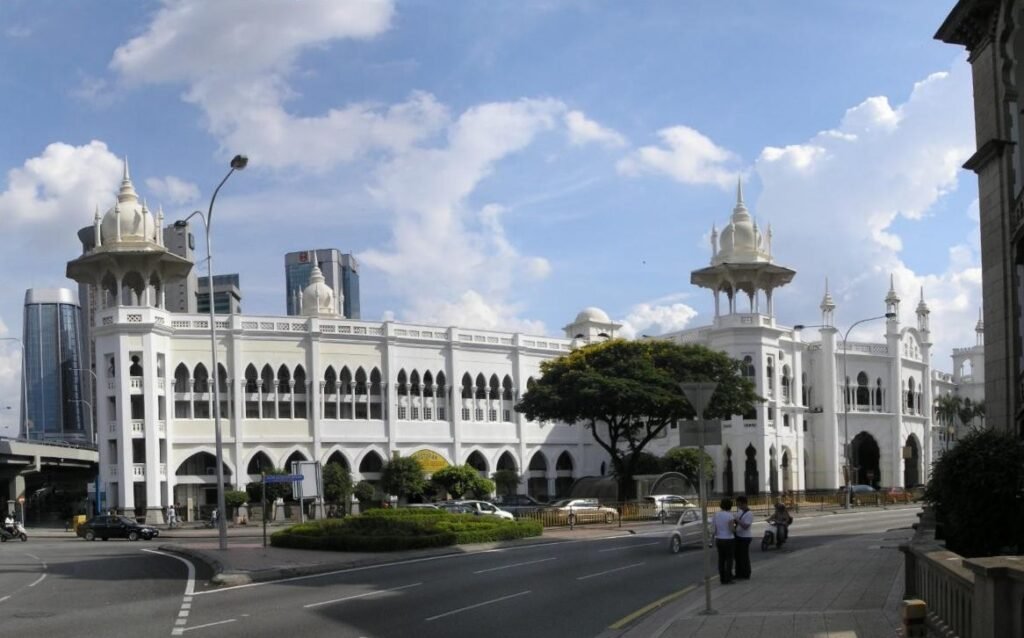
Domes, horseshoe arches and slender turrets in brilliant white: a railway station that looks like a palace from the East.
At a glance
The old Kuala Lumpur Railway Station opened in 1910, the work of the British colonial architect Arthur Benison Hubback. He built it in the Indo-Saracenic style, mixing Mughal domes, Moorish arches and minaret-like turrets, all rendered in gleaming white. For most of the twentieth century it was the gateway to the Malaysian capital.
Key facts
- Location: Jalan Sultan Hishamuddin, Kuala Lumpur
- Architect: Arthur Benison Hubback
- Opened: 1910
- Style: Indo-Saracenic (Moorish/Mughal revival)
- Function: railway station (commuter services)
History
Hubback designed several of colonial Kuala Lumpur’s landmarks in the same Eastern manner, choosing it to suit a Malay and Muslim setting. The station opened in 1910 for the Federated Malay States Railways.
It served as the city’s main terminus for decades. When the modern KL Sentral hub opened nearby in 2001, the old station kept a quieter role on the commuter network, its architecture protected as heritage.
What you see
The long white façade is crowned by domes large and small, with rows of horseshoe and keyhole arches and thin turrets like minarets. The detail is closer to a palace or mosque than a railway shed. Inside, iron platform canopies recall its working purpose beneath the fantasy outside.
Practical information
- Open: daily, as a working commuter station
- Cost: free to view; train tickets as needed
- Best for: the white Indo-Saracenic façade
- Time needed: 15–30 minutes
Getting there
The old station is on the KTM Komuter line, one stop from KL Sentral, and a short walk from the National Mosque and the old colonial core. It sits across from the equally ornate former railway administration building.
Nearby
- National Mosque of Malaysia — modernist mosque nearby
- Masjid Jamek — Hubback’s riverside mosque in the old centre
Sources
- Encyclopædia Britannica / Wikipedia — Kuala Lumpur railway station
- Malaysian heritage / KTM — building information
- Wikimedia Commons — image source and licence
Find it on the map
See this place and what’s around it →📷 Become a Cultural Heritage Online photographer
Share your photos of places: they stay published under your name as the author. The more they're seen, the more you get noticed — and soon a contest will reward the most appreciated photos.
Log in or sign up free to add a photoIs this page about you?
This page is read by travellers and heritage enthusiasts who find it on Google. Tell us how you are connected to this place and we will take it from there.