

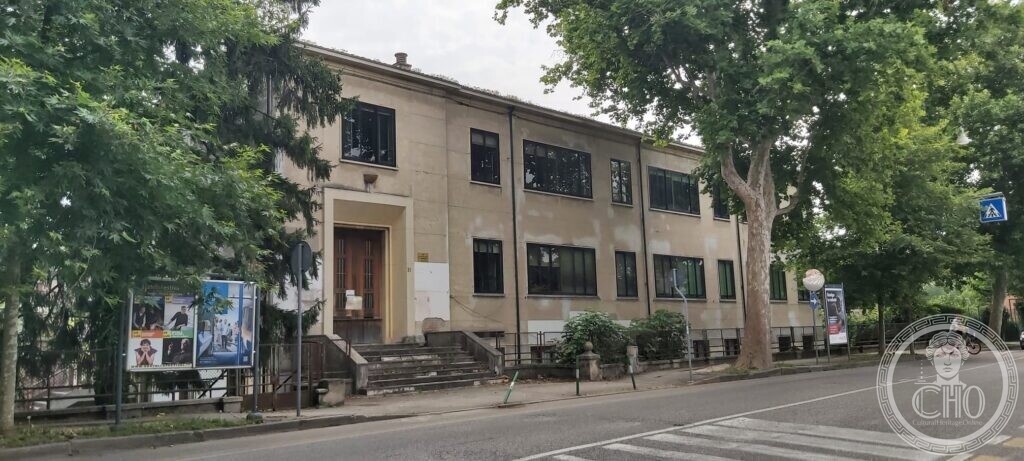
A sober two-storey school of the interwar years on the ring road north of Padua’s centre, built as a teacher-training institute and still a school today. Its date is reported from an online search and not from a document: this page says what is seen and what is missing.
At a glance
The building stands at number 31 of Via Pilade Bronzetti, in the San Giuseppe quarter of Padua, a short walk from Porta Trento and from the former Kofler perfume works. Stefano Vigolo, who photographed it in June 2024, identifies it as the former Regio Istituto Magistrale Fusinato, the state school that trained primary-school teachers, built between 1932 and 1935, and today a seat of the Istituto di Istruzione Superiore Concetto Marchesi, whose main seat is in Viale Codalunga.
What this page does not say. The dates of 1932–1935 and the name of the institute come from the photographer’s online searches; our own searches found the school’s present use but no published history of the building, no architect and no document on its construction. They are reported as beliefs, not as facts. The institute’s dedication is given by the photographer as Vincenzo Fusinato; the Fusinato usually honoured in Padua’s institutions is the poet Arnaldo, and we could not verify which name the school bore.
Key facts
- Where: Via Pilade Bronzetti 31, Padua
- Built: 1932–1935 according to the photographer’s searches; not documented in a published source found so far
- Original use: Regio Istituto Magistrale, the teacher-training school, named Fusinato
- Today: a seat of the Istituto di Istruzione Superiore Concetto Marchesi
- GPS: 45.4146, 11.8645 · Open in Google Maps (OpenStreetMap)
What is known, and what is believed
The istituto magistrale was the school of the Italian state that prepared teachers for the elementary classes, and in the 1930s many cities gave it a new building in the plain, modern manner of the time. Padua’s, according to the photographer’s research, went up on Via Bronzetti between 1932 and 1935 and took the name Fusinato; the building later passed to other schools, and now houses classes of the Istituto Concetto Marchesi. The quarter around it was transformed in the same decades: the Kofler perfume and talc works nearby, and the university’s own buildings on Via Marzolo, belong to the same Padua of the interwar years.
What you see
A two-storey block in pale plaster, with the plain surfaces and horizontal lines of the rationalist 1930s: a central entrance framed in stone, reached by a short flight of steps and marked by a slightly raised bay, with the number 31 on the pier beside it; to the right a long wing with two rows of large rectangular windows, those of the ground floor with simple sills, and a thin cornice under the flat roof. The front has lost patches of plaster and shows its age. Plane trees line the road in front, and poster boards for the city’s festivals stand at the corner.
Do you know more about this school?
If you know when the Istituto Magistrale Fusinato was built and by whom, which Fusinato it was named after, or a document or photograph that tells its story, write to Sofia at sofia@culturalheritageonline.com or through the contact page. What arrives with a source goes into this page, with your name as the contributor.
Nearby
- Ex Stabilimento Kofler — Padua’s perfume and talc works, a few steps away
Sources
- Ufficio Scolastico Regionale per il Veneto, Distretti, Comune di Padova, scuole statali (PDF): the Istituto Superiore Marchesi and its main seat in Viale Codalunga 1
- Università di Padova, Una nuova vita per la Casa dello studente Fusinato: the other Fusinato building of Padua, the student house of 1922–1935 on Via Marzolo, named after A. Fusinato — cited to distinguish the two
- Stefano Vigolo, photograph of 20 June 2024 and notes to the editorial staff (August and September 2026): the identification of the building, the name of the institute and the dates 1932–1935, from his online searches. Not a published source: reported as beliefs in the text
- OpenStreetMap, Via Pilade Bronzetti 31, Padova: the address and the position
Find it on the map
See this place and what’s around it →📷 Become a Cultural Heritage Online photographer
Share your photos of places: they stay published under your name as the author. The more they're seen, the more you get noticed — and soon a contest will reward the most appreciated photos.
Log in or sign up free to add a photoIs this page about you?
This page is read by travellers and heritage enthusiasts who find it on Google. Tell us how you are connected to this place and we will take it from there.