
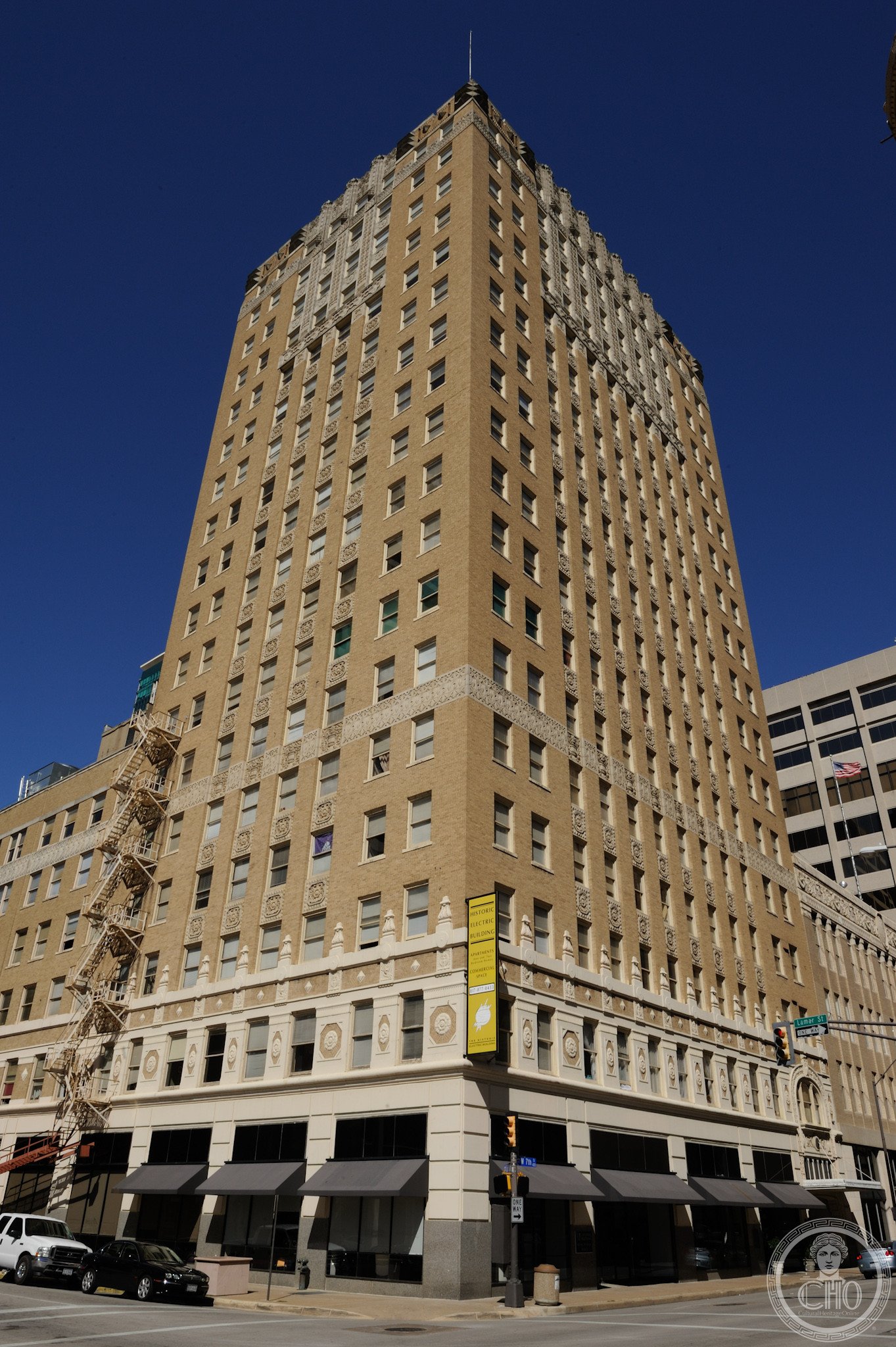
The 16-story Art Deco tower that dominates the 7th Street commercial corridor in downtown Fort Worth was completed in 1930 for the Fort Worth Power and Light Company, its polychrome terracotta facade representing one of the most accomplished examples of Art Deco commercial architecture in North Texas.
At a glance
The Electric Building at 410 West 7th Street in Fort Worth, Texas, was completed in 1930 as the headquarters of the Fort Worth Power and Light Company, the utility that supplied electric power to the growing North Texas city. Designed in a polychrome Art Deco style with terracotta ornament drawing on geometric and stylised natural motifs, the 16-story tower became the defining building of downtown Fort Worth’s 7th Street commercial district. The building was listed on the National Register of Historic Places for its architectural significance. It has since been converted to hotel use, preserving the exterior while adapting the interior for modern hospitality functions.
Key facts
- Location: 410 West 7th Street, downtown Fort Worth, Texas
- Completed: 1930
- Floors: 16 stories
- Style: Art Deco; polychrome terracotta ornament
- Original use: Fort Worth Power and Light Company headquarters
- Current use: Hotel (boutique conversion)
- Status: National Register of Historic Places; Texas State Historical Marker
History
The 1920s were years of rapid growth for Fort Worth, whose economy was tied to cattle, meatpacking, oil, and the railway network that made it a hub for the southern Great Plains. The Fort Worth Power and Light Company, which supplied electrical infrastructure to the expanding city and region, commissioned its new headquarters building at a moment when electricity itself was the emblematic technology of American modernity — a symbolism the Art Deco style was uniquely suited to express.
The building’s terracotta ornament programs the facade with geometric Art Deco motifs that were then associated with technological progress: zigzag patterns, stylised sunbursts, and angular decorative elements concentrated at the cornice and entrance portal. The polychrome character of the terracotta — using contrasting tones of cream, buff, and accented colour — gives the tower a presence on 7th Street disproportionate to its relatively modest footprint.
The Fort Worth Power and Light Company eventually merged with other regional utilities as the electric power industry consolidated through the mid-twentieth century. The building passed through successive corporate and commercial owners before being recognized for its architectural significance. Its conversion to hotel use, preserving the Art Deco exterior, followed the pattern established by other Texas commercial landmarks of the interwar period.
What you see
The building presents its best face from 7th Street, where the full 16-story elevation is visible in the context of the commercial streetscape. The terracotta ornament is at its most concentrated at the crown and at the ground-floor entrance portal, where the Art Deco geometric vocabulary — typical of North Texas commercial architecture of the late 1920s and early 1930s — can be examined at close range.
The building’s conversion to hotel use has preserved the exterior terracotta and the window rhythm of the original facade. The interior, adapted for hotel functions, no longer reflects the original layout of the utility company headquarters but has incorporated some original details into the lobby design.
Practical information
- Access: Hotel; lobby and public areas accessible to visitors.
- Location: 410 West 7th Street, two blocks from the Fort Worth Convention Center and within walking distance of Sundance Square.
- Combination: Pair with the Fort Worth Water Gardens (1974) one block south and the Bass Performance Hall (1998) three blocks east for a tour of Fort Worth’s architectural highlights.
- Time needed: 20 minutes for exterior and lobby.
Getting there
The Electric Building is at 410 West 7th Street in downtown Fort Worth, Texas. It is within the T (Trinity Railway Express) transit network that connects Fort Worth to Dallas; the Fort Worth Intermodal Transportation Center is several blocks north on Jones Street. By car, the building is accessible from I-30 (Exit 12A for Commerce Street) and from US-287 into downtown Fort Worth. Dallas/Fort Worth International Airport (DFW) is approximately 25 miles northeast via TX-121 or I-35W.
Nearby
- Sundance Square — The revitalized historic downtown district centered on Main Street, one block east, with 19th and early-20th-century commercial buildings and restaurants.
- Fort Worth Water Gardens (1974) — Philip Johnson and John Burgee’s dramatic modernist urban water feature in three distinct pools, one block south.
- Bass Performance Hall (1998) — Fort Worth’s principal performing arts venue, three blocks northeast, with two angel sculptures on its facade.
- Modern Art Museum of Fort Worth (2002) — Tadao Ando’s glass and concrete modern art museum in the Cultural District, fifteen minutes west by car.
Sources
- Texas Historical Commission. National Register of Historic Places nomination: Electric Building, Fort Worth.
- Texas State Historical Association. Handbook of Texas, “Fort Worth Power and Light Company.”
- Garrett, Julia Kathryn. Fort Worth: A Frontier Triumph. Encino Press, 1972.
- Texas Historical Commission Marker documentation, Electric Building.
- Wikipedia, “Electric Building (Fort Worth),” https://en.wikipedia.org/wiki/Electric_Building_(Fort_Worth).
Find it on the map
See this place and what’s around it →📷 Become a Cultural Heritage Online photographer
Share your photos of places: they stay published under your name as the author. The more they're seen, the more you get noticed — and soon a contest will reward the most appreciated photos.
Log in or sign up free to add a photoDo you manage this place?
This page is read by travellers and heritage enthusiasts who find it on Google. Keep it accurate — and make it work for you. Free for non-profit heritage institutions.