
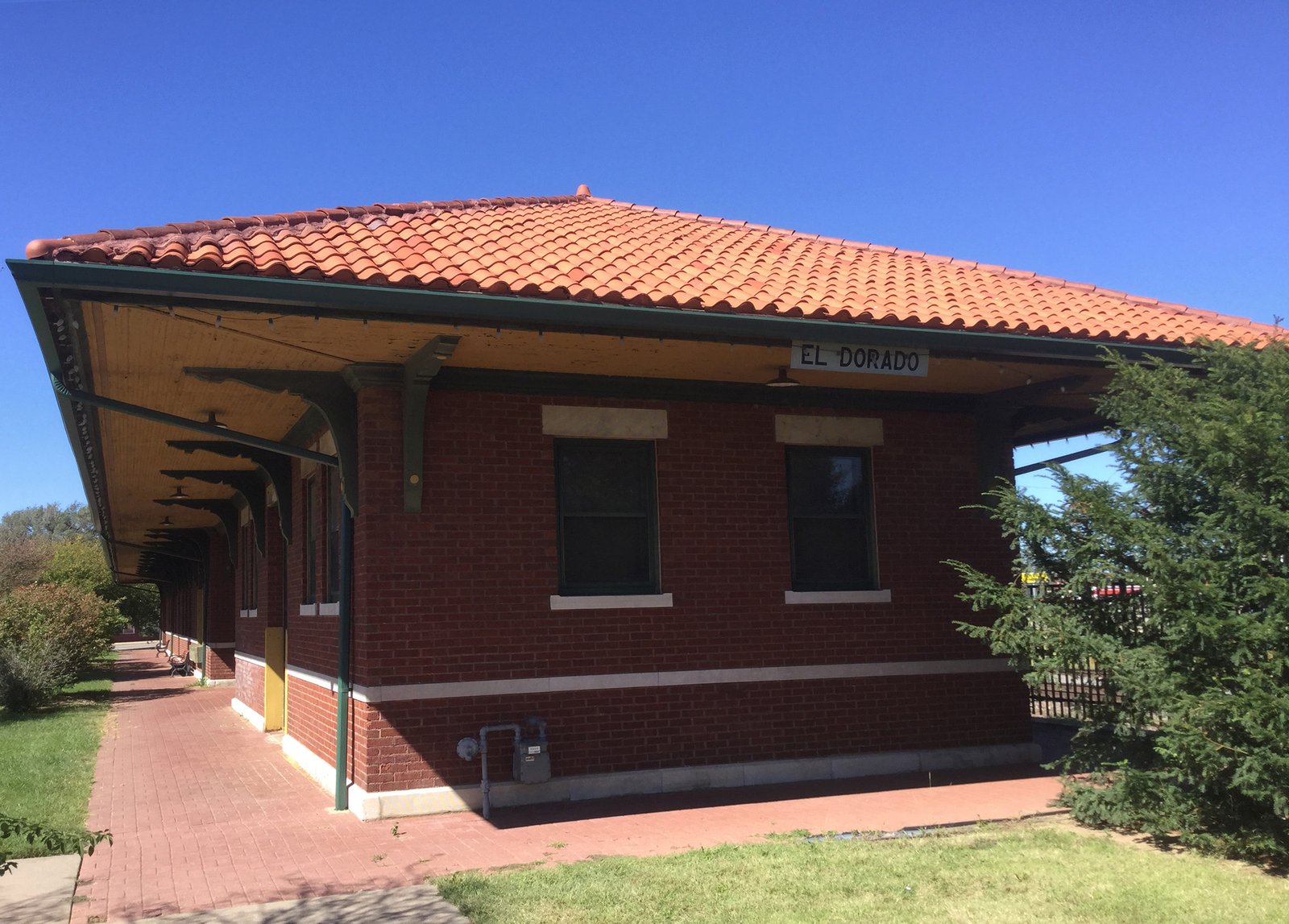
A red-brick railway station built for a booming Kansas oil town, its low tiled roof still marking the line where passenger trains once stopped.
At a glance
The El Dorado Missouri Pacific Depot is a former passenger station in Butler County, Kansas. Built in 1918 to a Mission Revival design by E. M. Tucker, Chief Engineer of the Missouri Pacific Railroad, it served travelers and freight along a busy regional line for four decades. Listed on the National Register of Historic Places in 1994, it survives as a rare intact example of railroad architecture from the era.
History
El Dorado’s earlier depot dated to the 1880s. By the 1910s, growth tied to the local oil industry pushed the Missouri Pacific to replace it. The new station, completed in 1918, cost some $400,000, a considerable sum for a small-town depot. It anchored a freight-passenger route running east from Wichita through El Dorado toward Eureka, Yates Center, Durand, Iola, Moran, Bronson, and Fort Scott. Trains carried both goods and travelers along this corridor for decades. Passenger service ended in 1958, as automobiles and highways drew riders away from the rails. The building remained standing after service stopped. It was formally recognized in 1994 with its listing on the National Register of Historic Places.
What you see
The depot is a one-story structure built of red brick. A red-tile roof caps the building, its eaves extending wide over the walls. This overhang is a hallmark of the Mission style, borrowed from Spanish colonial models and popular for American railroad architecture in the early twentieth century. The low, horizontal profile suited the depot’s practical role. Waiting passengers and freight handlers alike would have found shelter beneath those broad eaves, shielded from Kansas sun and rain. E. M. Tucker’s design favored function paired with a distinct regional style, giving the modest structure a visual identity beyond simple utility.
Cultural significance
The depot marks a moment when El Dorado’s oil-driven prosperity justified real investment in civic infrastructure. Its scale and cost reflected the town’s ambitions in 1918. As one of relatively few surviving Mission-style depots in Kansas, the building offers physical evidence of railroad design trends imported from the American Southwest. Its National Register listing acknowledges both its architectural distinction and its role in regional transportation history, a link to the freight and passenger networks that once tied small Kansas towns together.
Key facts
- Location: El Dorado, Butler County, Kansas, United States
- Built: 1918
- Architect: E. M. Tucker, Chief Engineer of the Missouri Pacific Railroad
- Style: Mission Revival architecture
- Original cost: approximately $400,000
- Passenger service ended: 1958
- Heritage status: Listed on the National Register of Historic Places, 1994
Practical information & getting there
The depot stands in El Dorado, a small city in south-central Kansas, roughly northeast of Wichita. You can reach the town by car via local highways connecting to the wider Wichita metro area. As a former station rather than an active museum, opening hours and public access may vary; check locally before visiting. The building’s exterior, with its brick walls and sheltering roofline, remains viewable from the street.
Sources & resources
Find it on the map
See this place and what’s around it →📷 Become a Cultural Heritage Online photographer
Share your photos of places: they stay published under your name as the author. The more they're seen, the more you get noticed — and soon a contest will reward the most appreciated photos.
Log in or sign up free to add a photoIs this page about you?
This page is read by travellers and heritage enthusiasts who find it on Google. Tell us how you are connected to this place and we will take it from there.