
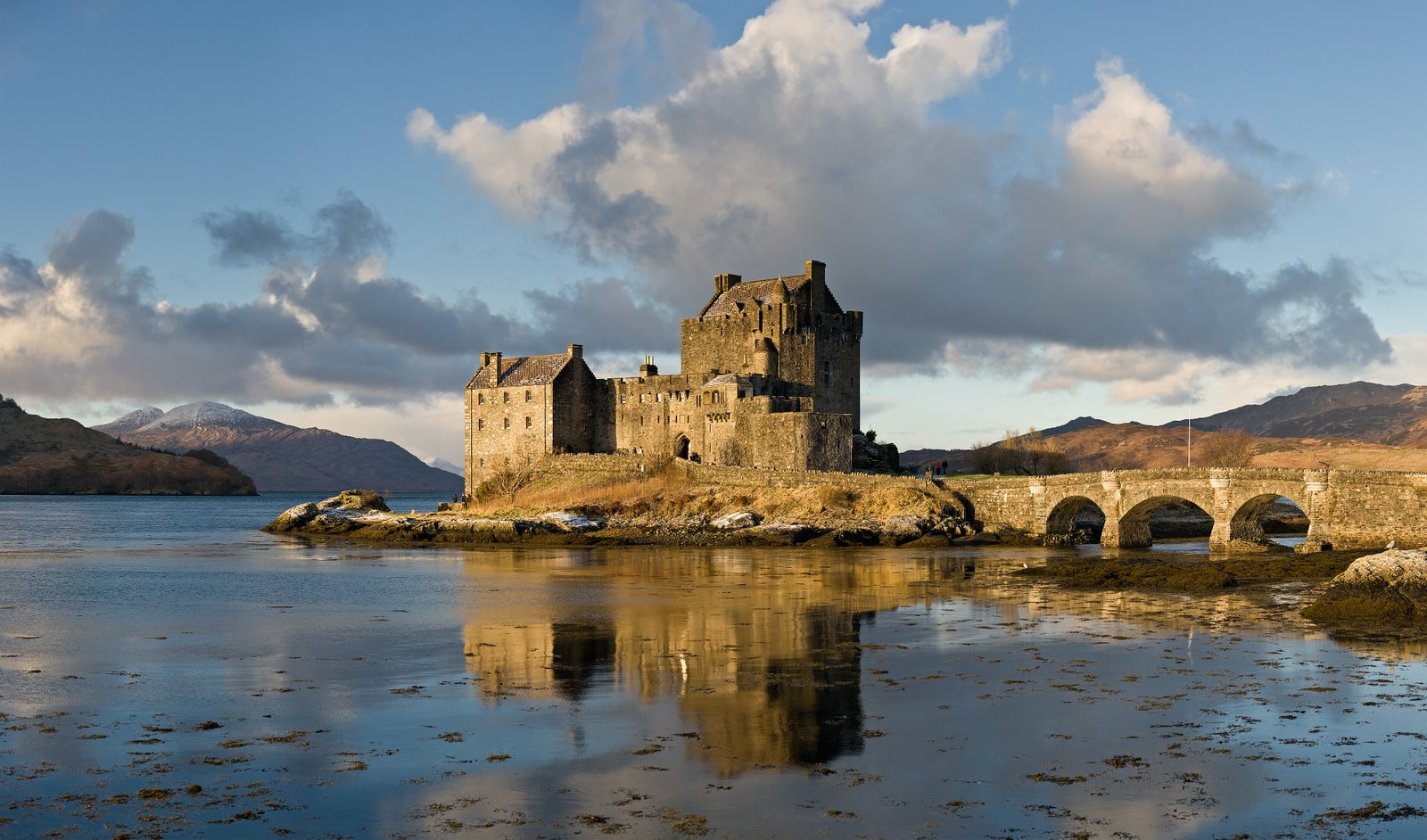
Possibly the most photographed castle in Scotland, Eilean Donan rises from a small island at the meeting of three sea lochs in Wester Ross — and owes its current form to a meticulous 20th-century reconstruction completed in 1932.
At a glance
Eilean Donan stands on a tidal island where Loch Duich, Loch Long, and Loch Alsh converge, 1 km east of the village of Dornie. A stone causeway bridge, added during the 20th-century restoration, connects the island to the mainland. The castle is the seat of Clan Macrae and houses a museum inside. Its profile — a compact keep surrounded by a curtain wall, mirrored in the still water of the lochs on calm mornings — has appeared on more Scottish tourism imagery than any other single building. What most visitors do not know is that the structure they see was built almost entirely between 1919 and 1932, following two centuries as a roofless ruin.
Key facts
- Period: Original fortification c. 13th century; destroyed 1719; rebuilt 1919–1932
- Status: Privately owned by the Macrae-Gilstrap family trust; open to visitors
- Film appearances: Highlander (1986, dir. Russell Mulcahy — exterior as Connor MacLeod’s highland home; Sean Connery as Ramírez trains here); The World Is Not Enough (1999, James Bond — aerial establishing shot of Scotland); Elizabeth: The Golden Age (2007); Made of Honor (2008)
- Scale: Small tidal island, approx. 50 × 40 m; stone causeway from mainland
- Access: Paid entry via causeway; the island is accessible by foot only; limited disabled access inside the keep
History
A castle was first recorded on the island in the 13th century, likely built by Alexander II of Scotland to defend the western seaboard against Viking incursions. Over the following four centuries, Eilean Donan changed hands repeatedly between Clan Mackenzie, who held the wider region, and Clan Macrae, who served as the Mackenzies’ constables and came to occupy and defend the castle. The alliance between these clans shaped the political landscape of the western Highlands through the late medieval period.
The castle’s destruction came swiftly in the spring of 1719. During the Jacobite Rising of that year, a garrison of around 46 Spanish soldiers — allies of the Jacobite cause — occupied Eilean Donan. Three British Royal Navy frigates, the Worcester, Enterprise, and Flamborough, arrived in Loch Duich and subjected the castle to a sustained bombardment over three days. The Spanish garrison surrendered; the frigates’ crews proceeded to destroy the castle walls and detonate 343 barrels of gunpowder stored inside. The castle collapsed almost entirely and lay as a roofless ruin for 200 years.
In 1911, Lt. Col. John MacRae-Gilstrap purchased the ruin and embarked on a reconstruction project that would take 20 years and cost approximately £250,000. Working from a single architectural drawing said to have been found in Edinburgh Castle and guided by oral traditions within Clan Macrae, his team rebuilt the keep, curtain walls, great hall, and the three-arched causeway bridge. The reconstruction was completed in 1932, the year MacRae-Gilstrap died. Historians have noted that the result is a plausible but not archaeologically precise recreation of the medieval original.
What you see
The exterior presents a compact rectangular keep with corbelled corner turrets, a battlemented curtain wall, and the distinctive three-arch stone bridge that has become the defining image of the castle. Inside, the Billeting Room on the ground floor displays Jacobite memorabilia, including a copy of the letter sent from King James VIII to the Spanish garrison in 1719. The Banqueting Hall, with its fireplace bearing the Macrae motto, and the Laich Hall below are furnished in period style consistent with the early 20th-century vision of a Highland great house. The reconstruction is earnest and visually convincing at the scale most visitors encounter it.
Director Russell Mulcahy chose Eilean Donan for Highlander (1986) precisely because the causeway bridge, framed against mist rising off the loch at dawn, reads cinematically as both ancient and otherworldly. In the film, the castle’s great hall and exterior walls stand in for the ancestral home of Connor MacLeod (Christopher Lambert), and Sean Connery’s character Ramírez practises sword technique on the bridge in the sequence that established the film’s visual grammar. The same image — castle on water at the junction of lochs — reappears as an aerial establishing shot in the James Bond film The World Is Not Enough (1999), where it signals Scotland before the narrative moves elsewhere.
Practical information
- Opening hours: Generally March–November; specific seasonal hours at eileandonancastle.com
- Entry: Paid admission; children under 5 free
- Photography: Permitted inside and outside; the best exterior shots are from the far end of the causeway at golden hour
- Café and shop: On site in the visitor centre adjacent to the causeway
- Guided tours: Included with admission; costumed interpretation available in peak season
Getting there
Eilean Donan is located on the A87, 1 km east of Dornie and approximately 15 km east of Kyle of Lochalsh (the mainland terminus for the Skye Bridge). There is a large car park on the mainland side of the causeway. The nearest train station is Kyle of Lochalsh, served by Scotrail from Inverness (2 hrs 30 min); local bus services (CityLink and Stagecoach) connect Kyle of Lochalsh to Dornie. The castle is also a standard stop on organised coach tours departing from Inverness and Fort William.
Nearby
- Isle of Skye (15 km west via the Skye Bridge) — the Cuillin mountains, Dunvegan Castle, and the Fairy Pools attract millions of visitors annually
- Loch Ness and Urquhart Castle (approx. 80 km east via the A87 and A82) — the ruined castle on the loch’s western shore is the most visited historic site in the Scottish Highlands
- Plockton (12 km south) — a famously picturesque fishing village with palm trees, used as the filming location for the BBC series Hamish Macbeth
Frequently asked questions
What films was Eilean Donan Castle in?
It appeared in Highlander (1986) as Connor MacLeod's Highland home, and in the James Bond film The World Is Not Enough (1999), where it stood in for MI6's Scottish headquarters.
Was James Bond filmed at Eilean Donan Castle?
Yes. It featured as MI6's Scottish headquarters in The World Is Not Enough (1999).
Can you visit Eilean Donan Castle?
Yes. It is open to visitors, generally from March to November, with paid admission. Children under 5 enter free.
Where is Eilean Donan Castle?
It sits in Wester Ross, in the Scottish Highlands, on a small island where three sea lochs meet, near the bridge to the Isle of Skye.
Is Eilean Donan Castle the original medieval building?
No. The medieval castle was destroyed in 1719. The building you see today was meticulously rebuilt between 1919 and 1932.
See this location in context: Set-Jetting: Six Famous Film & TV Locations You Can Actually Visit.
Sources
- Wikipedia: Eilean Donan
- Eilean Donan Castle official site — eileandonancastle.com
- Historic Environment Scotland — Scheduled Monument record
Find it on the map
See this place and what’s around it →
Historical events at this place (1)
📷 Become a Cultural Heritage Online photographer
Share your photos of places: they stay published under your name as the author. The more they're seen, the more you get noticed — and soon a contest will reward the most appreciated photos.
Log in or sign up free to add a photoIs this page about you?
This page is read by travellers and heritage enthusiasts who find it on Google. Tell us how you are connected to this place and we will take it from there.