

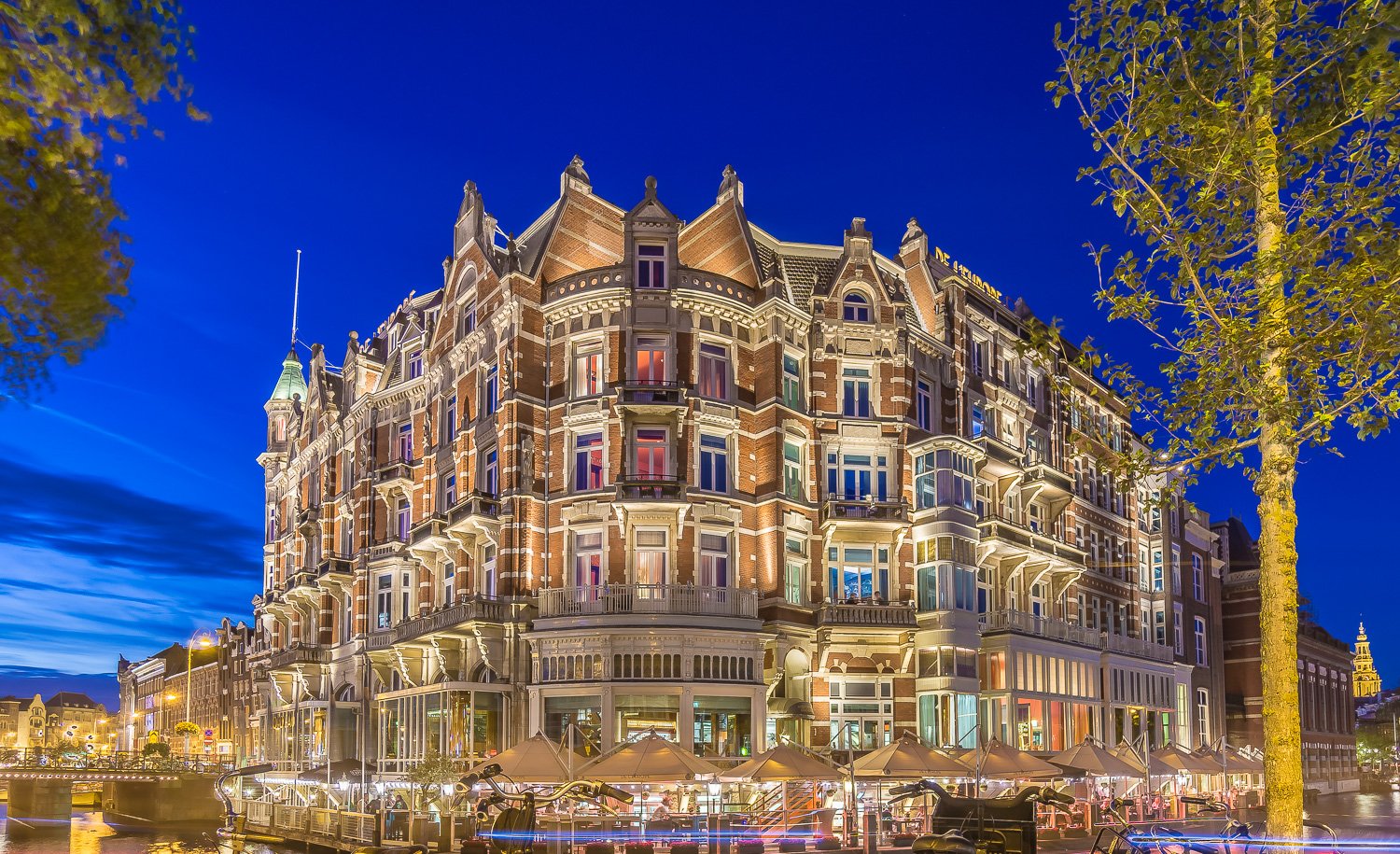
A defence tower held this bend of the Amstel from 1482. The hotel that took its place opened in 1896, red brick over the water, and still meets the river like a prow.
At a glance
De L’Europe stands where the Nieuwe Doelenstraat meets the Binnen-Amstel, on ground that carried a fortification tower called Het Rondeel from 1482 and then an inn of the same name. Willem Hamer jr. designed the present building in neo-Renaissance style; it opened on 23 September 1896 with some fifty rooms. The national monument register protects it as a representative example of the hotel-building wave that swept European cities in the last quarter of the nineteenth century, and the register is right about the wave: this is Amsterdam’s contribution to the age of the grand hotel, contemporary with the Ritz generation and still doing the same job.
Key facts
- Built: 1895–1896, opened 23 September 1896
- Architect: Willem Hamer jr. (1843–1913), of an Amsterdam architectural family three generations deep
- Style: neo-Renaissance, in red brick with natural-stone dressings
- Growth: two floors added in 1898 by A.L. van Gendt; a rear bay window in 1902 by C. Oosterbaan; the neighbouring Nieuwe Doelenstraat 4 folded in around 1910 by the Gebroeders van Gendt; numbers 6–8 around 1990 and 10–14 in 2008–2010
- Protection: Rijksmonument no. 518434 — sources place the designation in 2001 or 2002
- Site memory: the Rondeel tower of 1482, demolished in the 1630s, then the Rondeel inn until 1895
- Today: 111 rooms, owned by Heineken
History
The corner was defended before it was hospitable. Het Rondeel, a semicircular tower of Amsterdam’s medieval defences, stood here from 1482 until the city outgrew its walls in the 1630s; an inn then rose on the old foundations and kept the tower’s name for two and a half centuries. The hotel’s own history records that under H.J. Wolters, from 1845, it became a guest house that welcomed families — a novelty in the city, by that account.
In 1894 the old Rondeel went to auction, and the buyers cleared it for something without precedent on the site. Hamer’s hotel went up through 1895 and opened in September 1896; the newspaper De Tijd, quoted in the city’s topographical record, saluted its enormous wine cellars and looked forward to the champagne. The building grew almost immediately — upward in 1898, backward in 1902, sideways in 1910 — each time under a different architect, and each time keeping Hamer’s river front intact.
The Heineken connection runs deep, though the sources disagree on when it began: the city’s topographical record has the brewing company operating the hotel from 1919, while the hotel’s own history has Alfred “Freddy” Heineken buying the house in the 1950s. Either way it remains in Heineken hands, and it kept its screen credentials early: the hotel appears as a setting in Alfred Hitchcock’s Foreign Correspondent (1940). A full interior redesign by the Dutch studio Nicemakers arrived in 2020. The name has barely moved in one hundred and thirty years: Hotel de l’Europe from 1896, De L’Europe Amsterdam since 2011.
What you see
From across the Amstel the hotel reads as a long red-brick block trimmed in pale stone, balconies carried on carved consoles, the corner turned with an entrance that rewards a pause: the stone around it is worked with owls and parrots. Higher up, the street facade carries kneeling medieval figures at the third floor and, lower, a run of birds and — the oddest tenant — a spider. The Amsterdam architecture centre notes how close the ornamental language sits to Cuypers’ Centraal Station across town, and the kinship shows: the same red-and-white confidence, here bent around a river corner.
The best of the building is the meeting of brick and water. The dining terrace hangs directly over the Amstel, and in low afternoon light the whole front doubles itself in the river — the one Amsterdam facade of its generation that was composed to be seen with its own reflection.
Practical information
- The building operates as a five-star hotel; the interiors are seen as a guest or a diner, not on a ticketed tour
- The facade and its ornament are best read from the far bank of the Amstel or from the Halvemaansbrug, a minute’s walk east
- The corner entrance carvings — the owls and parrots — are at eye level and free to anyone passing
- Afternoon light favours the river front; the reflection works best when the Amstel is calm
Getting there
De L’Europe stands at Nieuwe Doelenstraat 2–14, a two-minute walk from Muntplein, where several tram lines cross; Rokin metro station is three minutes north. Coordinates: 52.367644, 4.894466 (Google Maps). From Centraal Station it is a twenty-minute walk straight down the Rokin, arriving at the hotel’s best angle — across the water.
Nearby
- Tuschinski Theatre, the 1921 picture palace two streets east
- InterContinental Amstel Amsterdam, the 1867 grande dame upriver
- American Hotel, its Art Nouveau counterpart on Leidseplein
Sources
- Monumenten.nl, rijksmonument register entry 518434 — architects, dates, facade description, grounds of protection
- Arcam, Amsterdam architecture centre — the Rondeel site, expansions, the Centraal Station comparison
- Amsterdam op de kaart — construction timeline, room counts, the De Tijd notice, Heineken from 1919
- De L’Europe, official history — the 1482 tower, the Wolters guest house, the Heineken purchase, the 2020 redesign
- Coordinates verified against OpenStreetMap Nominatim for Nieuwe Doelenstraat 2–14, Amsterdam
Find it on the map
See this place and what’s around it →📷 Become a Cultural Heritage Online photographer
Share your photos of places: they stay published under your name as the author. The more they're seen, the more you get noticed — and soon a contest will reward the most appreciated photos.
Log in or sign up free to add a photoIs this page about you?
This page is read by travellers and heritage enthusiasts who find it on Google. Tell us how you are connected to this place and we will take it from there.