

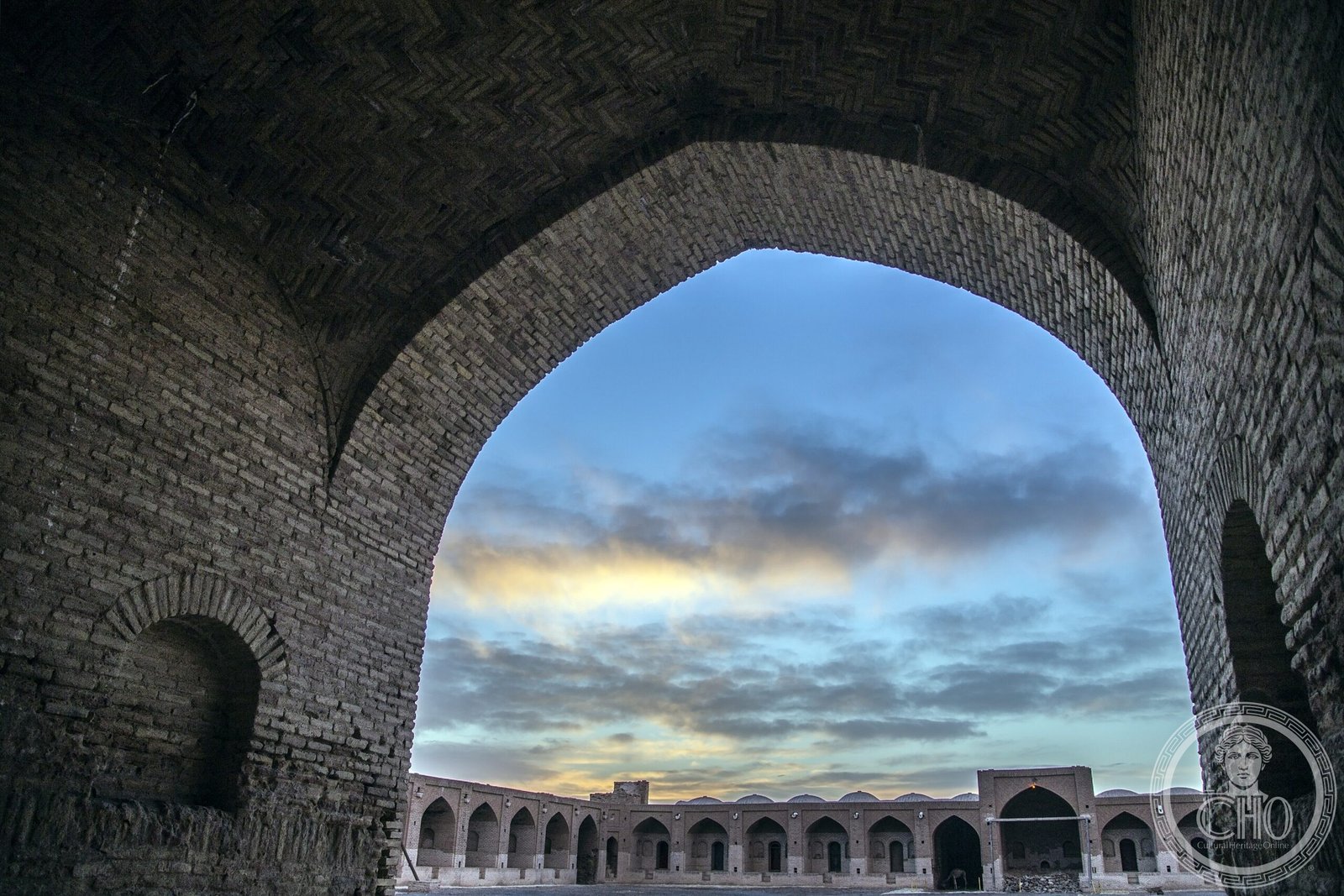
A monumental waystation spanning twelve millennia of Persian trade routes, Deir-e Gachin stands as the architectural embodiment of the Silk Road’s commercial and cultural exchange. Known as the “Mother of Iranian Caravanserais,” this complex testifies to centuries of restoration and adaptation across four imperial dynasties.
At a glance
Deir-e Gachin is a 12,000-square-meter caravanserai in the heart of Kavir National Park, roughly 80 kilometers northeast of Qom. Originally constructed during the Sasanian era, it preserves layers of restoration from the Seljuk, Safavid, and Qajar periods, with its current visible form dating to the Safavid era. The complex served merchants and caravans traversing the ancient route linking Ray and Isfahan.
History
The caravanserai’s foundations reach back to Sasanian times, reflecting Iran’s role as a hub of trans-Asian commerce. Successive dynasties—Seljuk, Safavid, and Qajar rulers—rebuilt and reinforced the structure to maintain its function as a secure refuge for traveling merchants and their goods.
In 2003, Deir-e Gachin was inscribed on Iran’s National Heritage List. Two decades later, in 2023, it gained international recognition as part of the Persian Caravanserai World Heritage Site inscription, a collective recognition of 54 caravanserais across Iran.
What you see
The caravanserai exemplifies the Persian four-iwan design, a symmetrical courtyard plan anchored by four monumental archways. Four circular towers occupy the corners; two half-oval towers flank the main southern gate. Brick, lime, adobe, and plaster form the load-bearing envelope.
Within the 12,000-square-meter footprint lie 44 chambers, four large stables, a mosque, a private underground shabestan (cool room), a fodder barn, a gristmill, and bathing facilities. Two ab anbars (water reservoirs) stand near the western bathhouse. A brick furnace, dam, and Islamic-era graveyard mark the surrounding landscape. East of the complex stands a Qajar-era fort-like structure in brick and clay.
Cultural significance
Deir-e Gachin embodies two thousand years of continuous occupation and adaptation. Its mosque likely occupies the footprint of a Sasanian fire temple, marking the region’s religious transition from Zoroastrianism to Islam. The caravanserai’s design encodes Persian pragmatism: discrete zones for merchants, livestock, servants, and security—each essential to survival on unforgiving routes.
The title “Mother of Iranian Caravanserais” reflects its architectural completeness and historical depth. As part of the 2023 World Heritage inscription, Deir-e Gachin now stands among UNESCO’s global witnesses to the Silk Road’s material culture.
Key facts
- Location: Central District, Qom County, Iran (coordinates: 35.0583°N, 51.4202°E)
- Area: 12,000 square meters
- Construction periods: Sasanian era (foundation); Seljuk, Safavid, and Qajar restorations; current form is Safavid
- UNESCO status: Inscribed as part of Persian Caravanserai World Heritage Site (2023)
- National heritage listing: Iran’s National Heritage List, 23 September 2003
- Setting: Kavir National Park, 35 km southwest of Varamin
Practical information & getting there
Deir-e Gachin lies 80 kilometers northeast of Qom (60 kilometers via the Garmsar Freeway) and 35 kilometers southwest of Varamin. The site sits within Kavir National Park. You will need to arrange transportation and inquire locally about access and visiting conditions, as detailed visitor information is limited. Contact local tourism authorities in Qom for current guidelines.
Sources & resources
Find it on the map
See this place and what’s around it →📷 Become a Cultural Heritage Online photographer
Share your photos of places: they stay published under your name as the author. The more they're seen, the more you get noticed — and soon a contest will reward the most appreciated photos.
Log in or sign up free to add a photoIs this page about you?
This page is read by travellers and heritage enthusiasts who find it on Google. Tell us how you are connected to this place and we will take it from there.