
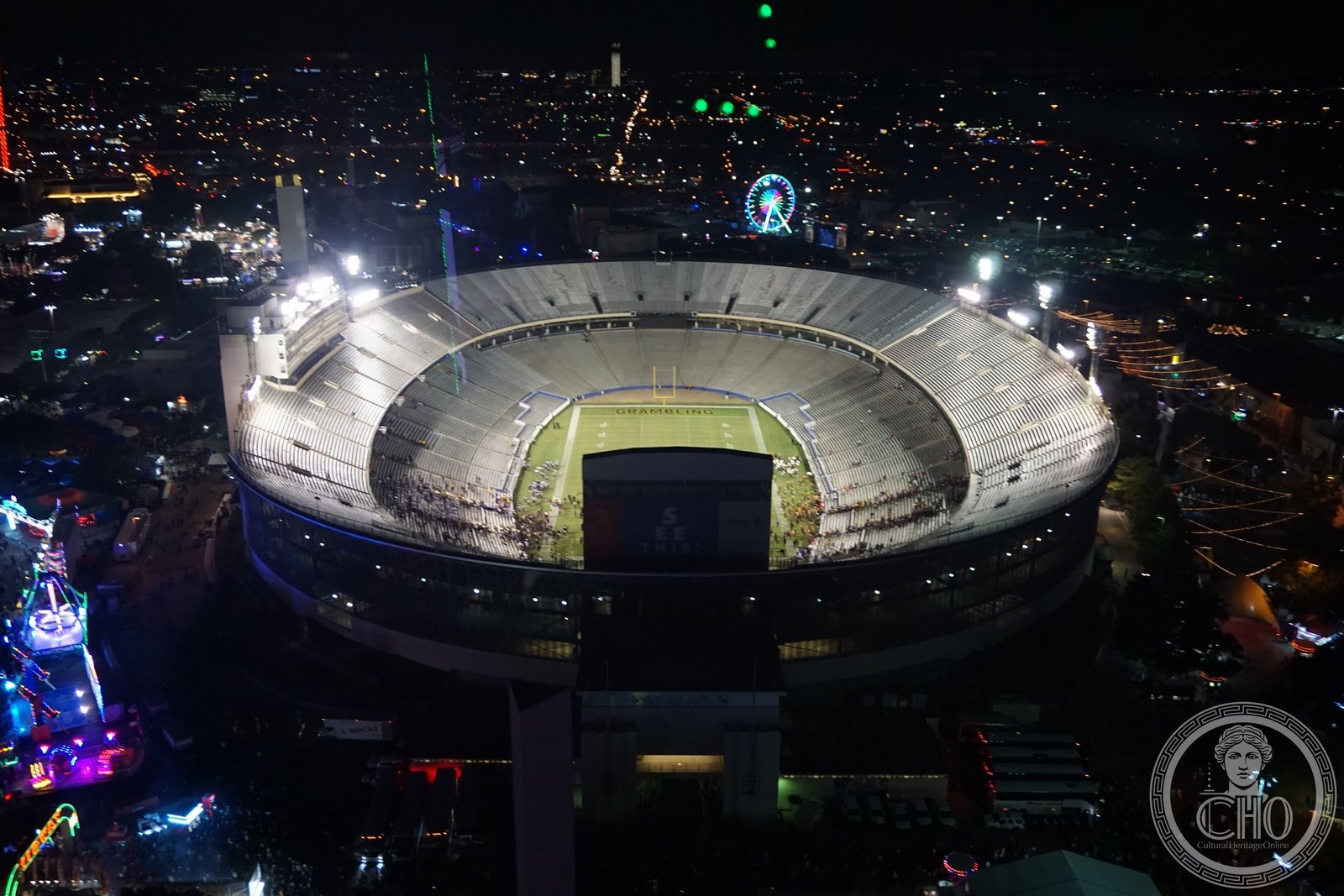
Built in 1930 and transformed in 1936 for the Texas Centennial Exposition, the Cotton Bowl is the largest Art Deco stadium in the American South and the centerpiece of Fair Park — a National Historic Landmark that remains the most intact 1930s exposition complex in the United States.
At a glance
The Cotton Bowl stands at the heart of Fair Park in East Dallas, encircled by the Art Deco buildings designed by architect George Dahl for the 1936 Texas Centennial Exposition — a six-month world’s fair celebrating the hundredth anniversary of Texas independence. Dahl gave the entire complex a unified Art Deco vocabulary: angular limestone facades, polychrome terra-cotta ornament, stylized bas-reliefs of Lone Star imagery and Texas flora. The Cotton Bowl received the same treatment in its major 1936 expansion, adding the Art Deco exterior walls that define its appearance today. The result is a stadium that reads simultaneously as architecture and landscape — the oval bowl nestled within a larger ensemble of buildings and esplanades, all speaking the same 1930s design language.
Key facts
- Address: 1300 Robert B. Cullum Boulevard, Dallas, TX 75210
- Original construction: 1930 (Fair Park Stadium)
- Expansion architect: George Dahl (1936, Texas Centennial)
- Style: Art Deco (1936 Texas Centennial expansion)
- Original capacity: 46,200 (1930); expanded to 72,000 (1936)
- Current capacity: over 90,000 seats (one of the largest stadiums in the South)
- NRHP: Part of Fair Park, a National Historic Landmark (1986)
- Cotton Bowl Classic: Held here every January 1 since 1937
History
The stadium opened in 1930 as Fair Park Stadium, built to serve the State Fair of Texas — an annual tradition that had occupied the Fair Park grounds since 1886. The original 46,200-seat structure was designed by Harry D. Payne in a plain utilitarian style with little architectural ambition. Its first six years were relatively quiet: college football games, racing, and fair events filled the calendar, but the stadium remained modest by Texas standards.
Everything changed in 1936. Texas won the right to host the Texas Centennial Exposition, a world’s fair commemorating a century of independence from Mexico, and Dallas was selected as the primary venue over San Antonio and Houston. Architect George Dahl was commissioned to redesign Fair Park almost entirely from scratch: new museums, exhibition halls, an esplanade, and a redesigned stadium — all unified by an Art Deco design vocabulary drawn from the latest Continental and American precedents. Dahl expanded the stadium to 72,000 seats and wrapped it in the limestone and terra-cotta Art Deco facade that remains today. The exposition ran from June to November 1936 and drew over 6 million visitors.
The stadium was renamed “Cotton Bowl” in 1936 to honor the bowl game that would debut here on January 1, 1937. The Cotton Bowl Classic — a postseason college football game — continued here annually for decades, hosting Texas vs. Alabama, Oklahoma vs. Texas, and other historic matchups. The Dallas Cowboys played their home games at the Cotton Bowl from 1960 to 1970 before moving to Texas Stadium in Irving. Today the stadium hosts the annual State Fair Classic (Prairie View A&M vs. Grambling State) and serves as venue for the Cotton Bowl Classic under the current College Football Playoff system, though the game itself moved to AT&T Stadium in Arlington in 2010.
What you see
The Cotton Bowl’s exterior facade, added in 1936 by George Dahl, is a lesson in Art Deco civic design at large scale. The curved concrete walls are articulated with vertical pilasters that rise to the parapet, creating a rhythm of light and shadow across the exterior. Stylized Lone Star motifs and geometric sunburst panels ornament the entrance portals, and polychrome terra-cotta inlays in burnt orange and cream echo the color palette used across Fair Park. The lettering “Cotton Bowl” at the main entrance is rendered in the characteristic sans-serif block fonts of the 1930s.
Seen from above — as from the adjacent State Fair of Texas observation tower — the bowl forms a perfect oval within the larger Art Deco ensemble of Fair Park: the Hall of State to the northwest, the music hall to the northeast, the esplanade and reflecting pool stretching toward the main gate. The relationship between the stadium and the other Fair Park buildings is deliberate; Dahl conceived the complex as a total environment, and the Cotton Bowl’s roofline was set to harmonize with its neighbors’ cornices. Fair Park is the best-preserved collection of 1930s Art Deco exposition architecture in the United States, and the Cotton Bowl is its anchor.
Practical information
- Events schedule: The Cotton Bowl hosts sporting events and concerts; check the Fair Park website for the calendar
- State Fair of Texas: The fairgrounds open every October for three weeks — the best time to see the full Art Deco ensemble of Fair Park with all buildings open
- Self-guided visit: Fair Park is open daily; the exterior of all buildings can be viewed year-round during park hours
- Parking: Large free parking lots surround Fair Park; paid parking available adjacent to the Cotton Bowl during events
- Photography: Permitted throughout Fair Park for personal use
Getting there
From downtown Dallas, take the DART Green or Blue Line to Fair Park Station — the trip is about eight minutes from Dallas Union Station. By car, Fair Park is accessed via Robert B. Cullum Boulevard (formerly Parry Avenue) from I-30 East; take the Fair Park exit and follow signs to Gate 5. The site is approximately three miles east of downtown. On foot or by bike, the Katy Trail and Elm Fork Trail connect Fair Park to central Dallas neighborhoods.
Nearby
- Hall of State (1936) — the most architecturally ambitious building in Fair Park, built as the Texas state pavilion for the Centennial Exposition; NRHP listed
- Texas Discovery Gardens — botanical gardens within the Fair Park complex
- African American Museum of Dallas — dedicated to the history and culture of African Americans, located within Fair Park
- Reunion Tower and Dealey Plaza — three miles west in downtown Dallas; Dealey Plaza (NRHP) is where President Kennedy was assassinated in 1963
Sources
- City of Dallas, Fair Park Master Plan, 2003
- Texas State Historical Association, Handbook of Texas: Cotton Bowl Stadium
- National Register of Historic Places, Fair Park Historic District Nomination, 1986
- Wikipedia, “Cotton Bowl (stadium)”
Find it on the map
See this place and what’s around it →Record researched and written by Luigi De Marchi for Cultural Heritage Online, 2026.
📷 Become a Cultural Heritage Online photographer
Share your photos of places: they stay published under your name as the author. The more they're seen, the more you get noticed — and soon a contest will reward the most appreciated photos.
Log in or sign up free to add a photoIs this page about you?
This page is read by travellers and heritage enthusiasts who find it on Google. Tell us how you are connected to this place and we will take it from there.