
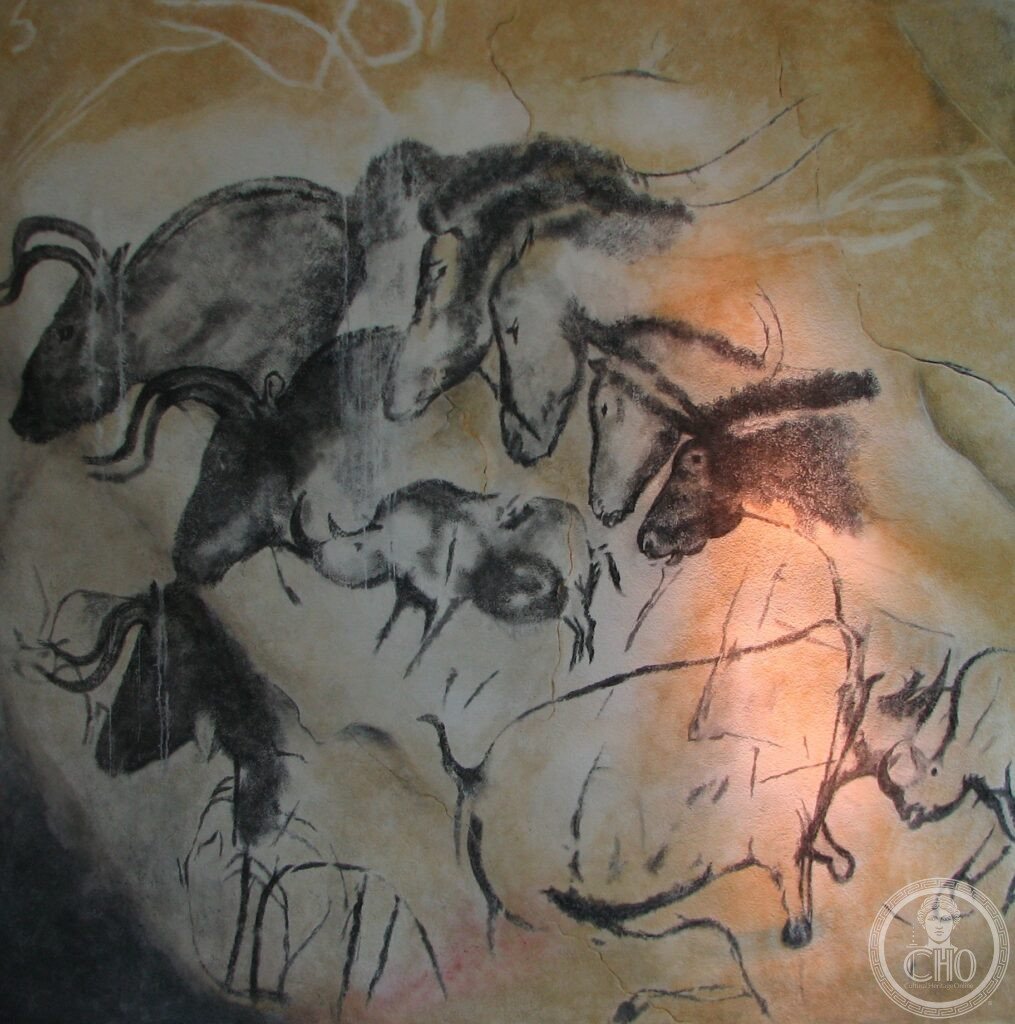
Chauvet Cave holds the oldest known representational paintings on earth, made nearly twenty thousand years before Lascaux yet already fully mastered in technique and composition. The original cave has never been open to visitors; what can be seen today is an exact full-scale replica built nearby.
At a glance
Chauvet Cave, formally the Grotte Chauvet-Pont d’Arc, was found in December 1994 by three speleologists, Jean-Marie Chauvet, Éliette Brunel Deschamps and Christian Hillaire, who squeezed through a narrow opening in a cliff above the Ardèche river. What they found reshaped the study of Palaeolithic art: paintings so accomplished in composition and perspective that they contradicted the long-held theory, associated with the art historian Henri Breuil, that prehistoric art developed gradually from crude beginnings to later sophistication. At Chauvet the earliest paintings are already among the most complex known.
Key facts
- Best-known composition: the Panel of the Lions, a frieze of around sixteen lions in charcoal, arranged as a charging pride with overlapping bodies and turned heads, facing a group of woolly rhinoceroses on the same wall.
- Location within the cave: the panel lies in the deepest section, known as the Hillaire Chamber.
- Access: the original cave has been permanently closed to the public since its discovery, to protect the paintings from the damage caused by visitor breath and body heat.
- Public presentation: a full-scale replica, the Caverne du Pont d’Arc, reproduces the major painted panels using the same pigments and techniques, cast from the original surfaces.
- Coordinates: 44.3850° N, 4.4163° E.
History
The paintings were made by artists of the Aurignacian culture, the earliest Upper Palaeolithic culture in Europe, associated with the first arrival of anatomically modern humans on the continent as they replaced the Neanderthal populations already established there. The Chauvet paintings show that these earliest Europeans already possessed the full range of artistic and technical skills seen in later prehistoric art: charcoal shading used to suggest volume, overlapping figures used to create depth, and animals grouped deliberately by species and by movement. None of this reads as tentative or experimental; it is the work of an established artistic tradition.
What you see
Because the original cave remains closed, visitors experience Chauvet through the Caverne du Pont d’Arc, a replica built close to the real site on the road between Vallon-Pont-d’Arc and Pont d’Arc. The entrance tunnel narrows and darkens to suggest the approach to the real cave, the interior is kept cool to evoke the cave environment, and guides use lighting designed to recall the flicker of Palaeolithic lamps. The reproduction includes the Panel of the Lions, the Panel of the Rhinoceroses, a Horse Panel, a Bear Panel and the Great Chamber, where a cave bear skull rests on a limestone slab as it does in the original. The natural arch of Pont d’Arc lies a short distance away and can be seen or reached on the same day as a visit to the replica.
Practical information
- Visiting the replica: the Caverne du Pont d’Arc is open seasonally and access is by guided tour in French or English; booking in advance is recommended, particularly in the summer months, and is best done through the site’s official channel.
- The original cave: not open to the public under any circumstances.
- Season: spring and autumn are quieter and cooler than midsummer, when the surrounding Ardèche gorges become very busy with holidaymakers.
- Transport on site: there is no public transport to the Caverne, so a car is effectively necessary in this part of the Ardèche.
Getting there
Vallon-Pont-d’Arc lies in the Ardèche department of southern France. The usual approach is via Lyon, reached by train from Paris, followed by a road journey south; Montpellier offers a shorter road link from the east. The Caverne du Pont d’Arc itself sits on the D290 between Vallon-Pont-d’Arc and Pont d’Arc.
Nearby
- Pont d’Arc — about 3 km east, a large natural stone arch formed by the Ardèche river cutting through the limestone plateau, best seen from the Serre de Tourre belvedere above it or from a kayak on the gorge below.
- Ardèche Gorges — the stretch of river between Pont d’Arc and St-Martin-d’Ardèche, popular for kayaking and canoeing.
- Lascaux IV — around 250 km northwest in the Dordogne, the fourth-generation replica of the Lascaux cave paintings and the natural companion visit for anyone interested in later Magdalenian cave art.
Sources
- Wikipedia, Chauvet Cave
- Wikipedia, Aurignacian
- Wikipedia, Caverne du Pont d’Arc
- UNESCO, Decorated Cave of Pont d’Arc, known as Grotte Chauvet-Pont d’Arc, WHS reference 1426
Find it on the map
See this place and what’s around it →📷 Become a Cultural Heritage Online photographer
Share your photos of places: they stay published under your name as the author. The more they're seen, the more you get noticed — and soon a contest will reward the most appreciated photos.
Log in or sign up free to add a photo