
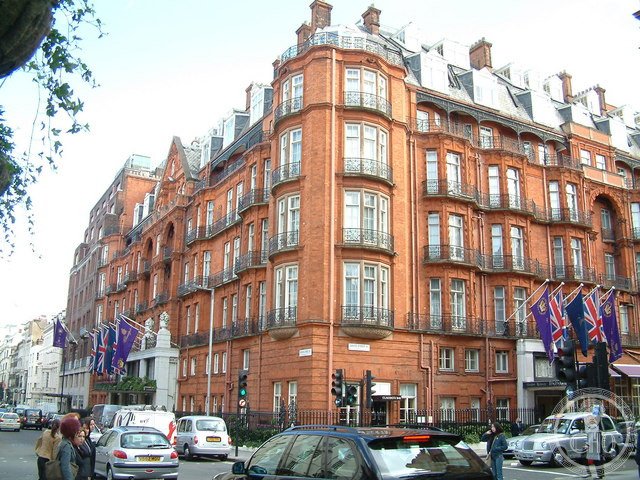
A red-brick landmark on a Mayfair corner, Claridge’s has been London’s quiet address for royalty and society since 1898 — and the place where English Art Deco found one of its finest interiors.
At a glance
Claridge’s is a five-star hotel at the corner of Brook Street and Davies Street, in the heart of Mayfair. Behind a Victorian red-brick exterior it holds a celebrated set of 1920s Art Deco interiors, and today it anchors the Maybourne Hotel Group’s London collection alongside The Connaught and The Berkeley.
History
The hotel began in 1812 as Mivart’s Hotel, a single terraced house on Brook Street run by James Mivart. In 1893 it was bought by Richard D’Oyly Carte, the impresario behind the Savoy, who set out to build a hotel to match. He commissioned C.W. Stephens — the architect of Harrods — to demolish the original buildings and raise an elegant seven-storey hotel in their place. The new Claridge’s opened in 1898.
Its defining character arrived in the 1920s. In 1925–26 the Savoy Group brought in Basil Ionides, a pioneer of English Art Deco, to remodel the restaurant; his engraved glass screens still stand. The architect Oswald Milne then created the Roman-stone façade and the mirrored foyer, replacing the old carriage entrance and giving the hotel the Deco threshold guests still cross today.
What you see
The street front stays true to Stephens’s 1898 design — solid red brick and stone, restrained and residential rather than showy. The drama is kept inside.
Milne’s foyer sets the tone with its mirrors and pale stone, while Ionides’s engraved-glass panels bring the 1920s into the dining rooms. It is one of the most complete surviving Art Deco hotel interiors in London, the reason Claridge’s is read as a design landmark and not simply a grand hotel.
Cultural significance
Through its D’Oyly Carte and Savoy Group lineage, Claridge’s became a fixed point of London society and a byword for discreet luxury. Its layered fabric — a Victorian rebuild wrapped around Jazz-Age interiors — makes it a rare case where two eras of British hotel-making survive intact in one building.
Key facts
- Origins: 1812, as Mivart’s Hotel on Brook Street
- Rebuilt: opened 1898, architect C.W. Stephens (also architect of Harrods)
- Art Deco: restaurant by Basil Ionides (1925–26); façade and mirrored foyer by Oswald Milne
- Location: corner of Brook Street and Davies Street, Mayfair
- Today: managed by the Maybourne Hotel Group
Practical information & getting there
Claridge’s is in the middle of Mayfair, a few minutes’ walk from Bond Street station (Central and Elizabeth lines) and Oxford Street. The restaurant, bar and afternoon tea are open to non-residents by reservation.
Sources & resources
- Historic Hotels Then & Now — Claridge’s (1856): historichotelsthenandnow.com/claridgeslondon.html
- Claridge’s — History & Heritage: claridges.co.uk/about-the-hotel/history-heritage
- e-architect — Claridge’s London Art Deco hotel building
- eHotelier — “Claridge’s: The Definitive History”
Find it on the map
See this place and what’s around it →📷 Become a Cultural Heritage Online photographer
Share your photos of places: they stay published under your name as the author. The more they're seen, the more you get noticed — and soon a contest will reward the most appreciated photos.
Log in or sign up free to add a photoIs this page about you?
This page is read by travellers and heritage enthusiasts who find it on Google. Tell us how you are connected to this place and we will take it from there.