
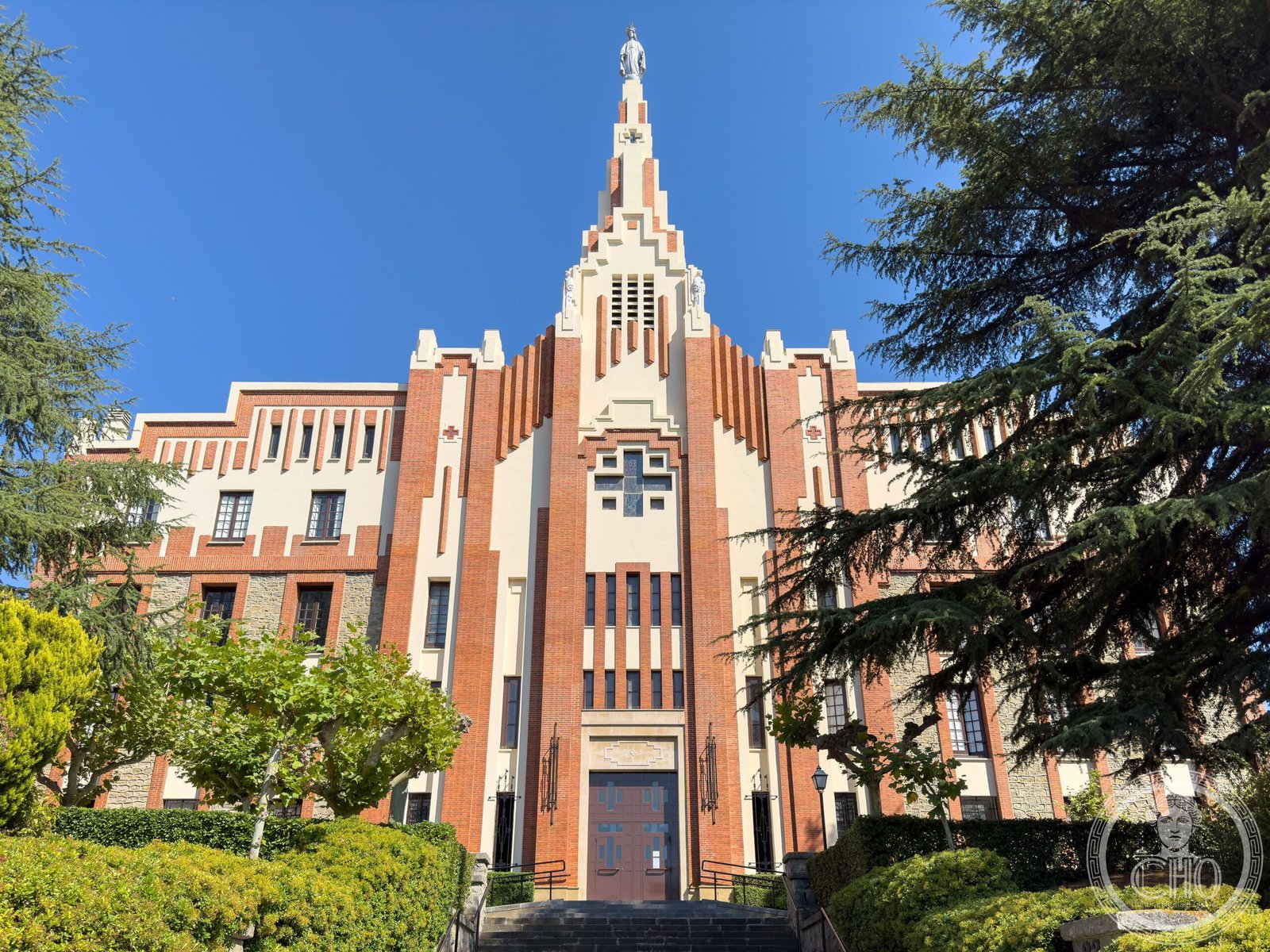
A striking modernist church in Pamplona’s Segundo Ensanche, designed by Víctor Eusa Razquin and celebrated for its geometric expressionism in white concrete and red brick.
At a glance
Built as a convent chapel for the Congregation of the Mission—known locally as the Paules—La Milagrosa exemplifies the architect’s bold déco-expressionist vocabulary. The church belongs to an era when Eusa was at his most formally experimental, treating architectural surface and form as unified sculptural gestures.
History
Construction began in 1928 and the church opened in 1930, part of the urban expansion of Segundo Ensanche. The building served the missionary community while becoming a landmark of Pamplona’s early twentieth-century modernism. The church remains intimately connected to the religious order whose presence defined its creation and purpose.
What you see
The dominant feature is a monumental geometric tower on the main façade that tapers progressively as it rises, crowned by a sculptural Christ. Eusa unified the composition in white concrete and red brick, creating sharp contrasts and linear emphasis. Sculpture appears throughout—but never depicting naturalistic human form. Instead, figures remain abstract and geometric, locked into the building’s austere logic rather than introducing figural softness.
Cultural significance
La Milagrosa stands as a defining work of Spanish geometric expressionism, a style that bridged Art Deco and functionalism. Eusa’s integration of sculpture with architecture—treating three dimensions as pure form—influenced modernist thinking in northern Spain. The church demonstrates how religious buildings could embrace radical formal innovation while serving their communities.
Key facts
- Country: Spain
- City: Pamplona
- Architect: Víctor Eusa Razquin
- Completed: 1930
- Coordinates: 42.8087, -1.6433
- Religious order: Congregation of the Mission (Paules)
Practical information & getting there
The church is located in the Segundo Ensanche neighbourhood of Pamplona. Contact the local parish or tourism office for visiting hours and services. The neighbourhood is accessible by public transport and on foot from Pamplona’s historic centre.
Sources & resources
Find it on the map
See this place and what’s around it →📷 Become a Cultural Heritage Online photographer
Share your photos of places: they stay published under your name as the author. The more they're seen, the more you get noticed — and soon a contest will reward the most appreciated photos.
Log in or sign up free to add a photoIs this page about you?
This page is read by travellers and heritage enthusiasts who find it on Google. Tell us how you are connected to this place and we will take it from there.