
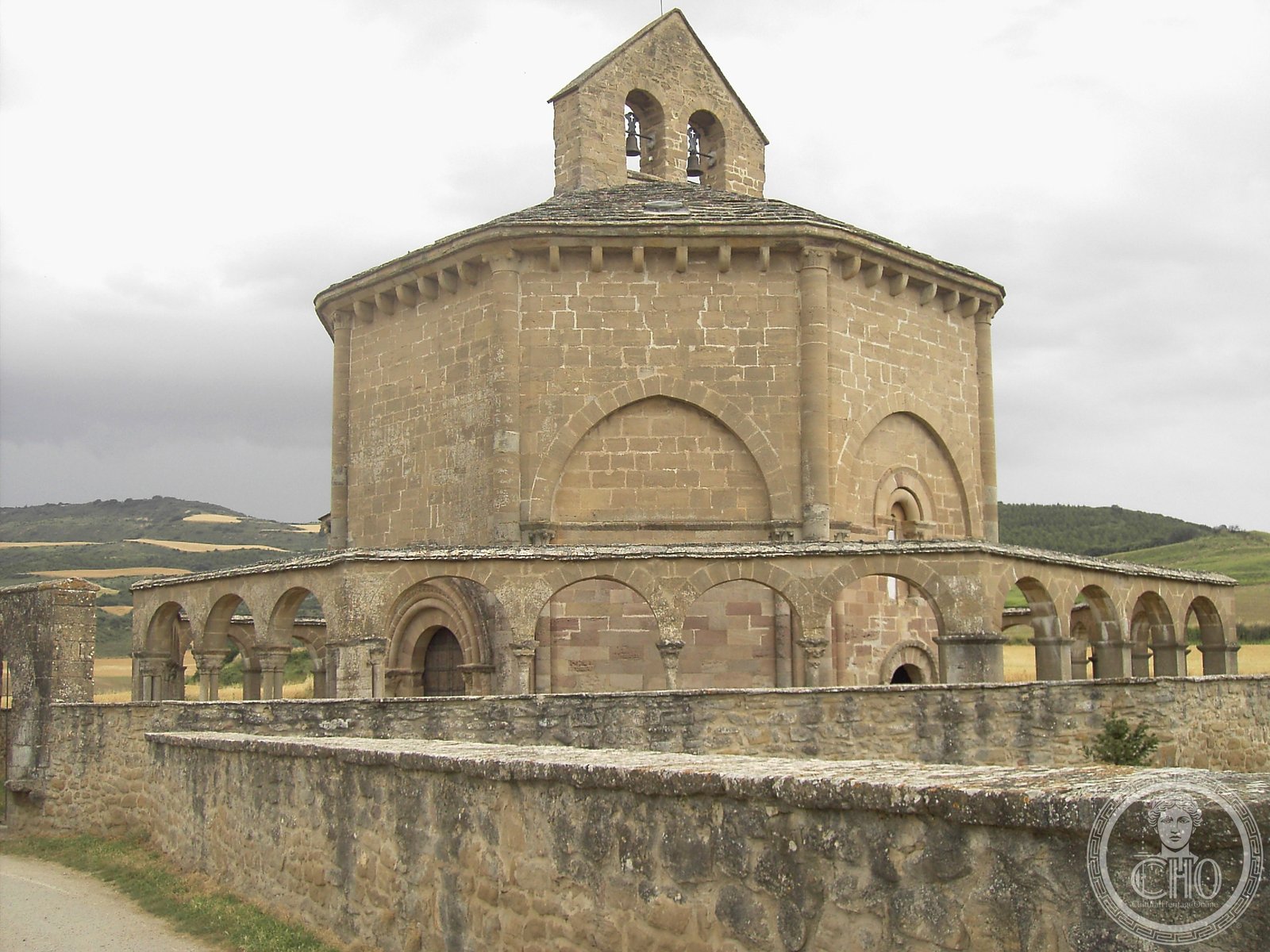
An enigmatic octagonal Romanesque sanctuary on the Way of Saint James, its true purpose lost to history yet marked by pilgrimage and mystery.
At a glance
This hermitage chapel stands alone in the Valdizarbe countryside, roughly 2 km southeast of Muruzábal in Navarre. Built in the 12th century, it remains one of the Camino de Santiago’s most intriguing monuments, its origins disputed and its original function unknown. Only its documented use as a shrine for pilgrims’ devotion to the Virgin Mary is certain.
History
The church’s earliest verified reference appears in 1487, mentioning a sodality dedicated to the Virgin of Eunate. Before that date, documentation vanishes entirely. Its location on the pilgrimage route and its octagonal design sparked theories, first from the late 19th century onward, linking it to the Knights Templar—a claim unsupported by evidence in this region. The Order of Saint John of Jerusalem likely operated a hospital nearby for Santiago pilgrims. Archaeological digs have uncovered numerous burials and scallop shells, the symbol of the Camino.
What you see
The church presents a slightly irregular octagonal plan with a small three-sided apse. Dressed stone masonry and robust walls employ the Romanesque vocabulary—semicircular arches, small alabaster windows, and the distinctive chessboard-pattern decoration characteristic of Navarre and Aragon. Eight ribs support an eight-rib vault system, inspired by Córdoba’s caliphate art. Surrounding arches, likely medieval additions or reconstructions, may derive from a vanished cloister. The whole composition evokes the Church of the Holy Sepulchre in Torres del Río, 55 km distant and equally mysterious.
Cultural significance
Saint Mary of Eunate embodies the Camino’s spiritual layering—Romanesque mastery, Islamic geometric influence, and the devotional practices of medieval pilgrims converge in its design. The building’s ambiguous origins invite scholarly debate and popular imagination alike. To this day, local communities from Valdizarbe observe a traditional romería, or pilgrimage festival, there, confirming its enduring role as a sacred site for regional veneration.
Key facts
- Country: Spain
- Region: Navarre
- Nearest town: Muruzábal
- Coordinates: 42.66666667°N, 1.75°W
- Construction period: 12th century
- Architectural style: Romanesque
- Located on the French Way path of the Camino de Santiago
Practical information & getting there
The church is accessible from Muruzábal, approximately 2 km to the southeast, via the Camino de Santiago route. Most pilgrims encounter it during their journey on the French Way. Specific hours and access conditions should be confirmed locally before visiting.
Sources & resources
Find it on the map
See this place and what’s around it →📷 Become a Cultural Heritage Online photographer
Share your photos of places: they stay published under your name as the author. The more they're seen, the more you get noticed — and soon a contest will reward the most appreciated photos.
Log in or sign up free to add a photoIs this page about you?
This page is read by travellers and heritage enthusiasts who find it on Google. Tell us how you are connected to this place and we will take it from there.